12 Lakh Tax-Free! New Income Tax Bill 2025
On August
11, 2025, Finance Minister Nirmala Sitharaman introduced the revised Income
Tax(No.2) Bill, 2025, in the Lok Sabha, marking one of the biggest tax reforms
in India’s history. This Bill was tabled earlier in February 2025, but was
later withdrawn due to some recommendations and unclear concerns.
Once passed,
the new law will replace the Income Tax Act, 1961, which has been followed by
India’s taxation system for over six decades.
Why was
this reform introduced?
The old law
had become bulky, confusing, and outdated. With the bulky 819 sections spread
across decades of amendments, taxpayers often struggle to navigate it. The new
bill :
Aims to
simplify rules for the taxpayers
Reduces
submission burden
Adopts a
digital-first approach
Reflects
Modern Business and income patterns
Key
Changes in the New Bill
1.Simpler
structure
The
structure of the Bill is simpler as compared to the old one(819 sections), it
only has 536 sections in 23 chapters, and the Legal language is simplified for
easy understanding of the general taxpayers.
2. One ‘Tax
Year’
The “One Tax
Year” provision replaces the confusing Financial Year and Assessment Year
system, merging both into a single ‘tax year’, making it easier for the general
public to understand.
It also helps in easier record-keeping, and
the paperwork reduction will also make the tax administration process faster.
It also
makes India’s system more globally consistent, as many countries already use a single-year
reference for Tax purposes.
3. All
digital and Faceless Assessments
The New bill
introduced the digital service. The taxpayers will not need to fill out physical
forms and will not need to make in-person visits to tax offices.
Now every
step of the process can be done online- filling, submitting documents, returns,
etc. It will happen through the official Income Tax portal.
Through the
faceless assessment, all communication can be done through the online system,
reducing the scope for personal bias or influence, ensuring transparent case
tracking for taxpayers.
4. 12
Lakh Tax-Free Limit
Under the
New Income Tax Bill 2025, announced in the Union Budget 2025, the basic
exemption limit under the new tax regime has been raised to ₹12 lakh. This
means that if your annual taxable income is up to ₹12 lakh, your tax payable
will be zero.
Previously,
under the new regime (before Budget 2025), the exemption limit was only ₹3
lakh, with tax slabs starting at 5% for incomes above that threshold. Now, with
the ₹12 lakh slab fully exempt, the new structure significantly reduces the tax
burden for middle-income earners.
This
decision greatly benefits middle-class and salaried workers, especially those
earning under ₹ 12 lakh annually, who previously paid a large portion of their
income in taxes. With the updated tax slabs, they will either pay no taxes or
see a significant reduction, which will increase their disposable income and
boost savings.
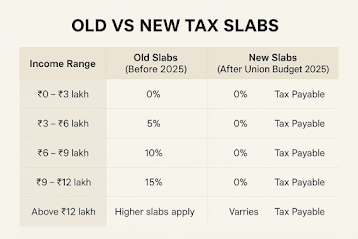
Income Tax Slabs
5.
Clearer Deductions
More clarity
on:
· Home loan interest
· Pre-construction loan interest
· House property deductions
· Commuted pension withdrawals
· Premature
withdrawals from NPS/UPS
6. Refund
and Compliance Ease
Under this
Bill, the central government allowed the TDS refunds even after the deadline,
without any penalty. Tax officers must give prior notice before enforcement
actions.
The digital
and faceless process also eased the process a lot.
7.
Penalty Confusion Resolved
The
confusion revolving around the penalty rate is also solved.
Before, the
penalty rules were scattered across different sections of the Income Tax Act.
For the same mistake, different officers could impose different penalties
because the wording was vague.
In the New
Bill 2025, all penalty provisions have been consolidated into one clear section
of the law. The amount, conditions, and process for each penalty are clearly
defined.
It resulted
in Transparency, Consistency, and fewer disputes.
Beneficial
for whom?
1. 1. Middle-Class Taxpayers
The increased tax-free limit under the new regime means a
large portion of their income is completely exempt, and the clarified deduction
rules make it easier to save without worrying about missing benefits.
The fast refunds and the digital and faceless assessment
reduced the hassle for many taxpayers.
2. Pensioners
Clear rules for commuted pension withdrawals ensure they know
exactly how much is tax-free when they take a lump sum.
3. Homebuyers
Clearer home loan interest and pre-construction interest
deduction rules give more certainty on how much tax they’ll save.
4. MSMEs (Micro, Small, and Medium Enterprises)
Compliance convenience: All-digital filing, shorter
assessment times, and straightforward penalty rules allow them to concentrate
on their business instead of long tax disputes.
Consistency in penalties and assessments reduces the risk of
sudden big tax demands.
The Bill is
expected to come into effect on April 1, 2026(assuming parliamentary approval).
Transitional arrangements are on the way from the old law to the new law.
The 2025
Income Tax Bill marks a significant step toward a simpler, fairer, and more
transparent tax system. By raising the exemption limit, clarifying deductions,
introducing fully digital and faceless assessments, and streamlining penalties,
the government has aimed to reduce confusion and improve compliance. These
changes particularly support middle-class taxpayers, pensioners, homebuyers,
and small businesses — groups that often bear the brunt of complex tax rules.
If implemented effectively, this bill could not only make paying taxes less
stressful but also build greater trust between citizens
and the tax system. Success will depend on smooth implementation and
public awareness.