
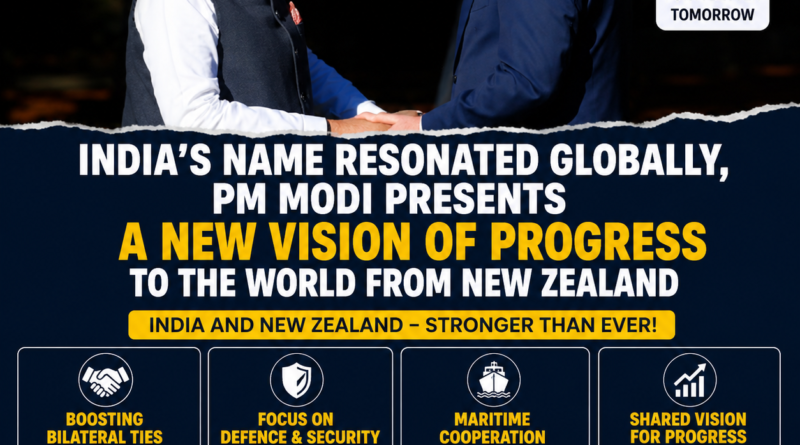
India and New Zealand Strengthen Strategic Partnership: PM Narendra Modi Presents a New Vision of Progress During Historic Visit
India and New Zealand Enter a New Era of Strategic Cooperation
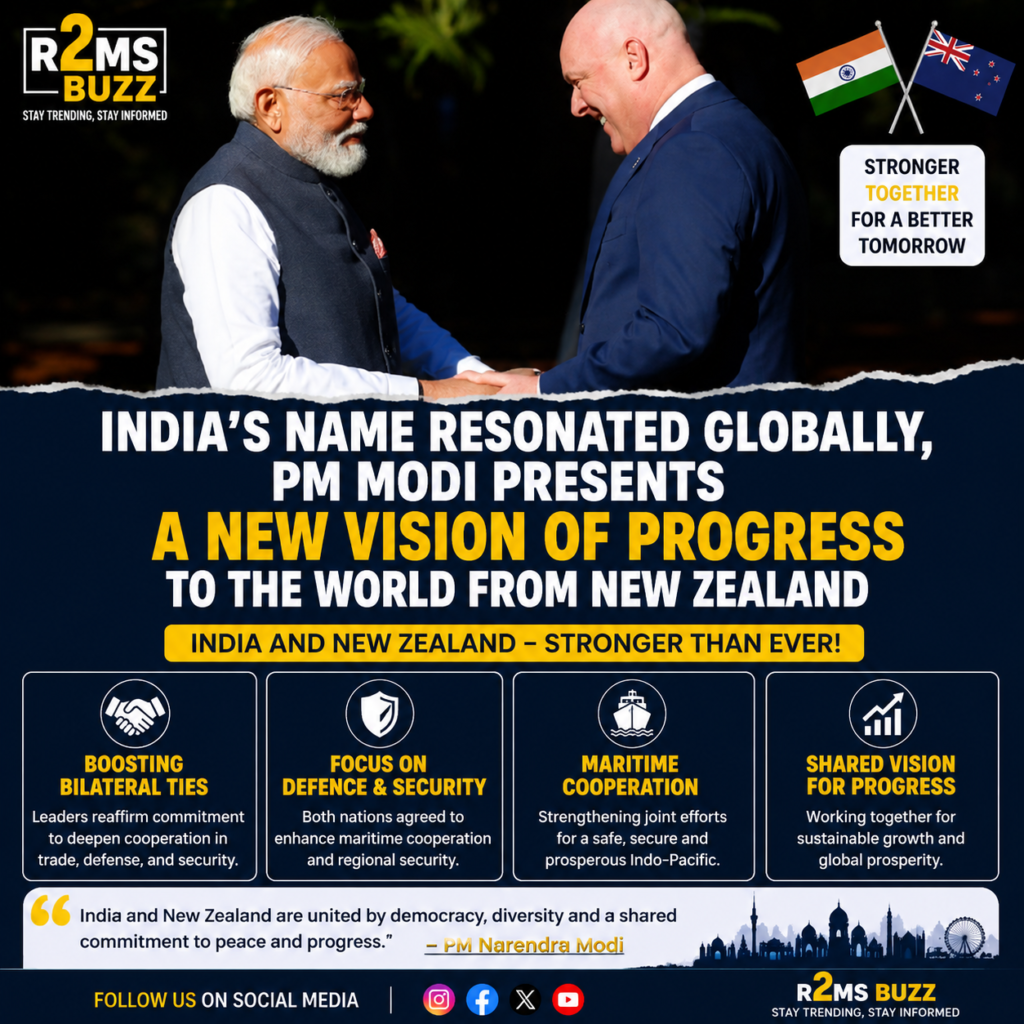
Prime Minister Narendra Modi’s official visit to New Zealand has emerged as a landmark moment in diplomatic relations between the two democratic nations. The visit highlighted India’s growing global influence while reaffirming New Zealand’s commitment to strengthening bilateral cooperation in trade, defence, education, innovation, and regional security.
The meeting between Prime Minister Narendra Modi and New Zealand’s leadership focused on building a future-oriented partnership that reflects the shared values of democracy, peace, economic development, and stability in the Indo-Pacific region.
With both countries agreeing to expand cooperation across several sectors, the visit is being viewed as one of the most significant milestones in India-New Zealand relations in recent years.
A Renewed Vision for India-New Zealand Relations
India and New Zealand have enjoyed friendly diplomatic ties for decades, but recent geopolitical developments and expanding economic opportunities have encouraged both nations to elevate their partnership.
During the high-level discussions, both leaders reaffirmed their commitment to working together on issues ranging from maritime security to climate resilience and technological innovation.
Prime Minister Modi emphasized that India and New Zealand share common democratic values and a mutual commitment to building an inclusive, peaceful, and prosperous Indo-Pacific region.
The visit reflects India’s broader foreign policy objective of strengthening partnerships with trusted democratic nations across the world.
Strong Focus on Trade and Economic Growth
One of the major highlights of the visit was the emphasis on enhancing bilateral trade and investment.
India has become one of the world’s fastest-growing major economies, creating enormous opportunities for international businesses. New Zealand, known globally for its agricultural expertise, education sector, food processing industries, and technological innovation, sees India as an important long-term economic partner.
Discussions reportedly focused on:
- Expanding bilateral trade.
- Encouraging private sector investments.
- Increasing cooperation in agriculture and dairy technology.
- Promoting digital innovation.
- Supporting startups and entrepreneurship.
- Improving market access for businesses in both countries.
Business leaders from both nations expressed optimism that stronger economic cooperation would create employment opportunities while benefiting consumers through increased trade.
Defence and Security Cooperation Takes Centre Stage
Security cooperation formed another important pillar of the discussions.
Both countries acknowledged the importance of maintaining peace, stability, and freedom of navigation across the Indo-Pacific region.
The leaders discussed ways to enhance:
- Defence dialogue.
- Security cooperation.
- Intelligence sharing.
- Counter-terrorism coordination.
- Maritime surveillance.
- Joint military engagements.
Although India and New Zealand are geographically distant, both countries recognize that regional security challenges require stronger international partnerships based on trust and shared democratic values.
Maritime Cooperation in the Indo-Pacific
The Indo-Pacific has become one of the world’s most strategically significant regions.
India has consistently emphasized the importance of ensuring a free, open, inclusive, and rules-based Indo-Pacific.
During the visit, both countries agreed to deepen maritime cooperation through:
- Naval exchanges.
- Maritime domain awareness.
- Search and rescue coordination.
- Disaster response.
- Protection of international shipping routes.
- Blue economy initiatives.
Strengthening maritime collaboration will help improve regional stability while protecting critical sea lanes that support global trade.
Education Partnership Expected to Grow
Education remains one of the strongest bridges connecting India and New Zealand.
Thousands of Indian students choose New Zealand every year for higher education because of its globally recognized universities and research institutions.
The discussions included opportunities for:
- Student exchange programmes.
- Joint academic research.
- Skill development initiatives.
- Faculty collaborations.
- Innovation partnerships.
Educational cooperation is expected to strengthen people-to-people connections while helping students acquire internationally relevant skills.
Technology and Innovation Collaboration
Both governments acknowledged the growing importance of digital transformation in economic development.
India’s rapidly expanding digital economy and New Zealand’s strengths in research and innovation create significant opportunities for collaboration.
Areas identified for future cooperation include:
- Artificial Intelligence.
- Cybersecurity.
- Fintech.
- Agricultural technology.
- Clean energy.
- Digital public infrastructure.
- Space technology.
Experts believe such partnerships can accelerate innovation while generating new opportunities for businesses and researchers in both countries.
Climate Change and Sustainable Development
Climate change was another key topic during bilateral discussions.
India and New Zealand agreed that sustainable development requires global cooperation.
The leaders discussed collaboration in:
- Renewable energy.
- Climate adaptation.
- Green technologies.
- Sustainable agriculture.
- Environmental conservation.
- Disaster resilience.
Both nations emphasized balancing economic growth with environmental responsibility.
Indian Community Plays an Important Role
The Indian diaspora has become one of the strongest links between India and New Zealand.
Indian-origin professionals contribute significantly across sectors including:
- Healthcare.
- Information Technology.
- Education.
- Business.
- Hospitality.
- Public services.
Prime Minister Modi appreciated the contribution of the Indian community in strengthening cultural and economic ties between both countries.
The growing diaspora continues to serve as an important bridge connecting people, businesses, and institutions.
Shared Democratic Values
India and New Zealand are vibrant democracies that strongly support:
- Rule of law.
- Freedom of expression.
- Democratic institutions.
- Inclusive development.
- Peaceful international cooperation.
These shared principles provide a solid foundation for expanding strategic cooperation across multiple sectors.
Both leaders reiterated their commitment to resolving international challenges through dialogue, diplomacy, and multilateral engagement.
Opportunities for Indian Businesses
As India’s economy continues to expand, stronger engagement with New Zealand offers fresh opportunities for businesses.
Potential areas include:
- Agricultural exports.
- Food processing.
- Pharmaceuticals.
- Information Technology.
- Tourism.
- Renewable energy.
- Infrastructure development.
- Education services.
Small and medium enterprises are also expected to benefit from greater economic cooperation.
Tourism Could Receive a Boost
Tourism is another sector likely to benefit from improved bilateral relations.
New Zealand’s scenic landscapes continue to attract Indian tourists, while India’s cultural diversity and historical heritage remain popular among New Zealand travelers.
Better connectivity, stronger diplomatic ties, and increasing awareness may encourage more tourism in both directions.
Tourism contributes significantly to employment while strengthening cultural understanding between nations.
Significance for the Indo-Pacific Region
India’s growing engagement with countries like New Zealand reflects its expanding role in regional diplomacy.
As geopolitical dynamics continue to evolve, partnerships built on trust, democracy, and mutual respect become increasingly important.
Both countries reaffirmed their commitment to supporting:
- Regional peace.
- Maritime security.
- Economic resilience.
- Sustainable development.
- International law.
Analysts believe such partnerships contribute to long-term stability throughout the Indo-Pacific region.
Looking Ahead
The outcomes of Prime Minister Narendra Modi’s visit indicate that India and New Zealand are entering a new phase of comprehensive strategic cooperation.
Future engagements are expected to include:
- More ministerial-level dialogues.
- Increased business delegations.
- Academic partnerships.
- Technology collaborations.
- Defence exchanges.
- Greater cultural interaction.
As bilateral ties continue to strengthen, both countries are well-positioned to build a partnership that benefits their citizens while contributing to regional and global stability.
Conclusion
Prime Minister Narendra Modi’s visit to New Zealand marks an important milestone in India’s diplomatic journey. The discussions demonstrated a shared commitment to expanding cooperation across trade, defence, education, maritime security, technology, climate action, and people-to-people exchanges.
With both nations reaffirming their democratic values and common vision for peace and prosperity, the strengthened India-New Zealand partnership is expected to deliver long-term benefits for businesses, students, researchers, and citizens alike.
As global challenges continue to evolve, closer collaboration between India and New Zealand reflects a forward-looking approach that prioritizes sustainable development, regional stability, and shared economic progress.