
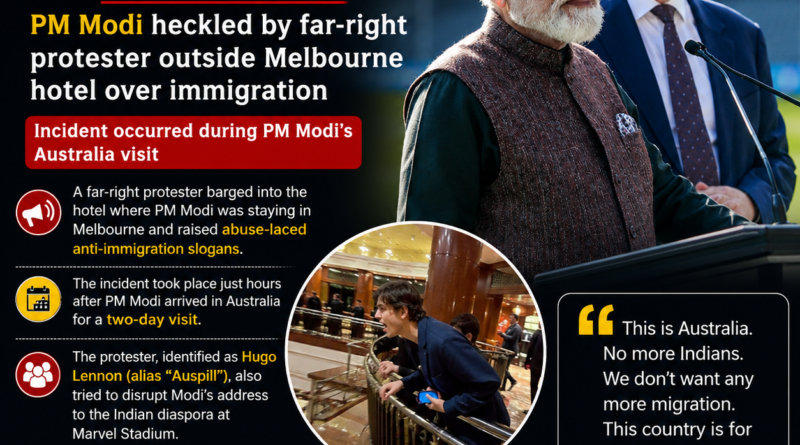
PM Narendra Modi Heckled During Australia Visit: Protester Raises Anti-Immigration Slogans Outside Melbourne Hotel
PM Modi’s Australia Visit Witnesses Brief Protest Outside Melbourne Hotel
Prime Minister Narendra Modi’s official visit to Australia attracted global attention after a far-right protester reportedly interrupted the atmosphere outside a Melbourne hotel by shouting anti-immigration slogans. While the incident was brief and quickly brought under control by local authorities, it generated widespread discussion on social media and highlighted the challenges world leaders often face during high-profile international visits.
According to reports, the protest occurred shortly after Prime Minister Modi arrived in Melbourne for a two-day visit aimed at strengthening India-Australia relations. Security personnel responded promptly, and the situation was contained without affecting the Prime Minister’s official engagements.
The episode has sparked conversations about freedom of expression, public security, and the importance of maintaining respectful democratic dialogue during visits by international leaders.
What Happened Outside the Melbourne Hotel?
Reports indicate that a far-right activist entered or approached the hotel area where Prime Minister Modi was staying and shouted slogans opposing immigration. The protester allegedly used inflammatory language while attempting to draw attention to his political views.
Witnesses stated that security officials acted immediately after the protest began. Police and security personnel escorted the individual away from the area before the situation could escalate further.
Authorities have not indicated that the protest posed any direct threat to the Prime Minister or members of the Indian delegation. Official engagements continued according to schedule.
Security Responds Swiftly
Australia follows strict security protocols whenever foreign heads of government visit the country. Prime ministers, presidents, and other high-ranking officials receive extensive protection coordinated by federal and local law enforcement agencies.
In this case, security officers reportedly intervened within minutes of the protest beginning. The quick response prevented disruption to official meetings and ensured the safety of the visiting delegation.
Officials routinely prepare for various scenarios during diplomatic visits, including protests, demonstrations, and crowd management, while balancing public safety with democratic rights.
Modi’s Visit Focused on Strengthening Bilateral Relations
Despite the brief incident, Prime Minister Modi’s visit remained focused on expanding cooperation between India and Australia.
Discussions during the visit covered several important areas, including:
- Trade and investment
- Defence and strategic cooperation
- Maritime security
- Critical minerals
- Education partnerships
- Technology and innovation
- Clean energy collaboration
- Indo-Pacific regional stability
India and Australia have significantly strengthened their relationship over the past decade, with both nations working closely through regional and multilateral forums.
Why India-Australia Relations Matter
India and Australia are important strategic partners in the Indo-Pacific region.
The two countries share common democratic values and cooperate across multiple sectors, including defence, education, science, agriculture, and cybersecurity.
Trade between the two nations has also expanded steadily, supported by agreements that encourage investment and business collaboration.
Experts believe stronger India-Australia ties contribute to regional stability, economic growth, and secure supply chains.
Understanding Political Protests
Political protests are common during visits by world leaders. Demonstrations may relate to domestic issues, foreign policy, immigration, climate change, or international conflicts.
In democratic societies, peaceful protests are generally protected by law. However, authorities also have a responsibility to ensure public safety and protect visiting dignitaries.
When demonstrations interfere with security or public order, police may intervene to prevent further disruption.
Debate Around Immigration Policies
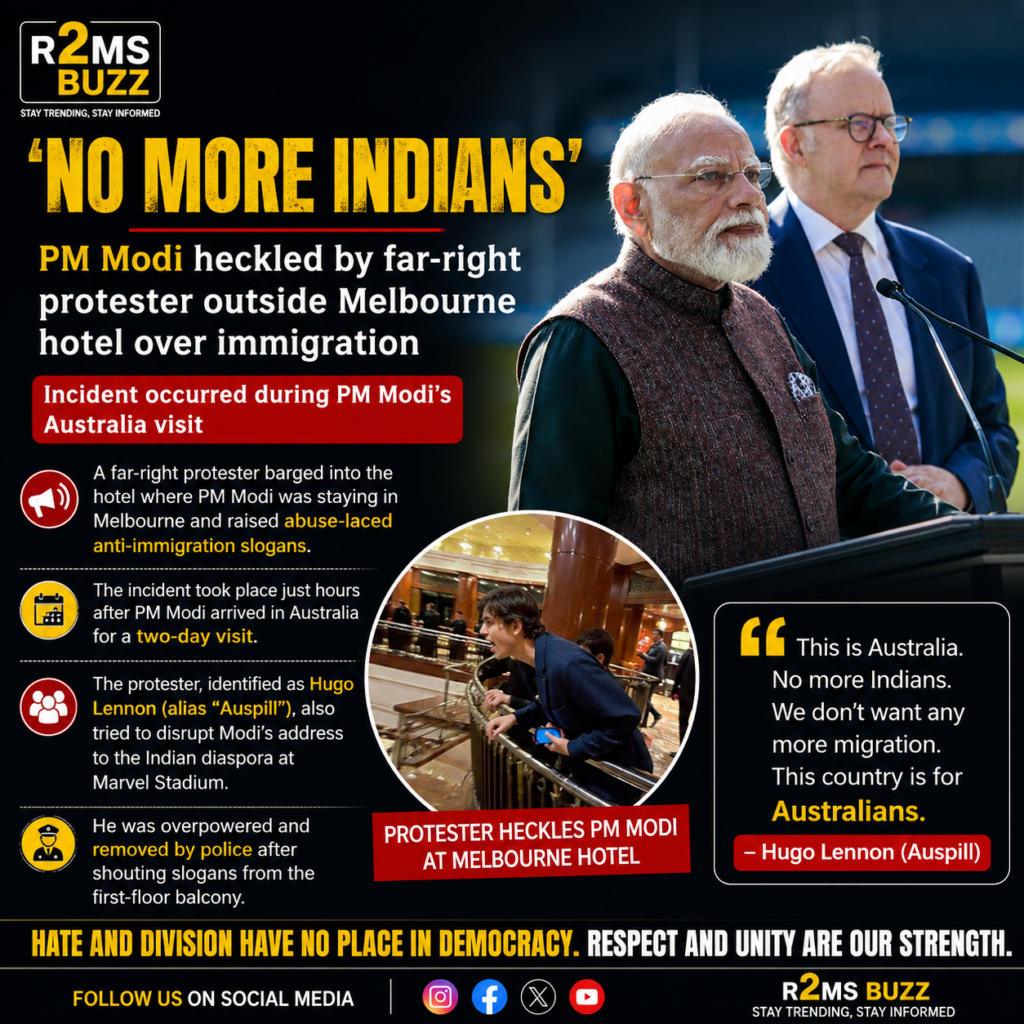
The slogans reportedly shouted during the protest reflected opposition to immigration policies.
Immigration remains a subject of political debate in many countries, including Australia. Different groups hold varying opinions regarding migration levels, border management, workforce requirements, and refugee policies.
While political opinions differ, governments generally encourage respectful public discourse and discourage hate speech or actions targeting communities based on nationality, ethnicity, or religion.
Indian Community in Australia
Australia is home to one of the largest and fastest-growing Indian diaspora communities.
Indian-origin residents contribute significantly to:
- Healthcare
- Information technology
- Higher education
- Engineering
- Scientific research
- Business and entrepreneurship
- Hospitality
- Public services
The Indian community has become an important bridge connecting both nations through cultural exchange, business, education, and people-to-people ties.
Diplomatic Visits Often Attract Public Attention
International visits by prominent leaders naturally attract significant public interest.
Supporters often gather to welcome visiting dignitaries, while protesters may use the opportunity to express political opinions.
Security agencies prepare extensively for such situations, ensuring official programmes continue without interruption.
The Melbourne incident demonstrated the importance of professional security coordination during high-profile diplomatic engagements.
Official Meetings Continued as Planned
Despite the protest, Prime Minister Modi’s scheduled meetings and public engagements reportedly continued without disruption.
Diplomatic discussions remained focused on strengthening cooperation between India and Australia across economic, strategic, and technological sectors.
Government officials from both countries emphasized the importance of maintaining strong bilateral relations based on mutual trust and shared democratic values.
Reactions on Social Media
The incident quickly gained attention online, with videos and photographs circulating across various social media platforms.
Public reactions were mixed. Many users praised the swift response by Australian security personnel, while others discussed the broader issues of immigration, political protests, and democratic freedoms.
Several observers also emphasized that the actions of an individual protester should not be viewed as representing the views of Australian society as a whole.
Freedom of Expression and Public Responsibility
Democratic societies recognize freedom of expression as an important constitutional value.
However, experts note that this freedom also carries responsibilities. Peaceful protest is generally protected, while speech or conduct that incites violence, threatens public safety, or targets communities through hatred may face legal consequences depending on local laws.
Maintaining respectful dialogue remains essential for preserving democratic institutions and social harmony.
Growing India-Australia Partnership
The India-Australia relationship has expanded considerably in recent years.
Key areas of cooperation include:
- Defence exercises
- Maritime security
- Renewable energy
- Critical minerals
- Supply chain resilience
- Digital technology
- Artificial intelligence
- Higher education
- Student mobility
- Counter-terrorism cooperation
Both governments continue working toward deeper economic and strategic collaboration.
Conclusion
The brief protest outside Prime Minister Narendra Modi’s hotel in Melbourne became one of the most discussed moments during his Australia visit. Although the incident attracted considerable media attention, it was quickly managed by security personnel and did not disrupt the Prime Minister’s official programme.
The visit itself remained focused on strengthening the growing partnership between India and Australia through cooperation in trade, defence, education, technology, and regional security.
As democratic nations, both India and Australia recognize the importance of balancing freedom of expression with public safety and respect for visiting dignitaries. The incident also serves as a reminder that isolated protests do not define the broader relationship between two countries that continue to deepen their strategic and economic cooperation.