

CM Vijay Calls for a Common School Textbook System Across India: A Vision for Equal and Affordable Education
Introduction
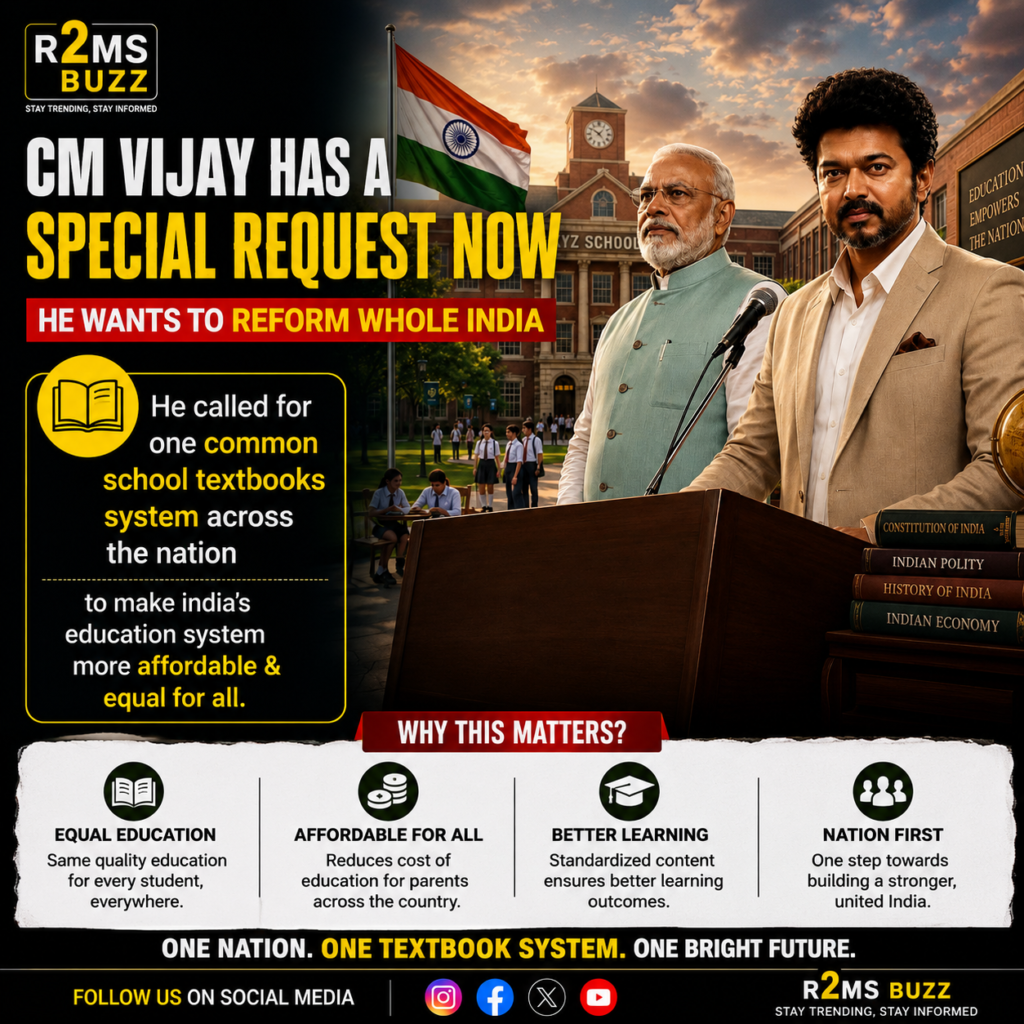
Education has long been considered the foundation of a nation’s progress. As India continues to modernize its education system through reforms and digital learning initiatives, discussions around creating equal opportunities for every student have gained momentum. A recent proposal attributed to CM Vijay has sparked nationwide debate after he reportedly advocated for a common school textbook system across the country.
The proposal aims to reduce educational inequality by introducing standardized textbooks that can be used by students regardless of the state they live in. Supporters believe such a move could lower education costs, improve learning quality, and ensure that every child receives access to similar academic resources. Critics, however, point out that India’s cultural and linguistic diversity may require a more balanced approach.
The discussion has generated interest among educators, parents, policymakers, and students, making it one of the most talked-about education-related topics in recent days.
What Is the Proposal?
According to reports circulating online, CM Vijay suggested introducing a common school textbook system across India. The primary objective behind the proposal is to make education more affordable while ensuring equal academic opportunities for students across different states.
The idea is based on the belief that children, irrespective of their social or economic background, should have access to quality educational material that follows a consistent academic standard.
While the proposal has attracted public attention, no nationwide policy has been announced. Any major education reform of this nature would require consultation between the Union Government, state governments, educational boards, and subject experts.
Why Is Educational Equality Important?
India has one of the world’s largest education systems, with millions of students enrolled in government and private schools.
However, there are noticeable differences in:
- Quality of textbooks
- Teaching standards
- Availability of learning resources
- School infrastructure
- Medium of instruction
- Access to digital education
These differences often create unequal learning opportunities for students.
Supporters of standardized educational resources argue that every child deserves the same quality of academic content, regardless of where they live or which school they attend.
How a Common Textbook System Could Help
If implemented carefully, a common textbook framework could offer several advantages.
1. Equal Learning Opportunities
Students across India would study core subjects using similar academic standards, reducing educational disparities.
2. Lower Educational Costs
Publishing textbooks on a larger scale could reduce printing costs, making books more affordable for families.
Government distribution programmes may also become more efficient.
3. Easier Student Transfers
Families frequently relocate because of employment or personal reasons.
A standardized curriculum could help students continue their education without major disruptions when moving between states.
4. Better Competitive Exam Preparation
Many national entrance examinations are based on common concepts.
Uniform textbooks could provide students with a stronger academic foundation for examinations such as JEE, NEET, CUET, and other competitive tests.
5. Improved Teacher Training
Teachers across different states could receive standardized training based on similar learning objectives, potentially improving classroom instruction.
Challenges That Cannot Be Ignored
Although the proposal appears promising, implementing a common textbook system across a country as diverse as India would not be simple.
Linguistic Diversity
India recognizes multiple languages, and education is provided in several regional languages.
Any common curriculum would need high-quality translations while preserving accuracy and local context.
Cultural Representation
Each state has its own history, traditions, literature, geography, and cultural identity.
Many education experts believe state-specific content should continue to be included alongside nationally relevant subjects.
Federal Structure
Education is a subject where both the Union and state governments play important roles.
Major reforms generally require cooperation between all stakeholders.
Existing National Education Reforms
India has already introduced several reforms under the National Education Policy (NEP) 2020.
Some important objectives include:
- Flexible learning pathways
- Skill-based education
- Critical thinking
- Digital learning
- Early childhood education
- Multilingual education
- Reduced rote learning
Any future proposal for common textbooks would likely need to align with these broader educational goals.
What Teachers and Parents Are Saying
The discussion has generated mixed reactions.
Many parents believe standardized textbooks could reduce educational expenses and ensure fairness.
Teachers appreciate the possibility of consistent academic standards but emphasize that classroom teaching, teacher quality, and student engagement remain equally important.
Some education experts suggest creating a national core curriculum while allowing states to include regional history, language, and culture.
Could Technology Support Such a System?
Digital education has transformed classrooms across India.
If a common textbook system is ever introduced, technology could play a significant role through:
- Free digital textbooks
- Interactive learning platforms
- Educational videos
- Online assessments
- Virtual classrooms
- AI-assisted learning tools
Digital access could help students in remote areas receive quality educational content without depending solely on printed books.
Impact on Rural Education
Students in rural areas often face shortages of quality educational resources.
A standardized textbook programme supported by digital platforms and teacher training could help bridge educational gaps between urban and rural schools.
However, experts note that improvements in internet connectivity, electricity, teacher availability, and school infrastructure would remain equally important.
Benefits for Competitive Education
Uniform academic standards may also reduce confusion among students preparing for national examinations.
When foundational concepts are taught consistently, students may find it easier to transition from school education to higher education entrance tests.
This could particularly benefit students from economically weaker backgrounds who may not have access to expensive coaching institutions.
Importance of Consultation Before Implementation
Education reforms affect millions of students, teachers, schools, and parents.
Before implementing any nationwide textbook policy, experts recommend extensive consultation with:
- State governments
- Education boards
- Teachers
- Child psychologists
- Curriculum experts
- Universities
- Parent associations
Such discussions can help ensure that reforms improve educational quality while respecting India’s diversity.
Looking Ahead
The proposal for a common school textbook system has opened an important national conversation about educational equality, affordability, and quality.
Whether or not such a policy is eventually adopted, the discussion highlights a shared goal: providing every child with access to quality education regardless of geography or economic background.
Balancing national academic standards with regional languages, culture, and local history will be essential if any future reforms are considered.
Conclusion
The proposal attributed to CM Vijay has renewed debate about the future of education in India. A common school textbook system has the potential to improve academic consistency, reduce educational costs, and create more equal learning opportunities. At the same time, careful planning would be required to preserve India’s linguistic and cultural diversity.
Ultimately, the success of any education reform depends not only on textbooks but also on skilled teachers, modern classrooms, digital access, supportive parents, and policies that place students at the center of learning. As conversations continue, the focus remains on building an education system that prepares India’s next generation for a brighter and more inclusive future.