Mercedes-Benz Responds to E20 Fuel Controversy After Sourav Joshi Raises Mileage Concerns
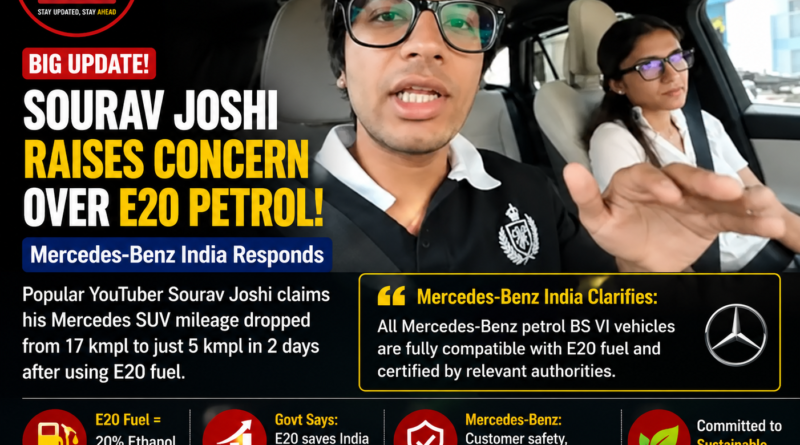
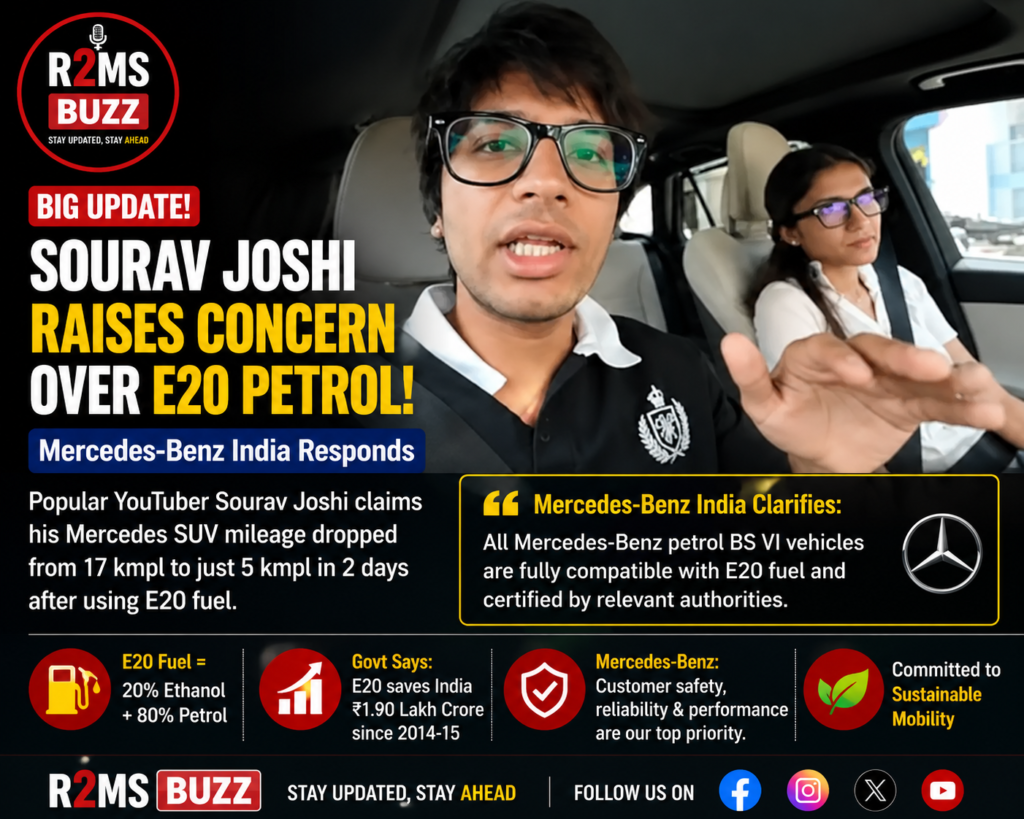
A fresh debate over E20 ethanol-blended petrol has gained national attention after popular YouTuber Sourav Joshi claimed that the mileage of his Mercedes-Benz SUV dropped drastically after refuelling with E20 fuel. His video quickly went viral on social media, prompting Mercedes-Benz India to issue an official clarification regarding the compatibility of its petrol vehicles with ethanol-blended fuel.
The luxury carmaker reiterated that all its BS VI petrol vehicles sold in India are fully compatible with E20 petrol and have been certified by the relevant regulatory authorities. The company also emphasized that customer safety, vehicle performance, and reliability remain its highest priorities.
The controversy has sparked a wider discussion among automobile owners, industry experts, and policymakers about the real-world impact of ethanol-blended petrol on fuel efficiency, engine performance, and long-term vehicle reliability.
What Triggered the Controversy?
The issue came into the spotlight after YouTuber Sourav Joshi shared his personal experience with his Mercedes-Benz petrol SUV.
In a vlog, Joshi claimed that soon after filling his vehicle with E20 petrol, he noticed a dramatic fall in fuel efficiency. According to him, the SUV, which previously delivered around 17 kmpl, saw its mileage drop to 9 kmpl, and later to nearly 5 kmpl within two days.
He also claimed that the estimated driving range displayed by the vehicle reduced from approximately 800 kilometres on a full tank to nearly 480 kilometres.
The video generated widespread discussion among automobile enthusiasts and existing vehicle owners, many of whom questioned whether ethanol-blended fuel could affect luxury vehicles.
It is important to note that these are claims made by the YouTuber based on his personal experience and have not been independently verified.
Mercedes-Benz Issues Official Clarification
Following the growing online discussion, Mercedes-Benz India released an advisory to reassure customers.
The company stated that every BS VI petrol model sold by Mercedes-Benz in India is officially certified for E20 fuel compatibility.
According to the automaker, its vehicles have undergone the required testing and comply with government regulations governing ethanol-blended petrol.
Mercedes-Benz emphasized that customers can continue using E20 fuel without concern, provided the vehicle falls under the certified BS VI petrol category.
The company also stated that it remains committed to maintaining the highest standards of:
- Vehicle safety
- Engine reliability
- Driving performance
- Customer satisfaction
Mercedes-Benz further said its technical teams are available to assist customers who have questions regarding E20 fuel usage.
What Is E20 Fuel?
E20 fuel is a blend consisting of:
- 20% Ethanol
- 80% Petrol
Ethanol is a renewable fuel primarily produced from agricultural products such as sugarcane, maize, and other biomass.
The Indian government has been actively promoting ethanol blending as part of its long-term energy strategy.
The objective is to reduce dependence on imported crude oil while supporting domestic biofuel production.
The move also aims to improve energy security and encourage cleaner transportation.
Why Is India Promoting Ethanol-Blended Fuel?
India imports a significant portion of its crude oil requirements.
Higher ethanol blending is expected to reduce petroleum imports, saving foreign exchange while promoting renewable energy.
According to the government, the ethanol blending programme offers several benefits:
- Reduced crude oil imports
- Lower carbon emissions
- Increased income opportunities for farmers
- Support for India’s sugar industry
- Greater energy security
- Reduced dependence on fossil fuels
Officials have stated that the programme has already generated substantial economic benefits.
Government’s Claim on Foreign Exchange Savings
The Central Government has repeatedly defended its ethanol blending initiative.
According to official figures, the programme has helped India save more than ₹1.90 lakh crore in foreign exchange since the 2014–15 financial year.
Officials argue that replacing part of imported petrol with domestically produced ethanol reduces import bills while encouraging local agricultural production.
The government considers ethanol blending an important component of India’s transition toward cleaner and more sustainable transportation.
Does E20 Affect Mileage?
One of the biggest concerns raised during the debate involves fuel efficiency.
Ethanol generally contains less energy per litre than conventional petrol.
Because of this characteristic, some reduction in mileage may occur depending on:
- Vehicle design
- Engine calibration
- Driving conditions
- Fuel quality
- Vehicle age
- Maintenance
However, automobile manufacturers designing engines specifically compatible with E20 usually calibrate them to operate efficiently with ethanol-blended fuel.
Experts note that dramatic mileage fluctuations should be examined carefully because several factors can influence fuel consumption beyond fuel composition alone.
Concerns About Older Vehicles
While Mercedes-Benz has confirmed compatibility for its BS VI petrol vehicles, experts note that older vehicles may behave differently.
Some automobiles manufactured before E20 compatibility standards became common may experience:
- Reduced fuel efficiency
- Performance variations
- Wear in certain rubber components
- Fuel system compatibility concerns
Vehicle owners are generally advised to refer to their manufacturer’s recommendations before using higher ethanol blends.
Manufacturers remain the most reliable source of guidance regarding fuel compatibility.
Sourav Joshi’s Concerns
During his vlog, Sourav Joshi expressed concern not only about reduced mileage but also about the long-term health of his luxury SUV.
He stated that he now worries every time he fills petrol in the vehicle.
The YouTuber also questioned whether ethanol-blended fuel could potentially affect engine performance over time.
While sharing his experience, he mentioned that he also owns an electric Mercedes G-Wagon, which naturally avoids issues related to petrol quality or fuel blending.
His comments resonated with many social media users who have been discussing ethanol blending in recent months.
Mercedes-Benz Reassures Customers
Responding to customer concerns, Mercedes-Benz reaffirmed that customer confidence remains extremely important.
The company encouraged owners experiencing technical issues to contact authorized Mercedes-Benz service centres.
It emphasized that trained technicians can evaluate individual vehicle conditions and provide technical guidance if required.
Mercedes-Benz also reiterated its commitment to sustainable mobility while ensuring that performance and reliability remain uncompromised.
E25 Fuel Not Yet Introduced
Amid discussions surrounding ethanol blending, some social media posts have also mentioned E25 fuel.
The government has clarified that E25 has not yet been introduced for public use.
Officials stated that E25 remains under testing and evaluation.
Currently, E20 remains the highest officially promoted ethanol blend for general petrol vehicles compatible with the programme.
Consumers have been advised to rely on official announcements rather than unverified online claims.
Growing Debate Among Vehicle Owners
The controversy has triggered widespread debate across the automotive community.
Supporters of ethanol blending argue that:
- It supports environmental goals.
- It reduces oil imports.
- It benefits farmers.
- It strengthens energy security.
Meanwhile, critics believe more real-world studies are needed regarding:
- Mileage changes
- Long-term engine durability
- Maintenance costs
- Performance across different vehicle models
Automobile experts say continued research and manufacturer guidance will help consumers better understand ethanol’s long-term impact.
Importance of Manufacturer Recommendations
Industry experts emphasize that every vehicle is engineered differently.
Modern BS VI vehicles specifically certified for E20 are designed and tested according to regulatory standards.
However, owners should always:
- Follow the fuel recommendations provided in the owner’s manual.
- Use fuel from reliable fuel stations.
- Maintain regular vehicle servicing.
- Contact authorized service centres if unusual performance changes occur.
Proper maintenance remains one of the most important factors affecting mileage and engine life.
Conclusion
The discussion surrounding E20 fuel compatibility gained national attention after YouTuber Sourav Joshi shared his experience of a sharp decline in the mileage of his Mercedes-Benz SUV. While his claims sparked concern among many vehicle owners, Mercedes-Benz India has responded by reaffirming that all of its BS VI petrol vehicles are fully certified for E20 fuel and meet the required regulatory standards.
At the same time, the debate has highlighted broader questions about ethanol-blended fuel, real-world mileage, and vehicle compatibility. As India continues expanding its ethanol programme to reduce crude oil imports and promote cleaner energy, both manufacturers and consumers are likely to remain closely engaged in discussions about fuel performance and long-term reliability. For vehicle owners, following manufacturer guidelines and seeking professional technical advice remains the best approach when evaluating fuel-related concerns.
Frequently Asked Questions (FAQs)
What is E20 fuel?
E20 is a fuel blend containing 20% ethanol and 80% petrol.
Is Mercedes-Benz compatible with E20 fuel?
Mercedes-Benz India has stated that all its BS VI petrol vehicles are officially certified and fully compatible with E20 fuel.
Why did Sourav Joshi criticize E20 fuel?
The YouTuber claimed that his Mercedes-Benz SUV experienced a significant drop in mileage after using E20 petrol. These claims are based on his personal experience and have not been independently verified.
Why is the Indian government promoting E20?
The government says ethanol blending reduces dependence on imported crude oil, supports farmers and the sugar industry, lowers emissions, and has helped save over ₹1.90 lakh crore in foreign exchange since 2014–15.
Has E25 fuel been introduced?
No. The government has clarified that E25 is still under testing and has not been rolled out for public use.