
How Does an FIR Work in India?
An FIR (First Information Report) is often the first step in the criminal justice process in India. Whenever a cognizable offence—such as murder, rape, kidnapping, robbery, or serious assault—is reported to the police, an FIR may be registered if the legal requirements are met.
Many people have heard the term “FIR” in news reports but are unsure about what it actually means, who can file it, or what happens after it is registered.
This guide explains the complete FIR process in simple language, including the legal procedure, citizens’ rights, the role of the police, and common myths.
Quick Facts About FIR
| Particular | Details |
|---|---|
| Full Form | First Information Report |
| Purpose | To record information about a cognizable offence |
| Registered By | Police |
| Applicable Law | Bharatiya Nagarik Suraksha Sanhita (BNSS), 2023 |
| Cost | Free |
| Copy of FIR | Generally provided free to the informant in applicable cases |
What Is an FIR?
An FIR is the first official record prepared by the police after receiving information about a cognizable offence.
It serves as the starting point for a criminal investigation and contains basic details such as:
- Date and time of the incident
- Place of occurrence
- Nature of the offence
- Names of persons involved (if known)
- Name and details of the informant
- Brief description of events
An FIR is not proof that a crime occurred. It is a formal record of information that enables the police to begin investigating.
What Is a Cognizable Offence?
A cognizable offence is a serious offence where the police generally have the authority to register an FIR and begin an investigation according to the law.
Examples include:
- Murder
- Rape
- Kidnapping
- Dowry death
- Dacoity
- Robbery
- Acid attack
- Terror-related offences
What Is a Non-Cognizable Offence?
Non-cognizable offences are generally less serious offences where the police follow a different legal procedure.
Examples may include:
- Defamation
- Public nuisance
- Minor assault (depending on circumstances)
- Certain cheating cases
The procedure differs from cognizable offences, and the police may require directions from a Magistrate before proceeding in some situations.
Who Can File an FIR?
One common misconception is that only the victim can file an FIR.
In reality, information may be given by:
- The victim
- A family member
- A witness
- A neighbour
- Any person who has knowledge of the incident
The key requirement is that the information relates to a cognizable offence.
Where Can an FIR Be Filed?
An FIR can generally be lodged at:
- The police station having jurisdiction over the area where the offence occurred.
- In many situations, a Zero FIR can also be registered at another police station and later transferred to the appropriate jurisdiction.
Zero FIR is particularly useful in emergencies where immediate reporting is important.
What Information Should Be Included?
When reporting an offence, try to provide:
- Date
- Time
- Exact location
- What happened
- Names of persons involved (if known)
- Description of suspects (if identity is unknown)
- Witness details
- Supporting evidence such as photographs or videos, if available
If some information is not immediately available, you should not guess or speculate.
Can Police Refuse to Register an FIR?
The answer depends on the facts and the nature of the complaint.
For information disclosing a cognizable offence, legal procedures generally require appropriate action by the police. If a person believes an FIR has been wrongly refused, the law provides certain remedies, including approaching senior police officers or the appropriate judicial authority, depending on the circumstances.
What Is a Zero FIR?
A Zero FIR allows a complaint relating to a cognizable offence to be recorded at any police station, even if the incident occurred outside that station’s jurisdiction.
The case can then be transferred to the police station that has territorial jurisdiction.
This provision is particularly important in emergencies and for offences requiring immediate action.
What Happens Immediately After an FIR Is Registered?
Once an FIR is recorded, the police may begin the investigation, which can include:
- Visiting the crime scene.
- Collecting physical and digital evidence.
- Recording witness statements.
- Conducting medical examinations where relevant.
- Identifying suspects.
- Taking further lawful investigative steps based on the facts of the case.
The exact course of the investigation depends on the nature of the alleged offence.
Common Myths
Myth: FIR means the accused is guilty.
Fact: An FIR is only the beginning of the legal process. Guilt or innocence is decided by the court after considering the evidence.
Myth: Only the victim can register an FIR.
Fact: Information may be provided by other people who have knowledge of the incident, subject to the applicable legal requirements.
Myth: Every complaint becomes an FIR.
Fact: Whether an FIR is registered depends on the nature of the information and the applicable legal provisions.
What Happens After an FIR Is Registered?
After an FIR is registered, the police begin an investigation to determine whether an offence has been committed and who may be responsible.
The investigation generally includes the following stages.
Step 1: Visit to the Crime Scene
The investigating officer may visit the place where the incident allegedly occurred to:
- Inspect the location.
- Collect physical evidence.
- Prepare a site plan if required.
- Take photographs or videos.
- Record observations.
Step 2: Collection of Evidence
The police gather different types of evidence depending on the case, such as:
- CCTV footage.
- Mobile phone records.
- Call records (subject to legal procedures).
- Documents.
- Medical reports.
- Forensic evidence.
- Digital evidence.
- Fingerprints.
- DNA evidence (where applicable).
The objective is to verify the facts through lawful investigation.
Step 3: Recording Witness Statements
Police may record statements from:
- Victims.
- Eyewitnesses.
- Neighbours.
- Family members.
- Other relevant persons.
Witness statements help investigators understand the sequence of events.
Step 4: Medical Examination
In cases involving injuries, sexual offences, or suspicious deaths, medical examinations may be conducted according to the applicable legal procedures.
Medical evidence can play an important role in the investigation.
Step 5: Identification of Suspects
Police analyse the available evidence to identify possible suspects.
This may involve:
- Questioning individuals.
- Examining digital evidence.
- Reviewing CCTV footage.
- Conducting identification procedures where permitted by law.
Step 6: Arrest (If Required)
A common misconception is that an FIR automatically results in arrest.
This is not correct.
Whether an arrest is made depends on:
- The nature of the alleged offence.
- The available evidence.
- Legal requirements.
- The circumstances of the case.
Police must act according to the law and applicable judicial guidelines.
Rights of the Person Filing the FIR
The informant generally has the right to:
- Receive a copy of the FIR where applicable.
- Provide additional information during the investigation.
- Be treated respectfully.
- Approach higher authorities if legal remedies are available.
- Seek updates where permitted under law.
Rights of the Accused
Indian law protects the rights of every accused person.
These include:
- Presumption of innocence until proven guilty.
- Right to legal representation.
- Right to a fair trial.
- Protection against unlawful detention.
- Opportunity to present evidence in defence.
An FIR is not proof of guilt.
What Is a Charge Sheet?
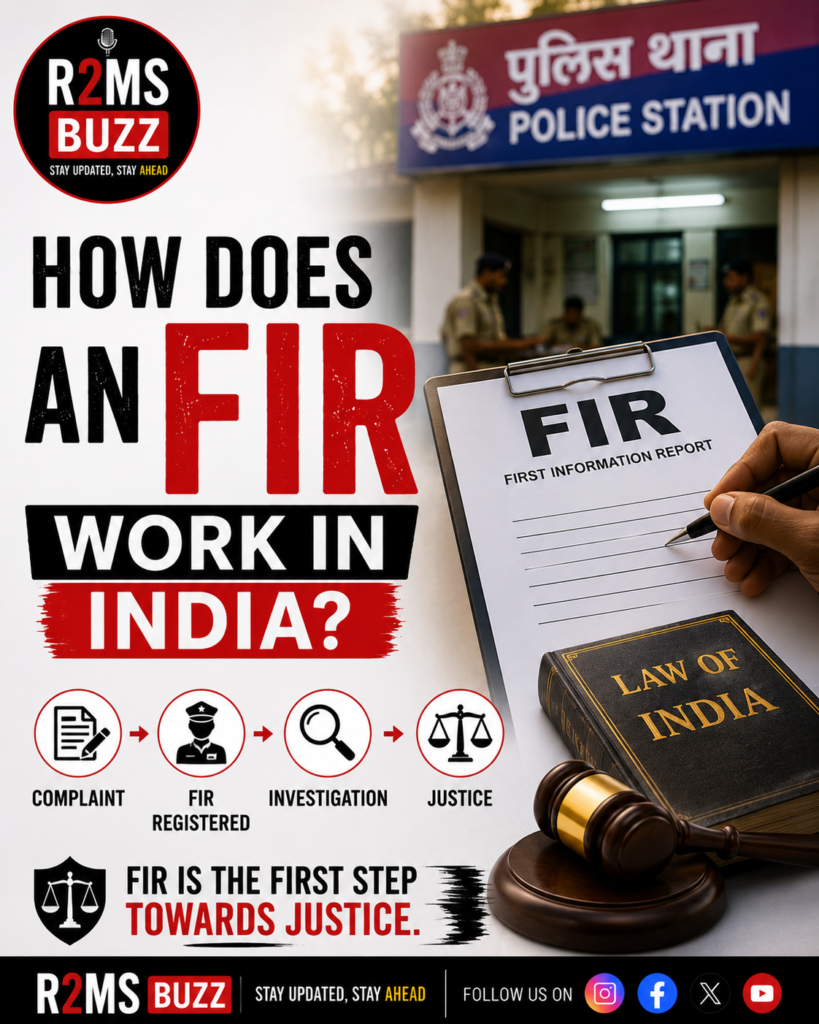
A charge sheet is a report submitted by the police to the court after completing the investigation.
It may include:
- Evidence collected.
- Witness statements.
- Expert reports.
- Medical reports.
- List of accused persons.
- Relevant documents.
The court then considers whether there is sufficient material to proceed with the case.
FIR vs Complaint
| FIR | Complaint |
|---|---|
| Relates to cognizable offences | May relate to any grievance or offence |
| Registered by police | Can be submitted to police or other authorities |
| Starts a criminal investigation | Does not automatically lead to an FIR |
| Used in serious criminal matters | Broader term covering various complaints |
FIR vs Charge Sheet
| FIR | Charge Sheet |
|---|---|
| First stage | Later stage |
| Begins investigation | Submitted after investigation |
| Contains initial information | Contains evidence gathered during investigation |
| Filed at the beginning | Filed before the court after investigation |
Can an FIR Be Withdrawn?
An FIR is part of the criminal justice process.
Whether proceedings can be closed, compounded, or otherwise resolved depends on:
- The type of offence.
- Applicable law.
- Orders of the competent court where required.
The legal position varies depending on the facts of each case.
Can False FIRs Be Filed?
Any legal system may receive complaints that are later found to be unsubstantiated.
Courts decide criminal cases based on evidence presented during the judicial process.
Making false statements to authorities can itself have legal consequences under applicable law.
What Happens After the Charge Sheet?
Once the charge sheet is filed:
Step 1
The court takes cognizance if appropriate.
Step 2
Charges may be framed depending on the evidence.
Step 3
Trial begins.
Step 4
Witnesses are examined.
Step 5
Cross-examination takes place.
Step 6
Arguments are heard.
Step 7
The court delivers its judgment.
Why Is an FIR Important?
An FIR serves several important purposes:
- It officially records the alleged incident.
- It enables the police to begin an investigation.
- It creates an official record of the complaint.
- It helps preserve evidence and witness information.
- It supports the criminal justice process.
Common Mistakes People Make
❌ Waiting several days before reporting a serious offence without a valid reason.
❌ Providing incorrect or exaggerated information.
❌ Sharing confidential investigation details on social media.
❌ Believing rumours about legal procedures.
❌ Assuming an FIR means automatic conviction.
Tips for Citizens
- Stay calm while reporting an incident.
- Provide accurate information.
- Keep copies of relevant documents.
- Preserve evidence whenever possible.
- Cooperate with investigators.
- Seek legal advice if required.
Frequently Asked Questions (FAQs)
What does FIR stand for?
FIR stands for First Information Report.
Is filing an FIR free?
Yes. Registration of an FIR does not require payment.
Can anyone file an FIR?
Information about a cognizable offence may be provided by the victim or another person with knowledge of the incident, subject to applicable legal requirements.
Does an FIR mean someone is guilty?
No. An FIR only starts the investigation. Guilt is determined by the court after evaluating the evidence.
Can police arrest someone immediately after an FIR?
Not necessarily. Arrest depends on the facts of the case, the law, and the evidence available.
Can an FIR be filed online?
Some states and Union Territories provide online facilities for certain categories of complaints or FIR-related services. Availability varies.
What is a Zero FIR?
A Zero FIR allows information about a cognizable offence to be recorded at any police station and later transferred to the appropriate jurisdiction.
How long does a police investigation take?
The duration depends on the complexity of the case, evidence, and legal procedures.
Can an FIR be cancelled?
The legal outcome depends on the facts, applicable law, and decisions of the competent authorities or courts.
Is an FIR a public document?
Access to FIRs may depend on applicable laws, court directions, privacy considerations, and the nature of the case.
Conclusion
An FIR is one of the most important documents in India’s criminal justice system because it marks the formal beginning of a police investigation into a cognizable offence. However, it is only the first step. Registration of an FIR does not establish guilt, nor does it guarantee conviction.
Understanding how the FIR process works helps citizens know their rights and responsibilities while also reducing common misconceptions. A fair investigation, supported by evidence and judicial oversight, remains essential to ensuring justice for everyone involved.
Also See related Article dowry harassment case, domestic violence case