
What Happens After an FIR Is Filed?
Many people believe that once an FIR (First Information Report) is registered, the accused is immediately arrested and punished. In reality, an FIR is only the starting point of the criminal justice process.
After an FIR is filed, the police begin an investigation to determine whether an offence has been committed, gather evidence, identify those involved, and submit their findings to the court. The investigation is meant to uncover facts—not to assume guilt or innocence.
Understanding what happens after an FIR helps citizens know their rights, avoid misconceptions, and understand how criminal investigations work in India.
Quick Overview
| Stage | What Happens |
|---|---|
| FIR Registration | Police officially record information about a cognizable offence |
| Investigation Begins | Police start collecting evidence |
| Crime Scene Inspection | Officers visit the location |
| Witness Statements | Statements are recorded |
| Evidence Collection | Physical and digital evidence is gathered |
| Arrest (if legally justified) | Police may arrest based on law and evidence |
| Charge Sheet | Police submit investigation report to court |
| Trial | Court hears the case |
| Judgment | Court decides guilt or innocence |
Why Is Investigation Necessary?
An FIR contains only the initial information received by the police.
The investigation helps answer questions such as:
- Did the alleged offence actually occur?
- What evidence supports or contradicts the allegations?
- Who was involved?
- Are there witnesses?
- What do forensic findings show?
Without a proper investigation, courts would not have sufficient evidence to decide criminal cases fairly.
Step 1: FIR Registration
The process begins when information relating to a cognizable offence is recorded by the police.
The FIR usually contains:
- Date and time
- Place of occurrence
- Nature of the offence
- Brief description of events
- Details of the informant
- Names of accused persons (if known)
This document becomes the foundation of the investigation.
Step 2: Police Assign an Investigating Officer
After registration, the police assign an Investigating Officer (IO).
The IO is responsible for:
- Conducting the investigation.
- Collecting evidence.
- Examining witnesses.
- Preparing reports.
- Coordinating forensic examinations where required.
- Submitting the charge sheet.
The officer must conduct the investigation fairly and impartially.
Step 3: Visit to the Crime Scene
The Investigating Officer generally visits the place where the alleged offence occurred.
During the inspection, officers may:
- Examine the location.
- Prepare a site plan.
- Photograph or video-record the scene.
- Look for physical evidence.
- Identify witnesses.
- Preserve important material.
Prompt examination can help protect valuable evidence.
Step 4: Collection of Physical Evidence
Evidence may include:
Documents
- Agreements
- Identity documents
- Receipts
- Financial records
Digital Evidence
- Mobile phones
- CCTV footage
- Emails
- WhatsApp messages
- Computer data
- GPS records
Forensic Evidence
- Fingerprints
- DNA samples
- Blood samples
- Weapons
- Clothing
- Hair samples
The type of evidence depends on the nature of the alleged offence.
Step 5: Recording Witness Statements
Witnesses play an important role in many investigations.
Police may record statements from:
- Victims
- Family members
- Neighbours
- Eyewitnesses
- Experts
- Medical professionals
Witness statements help investigators reconstruct the sequence of events.
Step 6: Medical Examination
Medical examinations are conducted in appropriate cases, such as:
- Assault
- Sexual offences
- Road accidents
- Suspicious deaths
Medical reports may assist investigators by documenting injuries or other relevant findings.
Step 7: Questioning Suspects
Police may question individuals connected with the case.
Questioning aims to:
- Verify information.
- Clarify inconsistencies.
- Compare statements with evidence.
- Identify additional leads.
Questioning does not itself establish guilt.
Can Police Arrest Immediately?
One of the biggest misconceptions is:
“FIR means immediate arrest.”
This is incorrect.
An arrest depends on several factors, including:
- Nature of the alleged offence.
- Available evidence.
- Legal requirements.
- Risk of absconding.
- Possibility of tampering with evidence.
- Need for custodial investigation.
Police are expected to follow applicable legal procedures and judicial guidelines before making arrests where required.
What If No Evidence Is Found?
Sometimes investigations reveal:
- Insufficient evidence.
- Incorrect information.
- Mistaken identity.
- No offence under the law.
In such situations, the police may submit an appropriate report to the court according to the applicable legal procedure.
This demonstrates why an FIR should not be viewed as proof that an accused person committed an offence.
Common Myths
Myth: Filing an FIR guarantees conviction.
Fact: Conviction depends on evidence presented before the court.
Myth: Police always arrest immediately.
Fact: Arrest depends on the facts, evidence, and legal requirements.
Myth: Investigation ends in one or two days.
Fact: Some investigations conclude quickly, while others take months depending on complexity.
Myth: Witness statements alone decide the case.
Fact: Courts consider witness testimony along with documentary, forensic, medical, and other evidence.
Step 8: Forensic Examination
In serious criminal cases, forensic science plays a vital role in helping investigators understand what happened. Experts analyze evidence collected from the crime scene and prepare scientific reports.
Common Types of Forensic Evidence
- DNA analysis
- Fingerprint examination
- Handwriting verification
- Ballistic examination (firearms)
- Cyber forensic analysis
- Mobile phone and computer data analysis
- Blood sample examination
Scientific evidence can support or challenge statements made during the investigation.
Step 9: Digital Evidence Collection
Modern investigations often involve digital evidence.
Police may examine:
- CCTV footage
- Mobile phones
- WhatsApp chats
- Emails
- GPS location history
- Social media posts
- Bank transactions
- Internet activity
Digital evidence is collected and examined according to applicable legal procedures.
Step 10: Expert Opinion
Depending on the nature of the case, investigators may seek opinions from:
- Doctors
- Forensic experts
- Cyber experts
- Financial experts
- Handwriting specialists
- Ballistic experts
These reports may become part of the investigation record.
Preparing the Charge Sheet
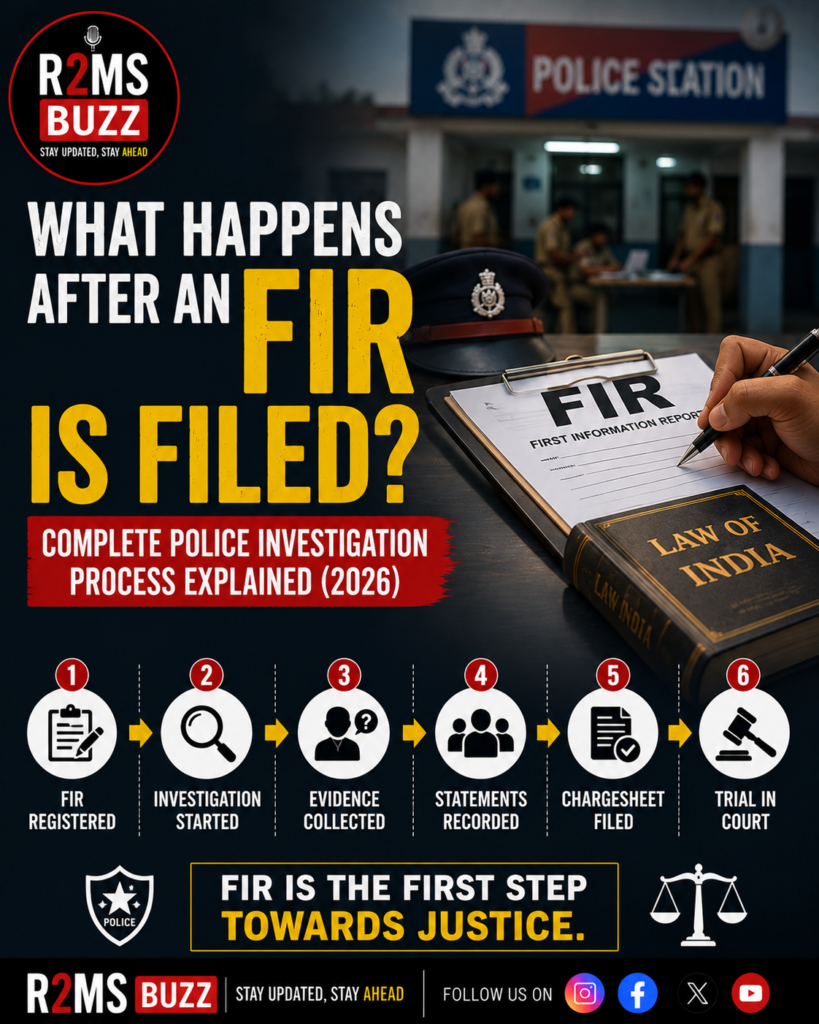
After completing the investigation, the Investigating Officer prepares a charge sheet.
A charge sheet generally contains:
- Details of the accused
- Nature of the alleged offence
- Witness list
- Documentary evidence
- Medical reports
- Forensic reports
- Seized materials
- Investigation findings
The charge sheet is submitted to the court for further proceedings.
What If Police Find No Evidence?
Not every investigation results in a charge sheet.
If investigators conclude that there is insufficient evidence or no offence is made out under the law, they may submit an appropriate final report to the court.
The court reviews the report and decides the next course of action according to law.
What Happens After the Charge Sheet?
Once the charge sheet reaches the court, the judicial process begins.
Court Process
1. Court Reviews the Charge Sheet
The judge examines whether there is sufficient material to proceed.
2. Charges May Be Framed
If the court finds sufficient grounds, formal charges may be framed against the accused.
The accused has the opportunity to understand the allegations and respond.
3. Trial Begins
The prosecution presents its evidence.
This may include:
- Witness testimony
- Documents
- Medical reports
- Forensic reports
- Digital evidence
4. Cross-Examination
The defence has the opportunity to question prosecution witnesses and challenge the evidence presented.
5. Defence Evidence
Where appropriate, the defence may produce:
- Witnesses
- Documents
- Expert opinions
- Other evidence
6. Final Arguments
Both sides present their legal arguments before the court.
7. Judgment
After considering all the evidence and arguments, the court delivers its judgment.
The court may:
- Convict the accused if guilt is proved beyond the applicable legal standard.
- Acquit the accused if the evidence is insufficient.
Rights of the Victim During Investigation
Victims have important rights during the investigation, including the ability to:
- Receive information about the progress of the case where permitted.
- Submit relevant evidence.
- Cooperate with investigators.
- Seek legal remedies available under law.
- Access victim support services where available.
Rights of the Accused
Every accused person also has legal protections, including:
- Presumption of innocence until proven guilty.
- Right to legal representation.
- Right to remain protected by due process.
- Right to a fair and impartial trial.
- Right to challenge evidence.
These safeguards are fundamental to the justice system.
Can an Investigation Be Reopened?
In certain situations, courts may permit further investigation if:
- New evidence emerges.
- Important evidence was previously overlooked.
- Additional inquiry is considered necessary under law.
Whether this happens depends on the facts of the case and judicial orders.
Common Mistakes People Make
❌ Assuming that an FIR means the accused is guilty.
❌ Sharing unverified allegations on social media.
❌ Destroying or tampering with evidence.
❌ Refusing to cooperate with lawful investigations.
❌ Believing every rumour circulated online.
Importance of Fair Investigation
A fair investigation protects:
- Victims
- Witnesses
- Accused persons
- Society
The objective is to establish facts based on evidence rather than assumptions or public opinion.
Timeline of a Criminal Case
| Stage | Process |
|---|---|
| 1 | FIR Registered |
| 2 | Investigation Begins |
| 3 | Crime Scene Examined |
| 4 | Evidence Collected |
| 5 | Witness Statements Recorded |
| 6 | Medical & Forensic Reports |
| 7 | Arrest (if legally justified) |
| 8 | Charge Sheet Filed |
| 9 | Court Trial |
| 10 | Final Judgment |
Frequently Asked Questions (FAQs)
How long does a police investigation take?
The duration depends on the complexity of the case, availability of evidence, and applicable legal procedures. Some investigations conclude quickly, while others may take considerably longer.
Does an FIR always lead to arrest?
No. Arrest depends on the facts, evidence, legal provisions, and the circumstances of the case.
Can police investigate without an FIR?
Certain inquiries may be conducted depending on the nature of the information received, but investigations into cognizable offences generally begin through the legal process applicable to such offences.
What is a charge sheet?
A charge sheet is the investigation report submitted by the police to the court after completing the investigation.
Can a case continue without witnesses?
Every case depends on its own evidence. Courts consider all admissible evidence, including documentary, scientific, medical, digital, and witness evidence.
Can CCTV footage become evidence?
Yes. CCTV footage may be used as evidence if collected and produced in accordance with applicable legal requirements.
What happens if the accused is found innocent?
If the court concludes that the prosecution has not proved its case according to the required legal standard, the accused may be acquitted.
What happens after acquittal?
An acquittal concludes the proceedings unless an appeal or other legal remedy is pursued as permitted by law.
Can police investigate old cases?
Yes. The legal position depends on the nature of the offence, available evidence, and applicable law.
Why is forensic evidence important?
Forensic evidence provides scientific analysis that can help investigators and courts assess the facts of a case.
Conclusion
The filing of an FIR marks the beginning—not the end—of the criminal justice process. From crime scene examination and evidence collection to forensic analysis, charge sheets, and court proceedings, each stage is designed to help establish the facts fairly and lawfully.
Understanding this process helps citizens appreciate that investigations are evidence-based and that courts ultimately determine guilt or innocence. Awareness of both victims’ rights and the rights of the accused is essential for maintaining confidence in the justice system.
Also See Related Article FIR Meaning, Government Corruption Case,Disproportionate Assets Case, How Does an FIR Work in India