
How Do Criminal Trials Work in India?
Every day, newspapers and television channels report that a person has been arrested, granted bail, or convicted by a court. However, many people are unfamiliar with what happens between the registration of an FIR and the final judgment.
A criminal trial is the legal process through which a court examines evidence, hears both the prosecution and the defence, and determines whether the accused is guilty according to law. The purpose of a criminal trial is not only to punish offenders but also to ensure that innocent people are not wrongly convicted.
This guide explains the complete criminal trial process in India in simple language.
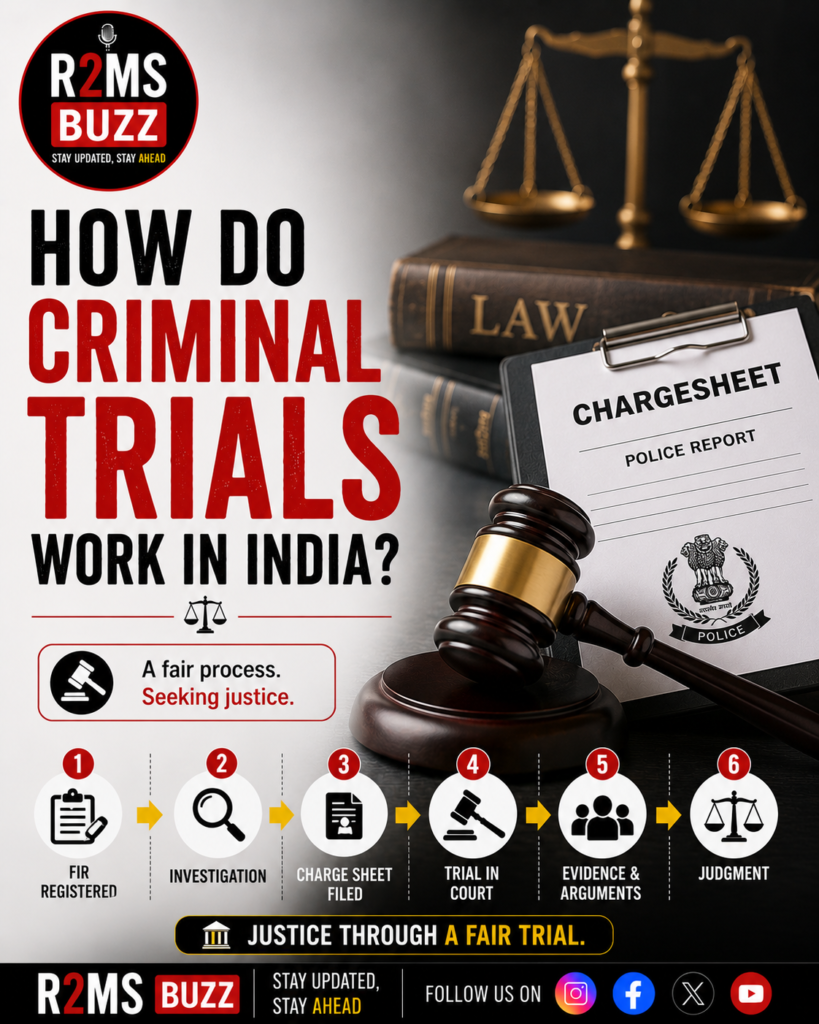
Quick Overview of a Criminal Trial
| Stage | Process |
|---|---|
| 1 | FIR Registered |
| 2 | Police Investigation |
| 3 | Evidence Collection |
| 4 | Arrest (if legally justified) |
| 5 | Charge Sheet Filed |
| 6 | Court Takes Cognizance |
| 7 | Charges Framed |
| 8 | Trial Begins |
| 9 | Evidence & Witnesses |
| 10 | Final Arguments |
| 11 | Judgment |
| 12 | Appeal (where applicable) |
What Is a Criminal Trial?
A criminal trial is a judicial proceeding in which a court examines allegations that a person has committed a criminal offence.
During the trial, the court:
- Examines evidence.
- Hears witness testimony.
- Reviews expert reports.
- Considers legal arguments.
- Applies the relevant law.
The court then decides whether the prosecution has proved its case according to the required legal standard.
Why Is a Criminal Trial Necessary?
A criminal trial helps ensure that justice is delivered fairly.
It protects:
- Victims.
- Witnesses.
- Accused persons.
- Society.
Without a proper trial, criminal cases would be decided based on assumptions instead of evidence.
Step 1: FIR Registration
Most criminal cases begin with the registration of an FIR relating to a cognizable offence.
The FIR records:
- Date and time of the incident.
- Nature of the offence.
- Details of the complainant.
- Basic facts of the case.
The FIR starts the investigation but does not determine guilt.
Step 2: Police Investigation
After the FIR is registered, the police begin investigating the case.
The investigation may include:
- Visiting the crime scene.
- Collecting evidence.
- Recording witness statements.
- Conducting medical examinations.
- Obtaining forensic reports.
- Examining digital evidence.
- Questioning suspects.
The objective is to discover the truth through lawful investigation.
Step 3: Arrest (Where Necessary)
Not every FIR leads to an arrest.
Police decide whether an arrest is necessary based on:
- Applicable law.
- Available evidence.
- Nature of the offence.
- Risk of absconding.
- Need for custodial investigation.
Every arrest must follow legal procedures.
Step 4: Bail Proceedings
After arrest, the accused may apply for bail where permitted by law.
The court considers:
- Seriousness of allegations.
- Evidence available.
- Investigation status.
- Risk of influencing witnesses.
- Other relevant factors.
Granting bail does not determine guilt or innocence.
Step 5: Filing of the Charge Sheet
After completing the investigation, the police prepare and submit a charge sheet before the competent court.
The charge sheet generally includes:
- Investigation findings.
- Witness list.
- Medical reports.
- Forensic evidence.
- Documentary evidence.
- Relevant legal provisions.
This report helps the court understand the investigation.
Step 6: Court Takes Cognizance
The court examines the charge sheet and supporting material.
If the court finds sufficient grounds to proceed, it takes cognizance of the case.
This means the court formally begins judicial proceedings.
It is not a declaration that the accused is guilty.
Step 7: Framing of Charges
The court studies the evidence presented by the prosecution.
If appropriate, it frames formal charges and explains them to the accused.
The accused is asked whether they:
- Plead guilty, or
- Wish to contest the charges.
Most contested cases proceed to trial.
Common Myths
Myth: Criminal trials begin immediately after an FIR.
Fact: Several stages—including investigation and filing of the charge sheet—usually occur before the trial begins.
Myth: Bail means the trial ends.
Fact: The trial continues even if the accused is granted bail.
Myth: Police decide the punishment.
Fact: Only the court decides guilt and punishment after evaluating all the evidence.
Myth: Media reports decide the case.
Fact: Courts decide criminal cases based on evidence presented during the trial, not on media coverage.
Step 8: Prosecution Presents Evidence
Once charges are framed, the trial formally begins.
The prosecution is responsible for presenting evidence to prove its case. This may include:
- Eyewitness testimony
- Documentary evidence
- CCTV footage
- Medical reports
- Forensic reports
- Digital evidence
- Expert opinions
- Seized articles
The prosecution must establish its case before the court according to the legal standard required in criminal trials.
Step 9: Examination of Witnesses
Witnesses are a vital part of most criminal trials.
The prosecution may call:
- Victims
- Eyewitnesses
- Police officers
- Medical professionals
- Forensic experts
- Independent witnesses
Each witness gives evidence under oath before the court.
The judge carefully observes:
- Consistency
- Credibility
- Accuracy
- Conduct of the witness
Step 10: Cross-Examination
After the prosecution examines a witness, the defence lawyer has the right to cross-examine them.
Cross-examination helps the court determine:
- Whether statements are consistent.
- Whether there are contradictions.
- Whether the witness is reliable.
- Whether the testimony is supported by other evidence.
This process is one of the most important safeguards in a fair trial.
Step 11: Defence Evidence
After the prosecution completes its evidence, the defence may present its case.
The defence may produce:
- Witnesses
- Documents
- Expert opinions
- Electronic evidence
- Medical reports
- Other admissible material
It is important to remember that the prosecution bears the burden of proving the charges according to law.
Step 12: Final Arguments
Once all evidence has been recorded, both parties present their final arguments.
Prosecution
The prosecution explains:
- Why the evidence supports the charges.
- How the legal requirements are met.
Defence
The defence argues:
- Why the evidence may be insufficient.
- Why reasonable doubt may exist.
- Why the accused should not be convicted.
The judge considers both sides before delivering a judgment.
Step 13: Judgment
After reviewing the entire record, the court delivers its judgment.
The court may:
- Convict the accused.
- Acquit the accused.
- Pass any other order permitted by law.
A conviction is based on the evidence and applicable legal principles—not on public opinion or media reports.
Step 14: Sentencing
If the accused is convicted, the court proceeds to determine the appropriate sentence.
The sentence depends on:
- The offence proved.
- The applicable law.
- The facts of the case.
- Aggravating and mitigating circumstances.
Sentences vary depending on the nature and seriousness of the offence.
Step 15: Appeal
A party dissatisfied with the judgment may have the right to challenge it before a higher court, subject to the applicable law.
The appellate court may:
- Uphold the judgment.
- Modify the judgment.
- Set aside the judgment.
- Order a fresh trial where legally justified.
Appeals are an important safeguard in the justice system.
Rights of the Victim During Trial
Victims have important legal rights during criminal proceedings.
Depending on the applicable law, they may:
- Be informed of significant developments.
- Participate where permitted.
- Seek compensation where applicable.
- Present relevant information through lawful procedures.
- Receive protection in appropriate cases.
Rights of the Accused During Trial
Every accused person is entitled to a fair trial.
These rights generally include:
- Presumption of innocence until proven guilty.
- Right to legal representation.
- Right to know the charges.
- Right to cross-examine witnesses.
- Right to present evidence.
- Right to appeal where permitted.
These safeguards are fundamental to ensuring justice.
Importance of Evidence
Courts decide criminal cases based on evidence—not rumours or speculation.
Evidence may include:
Documentary Evidence
- Agreements
- Financial records
- Official documents
Medical Evidence
- Injury reports
- Post-mortem reports
- Medical certificates
Digital Evidence
- CCTV footage
- Mobile phone records
- Emails
- Social media content
- GPS records
Scientific Evidence
- DNA analysis
- Fingerprints
- Ballistic reports
- Cyber forensic reports
Common Reasons Criminal Trials Take Time
The duration of a criminal trial varies.
Factors include:
- Number of accused persons.
- Number of witnesses.
- Complexity of evidence.
- Forensic examinations.
- Court workload.
- Adjournments.
- Appeals and other legal proceedings.
Complex cases involving multiple accused or extensive evidence may take considerably longer.
Common Misconceptions
Myth: An FIR means the accused will definitely be convicted.
Fact: An FIR only begins the investigation. Conviction depends on the evidence presented during the trial.
Myth: Bail ends the criminal case.
Fact: Bail allows temporary release from custody while the case continues.
Myth: Media reports determine guilt.
Fact: Only a court can determine guilt after examining admissible evidence.
Myth: A charge sheet guarantees conviction.
Fact: A charge sheet is an investigation report. The court independently evaluates all the evidence before reaching a decision.
Why Criminal Trials Matter
Criminal trials help ensure that:
- Innocent people are protected from wrongful conviction.
- Victims receive an opportunity to seek justice.
- Evidence is examined fairly.
- Both sides are heard.
- Judicial decisions are based on law.
A fair trial strengthens public confidence in the justice system.
Frequently Asked Questions (FAQs)
What is the purpose of a criminal trial?
A criminal trial allows the court to examine evidence and determine whether the prosecution has proved the charges according to law.
Who conducts a criminal trial?
Criminal trials are conducted by the competent criminal courts.
Can a criminal trial begin without an FIR?
Some criminal proceedings may begin through other lawful procedures depending on the nature of the offence, but many cognizable offences start with an FIR.
What happens if the accused pleads guilty?
The court follows the procedure prescribed by law before passing appropriate orders.
Can witnesses change their statements?
Witnesses are expected to tell the truth under oath. If there are inconsistencies, the court evaluates them along with the other evidence.
Can new evidence be produced during trial?
Subject to legal rules and court permission where required, additional evidence may be produced in appropriate circumstances.
What happens after conviction?
If convicted, the court imposes a sentence according to the applicable law. The convicted person may have legal remedies such as an appeal.
Can an acquitted person be tried again?
The legal position depends on constitutional protections, statutory provisions, and the facts of the case.
Why are forensic experts called to court?
They explain scientific findings and may clarify technical evidence for the court.
How long does a criminal trial usually take?
There is no fixed duration. The timeline depends on the complexity of the case, evidence, witnesses, and court proceedings.
Conclusion
A criminal trial is the foundation of India’s justice system. It ensures that allegations are tested through evidence, witness testimony, legal arguments, and judicial scrutiny rather than assumptions or public opinion. From the registration of an FIR to the final judgment and any subsequent appeal, every stage is designed to protect the rights of both victims and accused persons while ensuring that justice is delivered according to law.
Understanding the criminal trial process helps readers interpret legal news more accurately and appreciate the importance of due process, fairness, and evidence-based decision-making.
Also see related article Charge Sheet Process, How Does an FIR Work in India?, What Happens After an FIR Is Filed?, Anticipatory Bail, Difference Between Murder and Culpable Homicide