
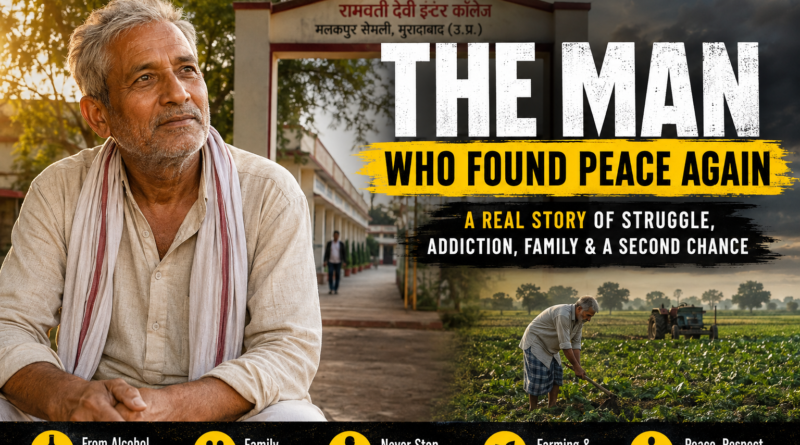
The Man Who Found Peace Again
A Real-Life Inspired Story of Lal Bahadur Shastri, Struggle, Addiction, Family, and a Second Chance
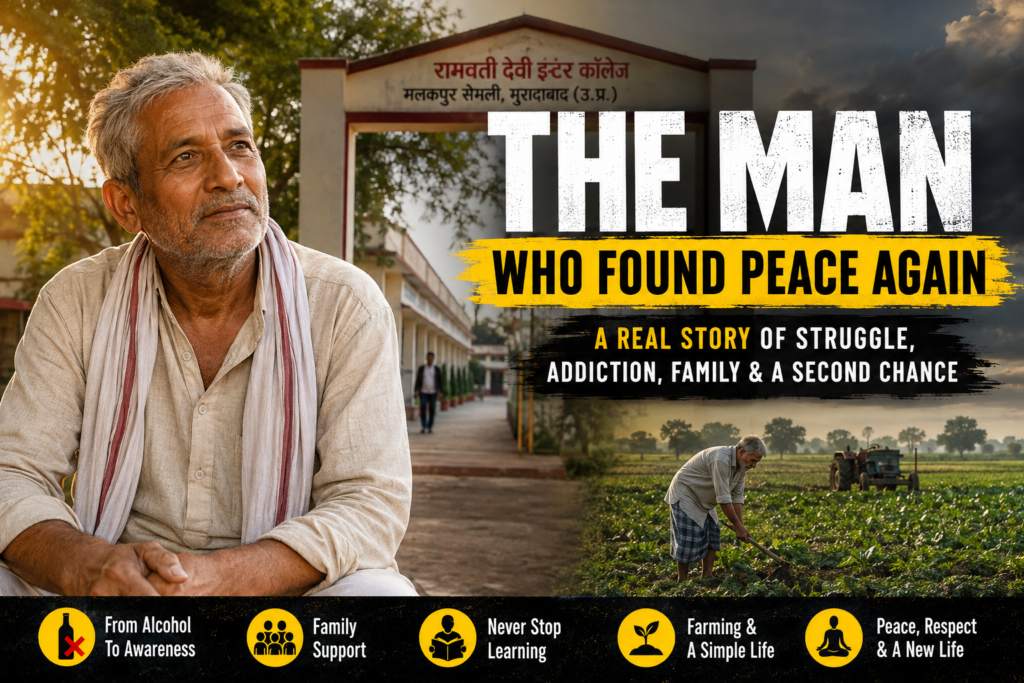
“Sometimes a person doesn’t need a new life. They just need someone to remind them that their old life can still be changed.”
Chapter 1 — The Man Who Lived Between Two Worlds
At around sixty years of age, Lal Bahadur Shastri had already lived through more than most people could imagine.
He had spent his early years in Bihar before circumstances brought his family to Moradabad, Uttar Pradesh.
His family eventually settled there.
They had agricultural land.
Not just a small piece of farmland, but land that had become extremely valuable over the years.
On paper, the land could have been worth crores.
But Lal Bahadur Shastri didn’t want to sell it.
For families rooted in villages, agricultural land isn’t always viewed simply as an asset.
It is identity.
It is security.
It is something passed from one generation to the next.
“Land can be worth crores,” people often say, “but once you sell it, you can’t get the same land back.”
Shastri Ji believed in that idea.
So the land remained.
He continued his agricultural work and somehow managed to keep his family going.
But there was another part of his life that was slowly destroying everything.
Alcohol.
Chapter 2 — When Alcohol Became a Habit
There was a time when drinking wasn’t an occasional activity for Shastri Ji.
It had become a part of his everyday life.
Almost every day, he would drink.
Sometimes he would drink locally made alcohol.
Sometimes he would drink until he could no longer control himself.
There were nights when he would collapse somewhere on the road.
Sometimes he would be found lying in a field or somewhere outside.
And sometimes he would return home intoxicated and create arguments.
His health was deteriorating.
His relationship with his family was deteriorating.
And his money was disappearing.
Every day seemed to follow the same pattern:
Earn something.
Drink.
Fight.
Sleep.
Repeat.
His family had become exhausted.
His wife was tired of seeing the same thing happen again and again.
His sons were frustrated.
But Shastri Ji seemed trapped inside the cycle.
Chapter 3 — A Family Slowly Falling Apart
Shastri Ji had a wife, two sons, and a daughter.
His daughter eventually got married.
His elder son also got married and started his own family.
Eventually, the family property was divided.
Whatever was supposed to go to the elder son went to him.
Whatever was kept for the younger son remained with him.
The family had technically moved forward.
But emotionally, things weren’t so simple.
As Shastri Ji’s drinking became worse, his family’s patience became thinner.
His regular income also reduced after the division of property.
The agricultural income that belonged to different family members was now divided.
His own financial situation became increasingly difficult.
And there was another problem.
His wife had become extremely strict about money.
She didn’t want to hand money to him because she knew what might happen to it.
She feared that the money would simply disappear into alcohol.
So Shastri Ji found himself in a strange position.
He owned valuable agricultural land.
But he had very little money available for everyday life.
His health was declining.
His family relationships were strained.
And his drinking continued.
Chapter 4 — The School That Became a Turning Point
Near the agricultural land was Ramwati Devi Inter College.
The school had a connection with Shastri Ji.
He knew the school owner and his family.
They knew him.
They had spoken to him many times.
The school already had someone who stayed there at night.
But as Shastri Ji’s situation became worse, the school owner decided to help him.
He told him:
“Shastri Ji, come and stay at the school.”
It wasn’t charity in the traditional sense.
The arrangement gave Shastri Ji a place to stay at night, some work to do, and an income.
Most importantly, it gave him something he had been missing:
A routine.
Chapter 5 — One Conversation Can Change a Life
The school owner’s family had known Shastri Ji for some time.
They understood his situation.
One day, his father sat down and spoke to him seriously.
He didn’t insult him.
He didn’t humiliate him.
He simply tried to explain what alcohol was doing to his life.
“Shastri Ji, drinking isn’t going to solve anything.”
“If you can’t stop completely, at least reduce it.”
“Don’t drink every day.”
“You have a family. You have children. You have land. You have a life.”
The words weren’t magical.
Shastri Ji didn’t suddenly become a completely different person overnight.
But something had changed.
Someone was still willing to believe that he could change.
And that mattered.
Chapter 6 — The First Small Change
Shastri Ji gradually started reducing his drinking.
It wasn’t an overnight transformation.
There were still difficult days.
But instead of drinking every day, he began drinking occasionally.
Once or twice a week.
Then less.
The difference was enormous.
The money that once disappeared into alcohol began staying in his pocket.
The arguments at home reduced.
His health slowly began improving.
His mind became clearer.
And the man who had once been found lying outside after drinking began spending his nights at the school.
He had a bed.
He had work.
He had people around him.
He had somewhere he was expected to be.
That simple routine started rebuilding his life.
Chapter 7 — The Unexpected Trauma
Just when life began becoming more stable, another difficult situation came into the family.
Shastri Ji’s granddaughter was only around 16–17 years old.
She became involved with a significantly older man, reportedly around 35, and eventually married him.
For a grandfather already dealing with years of family problems, this was another major emotional shock.
The family went through a difficult period.
There were questions.
There was worry.
There was emotional pain.
But by this point, Shastri Ji had already started changing.
Instead of returning completely to his old habits, he continued staying at the school.
He continued working.
He continued reducing his drinking.
The school became a kind of second home.
Chapter 8 — A Different Kind of Family
The relationship between Shastri Ji and the school owner’s family gradually became stronger.
The owner’s sons would talk to him.
They would sit with him.
They would listen to him.
Sometimes they would bring him good food from home.
Sometimes they would cook something special.
Sometimes they would simply sit and talk.
It might sound like a small thing.
But for someone who had spent years surrounded by conflict, these ordinary moments mattered.
Shastri Ji began experiencing something he hadn’t felt for a long time:
Peace.
He wasn’t constantly worrying about where he would sleep.
He wasn’t spending every day looking for alcohol.
He wasn’t constantly fighting.
He had people who respected him.
And slowly, the man who had once seemed to be destroying his own life began looking like himself again.
Chapter 9 — The Mind That Never Stopped Learning
There was something surprising about Shastri Ji.
Despite his age and everything he had gone through, his curiosity never disappeared.
He followed the news.
He knew what was happening around him.
He could speak Hindi well.
He had a strong understanding of geography and many general topics.
And most importantly, he still wanted to learn.
Many people believe that after reaching sixty, a person should simply stop trying new things.
Shastri Ji didn’t think that way.
His attitude was closer to:
“I still have time to learn.”
His mind was active.
He asked questions.
He talked to people.
He listened.
He stayed updated.
The years of drinking had damaged his health and relationships.
But they had not destroyed his curiosity.
And that curiosity became another part of his recovery.
Chapter 10 — From Surviving to Living
There is a difference between surviving and living.
For years, Shastri Ji had simply been surviving.
Drink.
Work.
Fight.
Sleep.
Repeat.
There was no real peace.
But now his days had structure.
He worked at the school.
He stayed there at night.
He continued farming.
The agricultural land still provided him with an additional source of income.
His drinking had reduced dramatically.
His family situation became calmer.
And his relationship with the people around him improved.
He could sit down and have a normal conversation.
He could laugh.
He could eat good food.
He could talk about current events.
He could discuss geography.
He could simply enjoy an ordinary evening.
For the first time in years, life didn’t feel like a battle.
Chapter 11 — The Land He Never Sold
Interestingly, the same land Shastri Ji had refused to sell remained an important part of his life.
The school was located near that land.
The school itself would have liked to acquire the property.
But its budget wasn’t enough.
Shastri Ji also wasn’t interested in selling it cheaply.
There was an emotional connection to the land.
It represented his family’s history.
His father’s legacy.
His children’s future.
So the land remained where it was.
And Shastri Ji continued farming.
He didn’t need to sell everything to survive.
He learned to make a living from what he already had.
Chapter 12 — A Man Who Got a Second Chance
Today, Shastri Ji’s life looks very different from the life he once lived.
He is around sixty.
One son is still unmarried.
His children have their own families.
His agricultural work continues.
He earns from farming.
He has a place to stay.
He has work.
He has people around him who respect him.
And most importantly, he has regained a sense of peace.
His past hasn’t disappeared.
The years of alcohol abuse cannot simply be erased.
The family conflicts cannot be forgotten.
The difficult memories will always remain part of his story.
But they no longer control his entire life.
Chapter 13 — The Real Change
Perhaps the biggest change wasn’t that Shastri Ji stopped drinking every day.
The biggest change was that he started believing that his life could still improve.
He was already around sixty.
He could have said:
“अब क्या सीखना है?”
“अब क्या बदलना है?”
“अब तो जिंदगी निकल गई।”
But he didn’t.
Instead, something inside him remained alive.
The desire to learn.
The desire to work.
The desire to talk.
The desire to live peacefully.
And that is perhaps the most inspiring part of his story.
The Moral of the Story
Shastri Ji’s story teaches us that age doesn’t decide whether a person can change.
Sometimes all a person needs is:
- Someone who believes in them.
- A safe environment.
- A daily routine.
- Meaningful work.
- People who treat them with dignity.
- And, most importantly, the willingness to change.
His life once felt like a never-ending cycle of alcohol, arguments and uncertainty.
But slowly, that cycle was broken.
Not in one day.
Not through a miracle.
But through small decisions made repeatedly.
He reduced his drinking.
He started working.
He continued farming.
He became more connected with people.
He started enjoying learning again.
And little by little…
his life came back on track.
A New Chapter
Shastri Ji still has responsibilities.
One son is yet to be married.
The agricultural work continues.
Life is not perfect.
But perhaps life doesn’t have to be perfect to be peaceful.
Sometimes, having a roof over your head, meaningful work, people who respect you, a little income, good food, and a mind that still wants to learn…
is already a lot.
And perhaps that is the real ending of Shastri Ji’s story:
He didn’t become a different person.
He simply found his way back to the person he could have been.
His story isn’t really about alcohol.
It’s about a second chance.
And sometimes…
a second chance is all a person needs.
Also See Some related Stories From Struggle to Success: The Inspiring Story of a Village Plumber, Kasis: A Journey from Love and Lost Dreams to Strength and Success, The Night That Changed Everything, ❤️ ARJUN & ANANYA, Rickshaw Driver’s Son IAS