
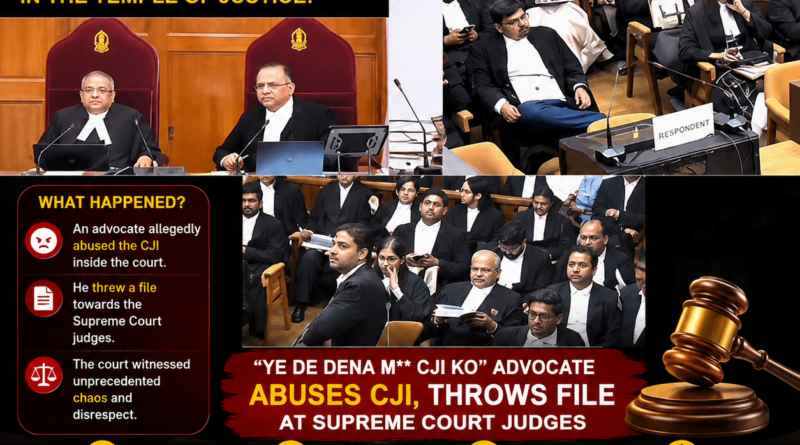
Alleged Disruption During Supreme Court Proceedings Sparks Debate on Courtroom Decorum and Judicial Respect
Introduction
India’s Supreme Court has long been regarded as the guardian of the Constitution and the final authority on matters of law and justice. Every proceeding inside the country’s highest court is expected to uphold the highest standards of professionalism, discipline, and respect. Recently, social media has been flooded with posts claiming that an advocate allegedly used abusive language toward the Chief Justice of India (CJI) and threw a file during court proceedings, leading to widespread public discussion.
The incident, if accurately reported, has sparked debate about courtroom conduct, legal ethics, and the responsibilities of advocates appearing before constitutional courts. At the same time, it is important to note that claims circulating on social media may not always present the complete picture. Readers should rely on official court records or credible news reports for verified details.
What the Viral Claims Say
According to viral social media posts, an advocate allegedly created a disturbance during proceedings before the Supreme Court by engaging in inappropriate behaviour toward the bench. The posts claim that abusive remarks were directed at the Chief Justice and that a file was thrown in the courtroom.
These allegations have quickly spread across digital platforms, generating strong reactions from legal professionals, students, and the general public.
However, the exact sequence of events and the legal proceedings surrounding the incident should be understood through verified reporting rather than social media alone.
Why Courtroom Decorum Matters
Courtrooms function according to established rules designed to ensure fairness, impartiality, and orderly proceedings.
Every participant—including judges, lawyers, litigants, and court staff—is expected to maintain professional conduct.
Courtroom decorum generally includes:
- Respectful communication
- Following judicial instructions
- Presenting legal arguments professionally
- Avoiding disruptive behaviour
- Maintaining discipline during hearings
These principles help ensure that justice is delivered efficiently and fairly.
The Role of Advocates
Advocates are officers of the court. While they are expected to defend their clients fearlessly, they are also required to uphold the dignity of the judicial system.
Professional responsibilities include:
- Respecting the bench
- Presenting arguments based on law
- Maintaining ethical conduct
- Following the Bar Council’s professional standards
- Protecting the integrity of judicial proceedings
Strong legal arguments are encouraged, but personal attacks or disorderly conduct have no place in courtroom proceedings.
Importance of Judicial Independence

India’s judiciary plays an essential role in protecting constitutional rights and ensuring the rule of law.
Judicial independence depends not only on constitutional safeguards but also on maintaining public confidence in the legal system.
Respect for judicial institutions does not prevent criticism of judgments or legal reasoning. However, criticism is expected to remain within the framework of law, ethics, and democratic values.
Legal Consequences of Courtroom Misconduct
If any individual engages in behaviour that disrupts court proceedings, several legal mechanisms may apply depending on the facts of the case.
Possible actions can include:
- Removal from the courtroom
- Disciplinary proceedings
- Professional action by legal authorities
- Proceedings under applicable laws, including contempt provisions where appropriate
Any action is taken only after following due legal process.
Reactions From the Legal Community
Reports of alleged courtroom disruptions often attract significant attention within the legal fraternity.
Senior advocates generally emphasize that:
- Courts must remain places of dignity.
- Lawyers should maintain professional ethics.
- Differences in legal opinion should be expressed respectfully.
- Judicial institutions deserve protection from unnecessary disruption.
Many legal experts also stress that lawyers have an important responsibility to set positive examples for younger members of the profession.
Social Media and Viral Information
In today’s digital environment, incidents involving public institutions spread rapidly across social media.
Unfortunately, viral posts sometimes:
- Omit important context.
- Contain edited videos.
- Present incomplete information.
- Exaggerate events.
- Spread unverified claims.
For this reason, readers should always verify information through official court records, statements from authorized authorities, or established news organizations before forming conclusions.
Respect for the Rule of Law
India’s legal system functions on the principle that disputes should be resolved through constitutional processes rather than confrontation.
The rule of law requires every participant to respect:
- Judicial procedures
- Constitutional institutions
- Legal ethics
- Professional standards
- Due process
Maintaining discipline inside courtrooms protects not only judges but also litigants seeking justice.
Freedom of Expression and Professional Responsibility
Advocates enjoy the freedom to argue cases vigorously and challenge legal interpretations.
However, this freedom carries corresponding professional responsibilities.
Legal advocacy is expected to remain:
- Fact-based
- Respectful
- Ethical
- Focused on legal issues
- Consistent with courtroom rules
Strong disagreement with judicial reasoning can be expressed through legal arguments, appeals, and constitutional remedies rather than disruptive behaviour.
Public Confidence in the Judiciary
The credibility of any judicial system depends heavily on public trust.
When court proceedings remain orderly and transparent, citizens are more likely to believe that justice is being administered fairly.
For this reason, preserving the dignity of constitutional institutions remains an important responsibility shared by judges, lawyers, litigants, and society as a whole.
Awaiting Verified Information
If an incident of this nature occurred, official records, court orders, or statements from the relevant authorities will provide the most reliable account.
Until then, it is advisable to avoid drawing conclusions based solely on viral social media posts or edited graphics.
Responsible journalism requires separating verified facts from allegations.
Conclusion
The viral claims regarding alleged misconduct during Supreme Court proceedings have generated widespread discussion about courtroom discipline, judicial dignity, and professional ethics within the legal community. Regardless of the specific facts—which should be established through official sources—the incident has reminded the public of the importance of maintaining respect for constitutional institutions and the rule of law.
India’s judiciary remains one of the pillars of the country’s democratic framework. Advocates, judges, and citizens all play a role in preserving the integrity of the justice system. As more verified information becomes available, discussions should continue to be guided by facts, legal principles, and respect for due process rather than speculation.