
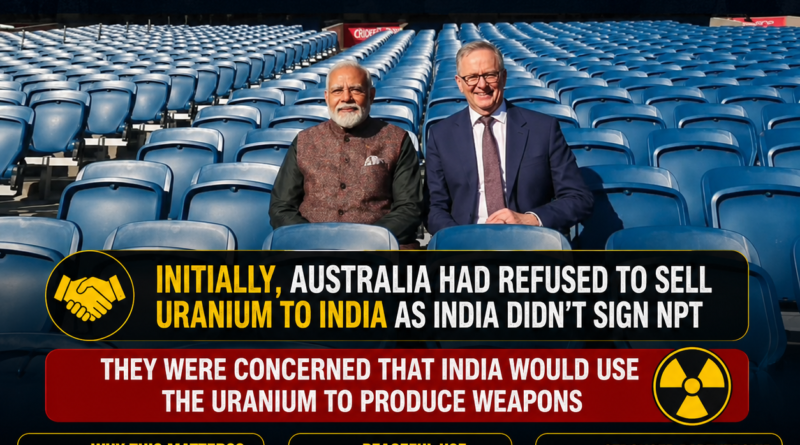
Australia Agrees to Supply Uranium to India for Peaceful Purposes
Introduction
Australia and India have continued to strengthen their strategic partnership over the past decade, expanding cooperation in trade, defence, education, critical minerals, and clean energy. One of the most significant milestones in this growing relationship has been Australia’s decision to supply uranium to India for peaceful civilian purposes under strict international safeguards.
The agreement reflects growing trust between the two democracies while supporting India’s long-term clean energy goals. Since India is among the world’s fastest-growing economies, the country’s demand for reliable and low-carbon electricity continues to rise. Nuclear energy has emerged as an important component of India’s strategy to meet future energy needs while reducing carbon emissions.
Australia, home to some of the world’s largest uranium reserves, plays a vital role in the global nuclear fuel market. The cooperation between the two nations represents not only an energy partnership but also a broader strategic alignment in the Indo-Pacific region.
Background of the Agreement
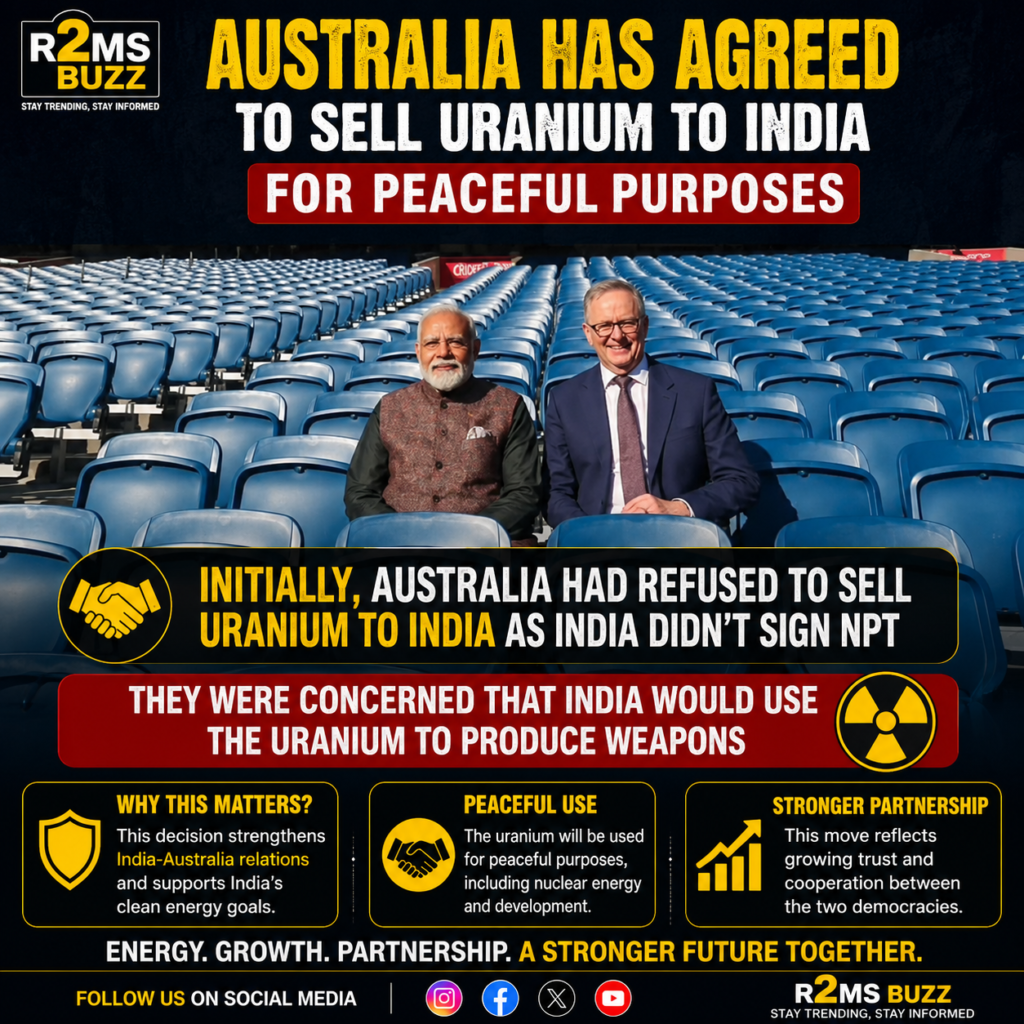
For many years, Australia did not permit uranium exports to India because India is not a signatory to the Nuclear Non-Proliferation Treaty (NPT). Australian governments maintained a policy of supplying uranium only to countries that had joined the treaty.
However, the situation changed after India received international recognition for its responsible nuclear record through the 2008 Nuclear Suppliers Group (NSG) waiver. This waiver allowed India to engage in civilian nuclear trade despite not being a member of the NPT.
Following years of diplomatic discussions, Australia signed a Civil Nuclear Cooperation Agreement with India, paving the way for uranium exports under strict monitoring and safeguards.
Why Australia Changed Its Position
Australia’s decision was based on several important considerations.
First, India has consistently maintained a strong non-proliferation record despite remaining outside the NPT framework.
Second, India agreed that Australian uranium would be used exclusively for peaceful civilian nuclear energy programmes under International Atomic Energy Agency (IAEA) safeguards.
Third, both countries have significantly expanded their strategic partnership, particularly in the Indo-Pacific region, where cooperation on security, trade, and technology has become increasingly important.
These factors helped build confidence between Canberra and New Delhi, leading to the landmark agreement.
Peaceful Use of Uranium
One of the most important aspects of the agreement is that Australian uranium is supplied solely for peaceful purposes.
This includes:
- Electricity generation through civilian nuclear power plants
- Scientific research
- Medical isotope production
- Advanced nuclear technology development
- Energy security initiatives
The agreement does not permit the use of Australian uranium for military or weapons-related purposes.
Strict accounting, inspections, and monitoring mechanisms ensure compliance with international safeguards.
Why India Needs Uranium
India’s electricity demand continues to increase due to rapid industrialization, urbanization, and population growth.
Although India possesses uranium reserves, domestic production alone is insufficient to support the country’s expanding civilian nuclear programme.
Importing uranium allows India to:
- Increase nuclear power generation
- Reduce dependence on fossil fuels
- Improve long-term energy security
- Support clean electricity production
- Lower greenhouse gas emissions
Reliable uranium supplies also help existing nuclear reactors operate more efficiently.
Australia’s Role in the Global Uranium Market
Australia holds some of the world’s largest known uranium reserves and has long been a major exporter of uranium for peaceful nuclear programmes.
Its uranium industry supplies several countries operating civilian nuclear reactors under international safeguards.
Australia’s export policies are governed by strict legal frameworks designed to ensure that nuclear materials are used only for peaceful purposes.
This reputation as a responsible supplier has strengthened Australia’s position in the global energy market.
Strengthening India-Australia Relations
The uranium agreement represents much more than an energy deal.
It reflects growing trust between India and Australia across several strategic areas.
Today, the two countries cooperate in:
- Defence and maritime security
- Trade and investment
- Critical minerals
- Cybersecurity
- Education and research
- Climate change initiatives
- Indo-Pacific regional stability
Both nations are also active members of the Quad grouping alongside the United States and Japan, promoting a free, open, and inclusive Indo-Pacific.
Nuclear Energy and India’s Climate Goals
India has committed to significantly reducing the carbon intensity of its economy while expanding renewable and clean energy.
Although solar and wind power continue to grow rapidly, nuclear energy provides an important source of stable electricity that is not dependent on weather conditions.
Nuclear power plants can generate electricity around the clock while producing very low greenhouse gas emissions during operation.
This makes nuclear energy an important complement to renewable sources in achieving long-term climate objectives.
Economic Benefits
The agreement also creates economic opportunities for both countries.
Benefits for India
- Stable uranium supply
- Improved energy security
- Increased electricity generation
- Support for industrial growth
- Reduced fuel shortages for reactors
Benefits for Australia
- Expanded export opportunities
- Stronger trade relationship
- Growth in the mining sector
- Increased strategic engagement with India
The partnership contributes to broader economic cooperation beyond the energy sector.
Safety and International Oversight
Civilian nuclear cooperation is governed by comprehensive international safeguards.
Australian uranium exports are subject to:
- International Atomic Energy Agency (IAEA) monitoring
- Bilateral agreements
- Nuclear accounting procedures
- Export control regulations
- Regular compliance verification
These mechanisms help ensure that nuclear materials remain dedicated to peaceful civilian use.
Challenges and Public Debate
Despite widespread support, nuclear energy continues to generate public discussion worldwide.
Some concerns include:
- Radioactive waste management
- High construction costs
- Long project timelines
- Safety considerations
- Environmental impact of uranium mining
Supporters argue that modern nuclear technology has become significantly safer and remains one of the most effective sources of low-carbon electricity.
Governments continue investing in improved reactor technologies and stronger safety standards.
Future of India-Australia Energy Cooperation
Energy cooperation between India and Australia is expected to expand beyond uranium.
Both countries are increasingly collaborating on:
- Green hydrogen
- Critical minerals
- Battery technology
- Renewable energy
- Rare earth supply chains
- Clean technology research
These partnerships are expected to support sustainable economic growth while strengthening regional resilience.
Strategic Importance in the Indo-Pacific
The growing partnership between India and Australia also has important geopolitical significance.
As major Indo-Pacific democracies, both countries support:
- Rules-based international order
- Maritime security
- Regional stability
- Supply chain resilience
- Economic cooperation
Their expanding partnership demonstrates shared interests in maintaining peace, security, and sustainable development across the region.
Conclusion
Australia’s decision to supply uranium to India for peaceful civilian purposes marks a significant milestone in the relationship between the two countries. The agreement reflects years of diplomatic engagement, growing mutual trust, and a shared commitment to clean energy, economic cooperation, and regional stability.
For India, reliable uranium supplies will support the expansion of civilian nuclear energy, helping meet rising electricity demand while contributing to lower carbon emissions. For Australia, the partnership strengthens its role as a trusted global supplier of uranium under strict international safeguards.
As India and Australia continue deepening cooperation across defence, trade, technology, education, and energy, this agreement serves as another example of the strong and evolving partnership between two important Indo-Pacific democracies working together for a sustainable and secure future.