
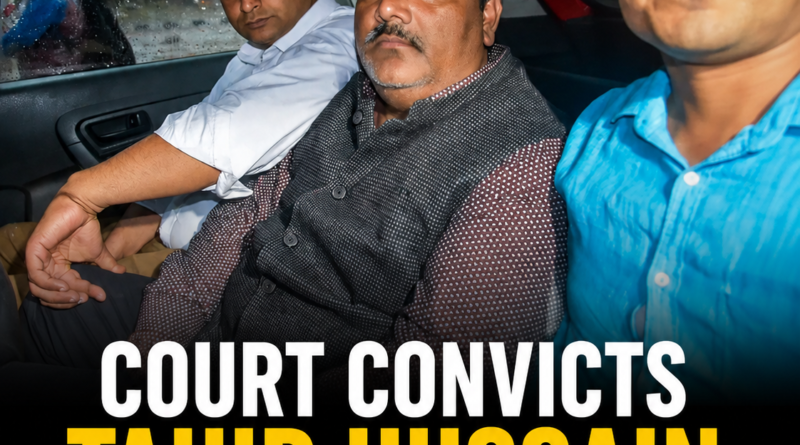
Delhi Riots 2020: Court Convicts Former AAP Councillor Tahir Hussain, Four Others in IB Officer Ankit Sharma Murder Case
Six years after one of the most widely discussed incidents during the 2020 Delhi riots, a Delhi court has delivered its verdict in the murder case of Intelligence Bureau (IB) officer Ankit Sharma. The Karkardooma Court convicted former Aam Aadmi Party (AAP) councillor Tahir Hussain and four others for their involvement in the killing, while acquitting six remaining accused due to lack of sufficient evidence.
The verdict was delivered by Additional Sessions Judge Praveen Singh, who heard the case involving 11 accused. The court found Tahir Hussain, Nazim, Qasim, Anas, and Javed guilty of offences including murder, kidnapping, rioting, and promoting enmity. The sentencing of the convicted individuals will take place in a separate hearing.
The judgment marks a significant development in one of the most sensitive criminal cases arising from the communal violence that shook northeast Delhi in February 2020.
Court Delivers Verdict After Six Years
The trial in the Ankit Sharma murder case lasted nearly six years before reaching its conclusion.
The prosecution presented witness statements, forensic reports, digital evidence, and other material collected during the investigation. After examining the evidence, the court concluded that five accused were guilty of the offences charged against them.
The remaining six accused were acquitted after the court found that the prosecution had failed to establish their guilt beyond reasonable doubt.
The verdict represents one of the major judicial outcomes related to the 2020 Delhi riots.
Who Was Ankit Sharma?
Ankit Sharma was an Intelligence Bureau (IB) officer serving with the Government of India.
According to the prosecution, Sharma returned home from work on February 25, 2020, during the violence that had engulfed parts of northeast Delhi.
Later that evening, he stepped out again but never returned home.
His disappearance led his family to begin searching for him throughout the night.
The following morning, his body was recovered from a drain near the Khajuri Khas culvert in the Chand Bagh area, one of the worst-affected locations during the riots.
His death became one of the most high-profile incidents of the violence.
Complaint Filed by Family
The case was registered at Dayalpur Police Station based on a complaint filed by Ankit Sharma’s father, Ravinder Kumar.
In his complaint, Kumar alleged that his son had been murdered by then-AAP councillor Tahir Hussain and his associates.
He claimed the accused had gathered inside Tahir Hussain’s premises before the incident and later disposed of Ankit Sharma’s body in a nearby drain.
The complaint formed the basis for the police investigation that followed.
Investigators subsequently examined witness testimonies, forensic evidence, CCTV footage, and other material during the probe.
Post-Mortem Findings
One of the important pieces of evidence presented during the investigation was the post-mortem report.
According to medical findings, Ankit Sharma’s body bore 51 external injury marks.
The injuries indicated that he had suffered multiple wounds before his death.
The medical evidence became a significant part of the prosecution’s case during the trial.
The defence, however, contested several aspects of the prosecution’s evidence throughout the proceedings.
Charges Against the Accused
The court convicted five accused under multiple provisions of criminal law.
The offences included:
- Murder
- Kidnapping
- Rioting
- Promoting enmity between communities
These charges arose from allegations connected with the communal violence that occurred during the 2020 Delhi riots.
Earlier, on March 24, 2023, the court had formally framed charges against all 11 accused after examining the investigation records.
The trial continued over the following years before the final judgment was delivered.
Six Accused Acquitted
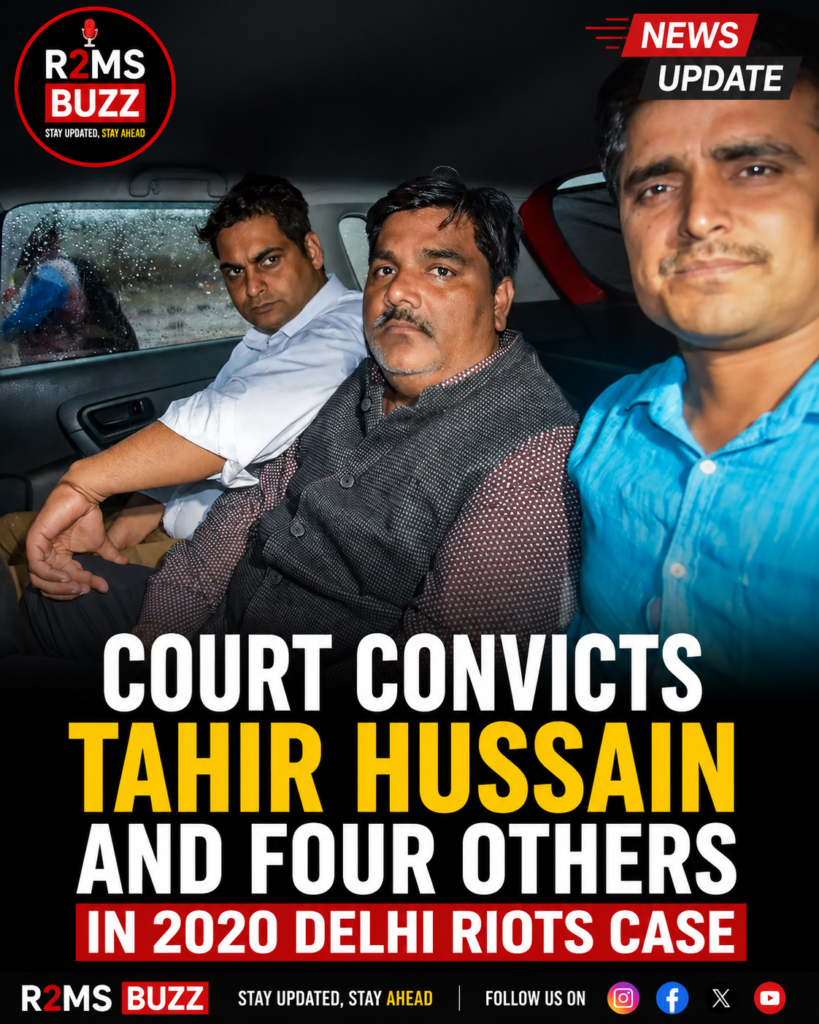
While five accused were convicted, the court acquitted six others.
Under Indian criminal law, guilt must be established beyond reasonable doubt.
Where evidence is considered insufficient, courts may acquit the accused.
The acquittals reflect the court’s assessment of the evidence presented individually against each accused rather than treating all accused persons identically.
Legal experts note that such distinctions are common in complex criminal trials involving multiple defendants.
Tahir Hussain’s Political Journey
Tahir Hussain served as an elected councillor of the Aam Aadmi Party (AAP) before the riots.
After his name surfaced during the investigation, the party suspended him.
Despite the ongoing legal proceedings, Hussain later entered electoral politics again.
During the 2025 Delhi Assembly elections, he contested the Mustafabad constituency on a ticket from the All India Majlis-e-Ittehadul Muslimeen (AIMIM).
He campaigned after obtaining custody parole from the court.
In the election, BJP candidate Mohan Singh Bisht won the seat, while Hussain finished third with approximately 33,000 votes.
Background of the Delhi Riots
The violence occurred between February 23 and February 26, 2020, during protests related to the Citizenship Amendment Act (CAA).
Supporters and opponents of the law clashed in several parts of northeast Delhi.
The situation quickly escalated into large-scale communal violence involving stone-pelting, arson, and attacks on people and property.
According to official figures:
- 53 people lost their lives
- More than 250 people were injured
- Around 800 shops were damaged or destroyed
- More than 500 houses were affected
The riots became one of the most serious episodes of communal violence witnessed in Delhi in recent decades.
Importance of Due Process
Throughout the proceedings, the court followed established criminal procedures.
The prosecution was required to establish the guilt of each accused individually through evidence.
Similarly, every accused was given an opportunity to defend themselves during the trial.
The verdict illustrates the functioning of India’s criminal justice system, where judicial findings are based on evidence presented before the court.
Any convicted individual retains the legal right to challenge the judgment before a higher court through the appellate process.
Impact of the Case
The murder of Ankit Sharma attracted nationwide attention because he was a serving Intelligence Bureau officer and because his death occurred during widespread communal violence.
The case became one of the most closely watched trials arising out of the 2020 Delhi riots.
For Sharma’s family, the verdict represents an important stage in a legal battle that has continued for several years.
For legal observers, the judgment is also significant because it demonstrates how riot-related cases involving multiple accused are examined individually through lengthy judicial proceedings.
Sentencing to Be Decided Separately
Although the court has pronounced its verdict on guilt, the sentencing process remains pending.
During the sentencing hearing, both the prosecution and defence will have an opportunity to present arguments regarding the appropriate punishment.
The court will consider factors such as:
- Nature of the offence
- Circumstances of the crime
- Applicable legal provisions
- Mitigating and aggravating circumstances
Only after that hearing will the court announce the punishment for the convicted individuals.
Legal Process Continues
The conviction does not necessarily mark the end of the legal process.
The convicted persons have the right to challenge the judgment before the Delhi High Court and, if necessary, before the Supreme Court.
Until all appeals are exhausted, the judicial process continues according to law.
Legal experts expect further proceedings depending on whether appeals are filed after sentencing.
Conclusion
The conviction of former AAP councillor Tahir Hussain and four others in the murder of IB officer Ankit Sharma marks a major development in one of the most significant cases arising from the 2020 Delhi riots. After nearly six years of investigation and trial, the Karkardooma Court found five accused guilty while acquitting six others, highlighting the court’s assessment of the evidence presented against each individual.
While the verdict answers an important phase of the criminal trial, the legal process is not yet complete. Sentencing is still pending, and the convicted individuals retain the right to appeal. The case remains an important chapter in the judicial examination of the 2020 Delhi riots and reflects the continuing efforts of the courts to address cases arising from one of the capital’s most tragic episodes of communal violence.
FAQs
1. Who was Ankit Sharma?
Ankit Sharma was an Intelligence Bureau (IB) officer who was killed during the 2020 Delhi riots.
2. Who has been convicted in the case?
The court convicted Tahir Hussain, Nazim, Qasim, Anas, and Javed.
3. How many accused were acquitted?
The court acquitted six accused after finding insufficient evidence against them.
4. What charges were proved against the convicted persons?
They were convicted of murder, kidnapping, rioting, and promoting enmity.
5. What happens next in the case?
The court will hold a separate hearing to determine the sentence, after which the convicted persons may appeal the judgment.