
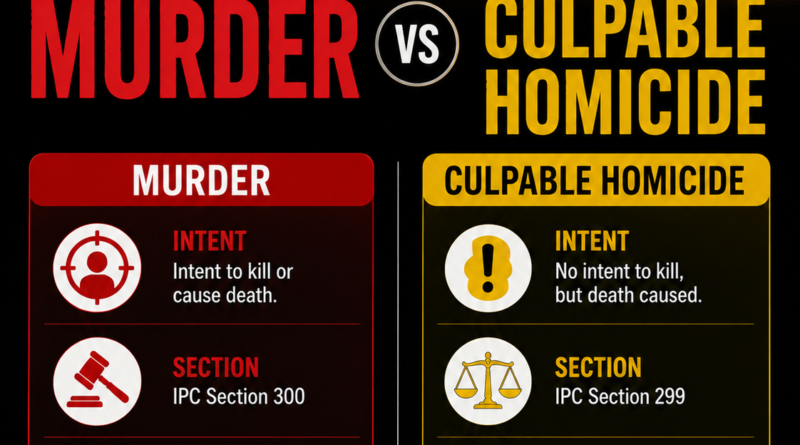
Difference Between Murder and Culpable Homicide
The terms murder and culpable homicide are frequently used in crime reports, television debates, and court proceedings. Many people assume they mean the same thing, but under Indian criminal law they are distinct concepts.
Every murder is a form of culpable homicide, but not every culpable homicide amounts to murder. The distinction depends on factors such as intention, knowledge, circumstances, and the facts proved during investigation and trial.
Understanding this difference helps readers better interpret legal news and court decisions.
What Is Homicide?
Homicide simply means the death of one person caused by another person.
However, not every homicide is a crime. Depending on the circumstances, a homicide may be:
- Lawful
- Excusable
- Justifiable
- Criminal
When the law treats the killing as a criminal act, it falls into categories such as culpable homicide or murder, depending on the facts.
What Is Culpable Homicide?
Culpable homicide generally refers to causing the death of another person through an act done with the required intention or knowledge specified under criminal law.
Whether a particular act amounts to culpable homicide depends on:
- The accused’s intention.
- The accused’s knowledge of likely consequences.
- The surrounding circumstances.
- The evidence presented before the court.
What Is Murder?
Murder is considered one of the most serious forms of criminal homicide.
A court may classify a culpable homicide as murder when the legal requirements for murder are satisfied after examining the evidence and applicable law.
Because the distinction depends on legal interpretation, courts carefully evaluate each case on its own facts.
Simple Example
Example 1: Murder
Suppose a person deliberately attacks another with a deadly weapon after planning the act and causes death.
If the evidence establishes the required legal elements, the court may treat the act as murder.
Example 2: Culpable Homicide Not Amounting to Murder
Suppose two people suddenly get into a fight. During the altercation, one person strikes the other without prior planning, and the injured person later dies.
Depending on the facts, intention, and other legal considerations, the court may conclude that the act amounts to culpable homicide not amounting to murder rather than murder.
Every case is decided individually.
Key Difference
The most important distinction lies in the degree of intention and the surrounding circumstances.
Courts examine questions such as:
- Was the act planned?
- Was there an intention to cause death?
- Was there knowledge that death was likely?
- Did the incident occur suddenly?
- Was there grave provocation?
- Was the force used excessive?
- What does the evidence show?
The answers help determine the appropriate legal classification.
Factors Courts Consider
When deciding whether an offence is murder or culpable homicide, courts may consider:
- Nature of the weapon used.
- Number of injuries.
- Place where injuries were caused.
- Conduct before and after the incident.
- Medical evidence.
- Witness testimony.
- Motive, where relevant.
- Overall circumstances.
No single factor decides the outcome.
Common Situations
The legal classification may vary in situations involving:
- Sudden fights.
- Family disputes.
- Self-defence claims.
- Group clashes.
- Road rage incidents.
- Accidental acts with criminal negligence (where applicable).
- Planned attacks.
Each case is assessed independently.
Why the Difference Matters
The distinction affects:
- The charges filed.
- The punishment that may apply.
- The legal arguments made by both sides.
- The court’s final judgment.
That is why investigators, prosecutors, defence lawyers, and judges carefully examine the evidence before reaching conclusions.
Common Myths
Myth: Every death caused by another person is murder.
Fact: The legal classification depends on the facts, evidence, and applicable law.
Myth: Police decide whether it is murder.
Fact: Police investigate and submit evidence. The court ultimately determines the appropriate legal classification.
Myth: The same punishment applies in every case.
Fact: Punishment depends on the offence proved and the relevant legal provisions.
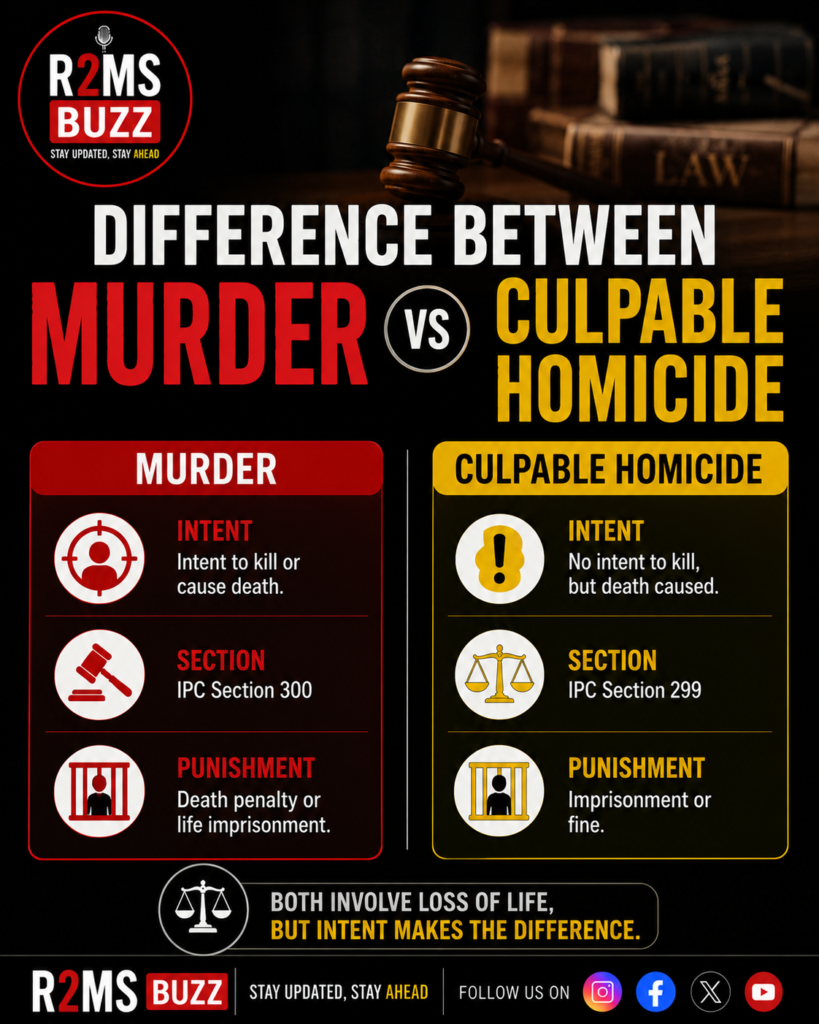
Comparison Table: Murder vs Culpable Homicide
| Basis | Murder | Culpable Homicide |
|---|---|---|
| Nature | More serious offence | Broader category of criminal homicide |
| Intention | Higher degree of intention or knowledge | Intention or knowledge may exist but legal requirements for murder may not be fully met |
| Circumstances | Usually involves more aggravated circumstances | May arise in less aggravated circumstances depending on the facts |
| Court Decision | Determined after trial | Determined after trial |
| Punishment | Depends on the applicable law and court’s decision | Depends on the applicable law and court’s decision |
Circumstances Where Culpable Homicide May Not Amount to Murder
The legal classification depends entirely on the facts of each case. Courts may consider circumstances such as:
Sudden Fight
If a death occurs during a sudden quarrel without prior planning, the court examines whether the legal ingredients of murder are established or whether the offence falls into another category.
Grave and Sudden Provocation
Where recognised by law, the surrounding circumstances—including provocation—may influence the legal classification. Courts closely examine the evidence before reaching a conclusion.
Exceeding the Right of Private Defence
A person acting in self-defence may still face legal scrutiny if the force used goes beyond what the law permits. The court evaluates whether the facts justify a different legal classification.
Sudden Heat of Passion
Incidents that occur in the heat of the moment without premeditation are assessed on their specific facts, including the conduct of everyone involved.
How Police Investigate Homicide Cases
Investigations into deaths are among the most detailed in criminal law.
Police may:
- Secure the crime scene.
- Prepare a site inspection report.
- Collect physical evidence.
- Record witness statements.
- Obtain CCTV footage.
- Examine mobile phone records where lawful.
- Conduct forensic examinations.
- Arrange a post-mortem examination.
- Consult experts where required.
The objective is to reconstruct the events accurately.
Importance of Medical Evidence
Medical evidence often plays a key role in determining:
- Cause of death.
- Nature of injuries.
- Approximate time of death.
- Possible weapon involved.
- Whether injuries were sufficient to cause death.
Medical findings are considered alongside all other evidence.
Role of Forensic Science
Modern investigations frequently rely on forensic analysis, including:
- DNA examination.
- Fingerprint comparison.
- Blood analysis.
- Ballistics (firearms).
- Digital forensics.
- Trace evidence examination.
Scientific evidence can help corroborate or challenge witness testimony.
How Courts Decide the Difference
Courts do not rely on one factor alone. They consider the entire body of evidence, including:
- Witness testimony.
- Medical reports.
- Forensic reports.
- Motive, where relevant.
- Conduct before and after the incident.
- Circumstances surrounding the occurrence.
The prosecution must establish its case according to the legal standard required in criminal trials, while the defence has the opportunity to challenge the evidence.
Why Accurate Reporting Matters
When reporting crime, it is important to avoid assuming the final legal classification before the court has considered the evidence.
News reports often use terms such as “murder” or “homicide” in everyday language, but the final legal determination is made by the court after trial.
Responsible reporting helps readers understand that investigations and trials are separate stages of the justice process.
Common Misconceptions
Myth: Every intentional killing is automatically murder.
Fact: The legal classification depends on the specific facts, evidence, and applicable law.
Myth: The police decide whether an offence is murder forever.
Fact: Police investigate and submit evidence, but the court determines the final legal classification.
Myth: Media reports decide the charges.
Fact: News reports inform the public, but judicial decisions are based on evidence presented in court.
Myth: A single witness is enough to decide every case.
Fact: Courts assess witness testimony together with documentary, medical, forensic, and other admissible evidence.
Why Understanding the Difference Is Important
Knowing the distinction helps readers:
- Understand crime reports more accurately.
- Follow court proceedings with better context.
- Avoid spreading misinformation.
- Appreciate the importance of evidence-based investigations.
- Recognize that legal conclusions are reached through judicial processes.
Frequently Asked Questions (FAQs)
What is the main difference between murder and culpable homicide?
The distinction depends on the degree of intention, knowledge, circumstances, and the legal requirements established under criminal law.
Is every culpable homicide considered murder?
No. While every murder is a form of culpable homicide, not every culpable homicide amounts to murder.
Who decides whether an offence is murder?
The court determines the appropriate legal classification after considering all the evidence.
Does an FIR decide the offence?
No. An FIR starts the investigation. The legal classification may change during investigation or trial based on the evidence.
Can charges change during a criminal case?
Yes. Depending on the evidence and court proceedings, charges may be altered according to law.
What role does forensic evidence play?
Forensic evidence provides scientific analysis that may support or challenge other evidence in the case.
Why is intention important?
The accused’s intention or knowledge is one of the key factors courts examine when determining the nature of the offence.
Can eyewitness testimony alone decide a case?
Courts consider eyewitness testimony along with all other admissible evidence.
Is every suspicious death a murder?
No. Investigators first determine the cause and circumstances of death before legal conclusions are reached.
Why should readers understand these legal terms?
Understanding these concepts helps people interpret legal news accurately and avoid misconceptions about criminal cases.
Conclusion
The distinction between murder and culpable homicide is one of the most important concepts in Indian criminal law. Although both involve the death of a person, the legal classification depends on factors such as intention, knowledge, surrounding circumstances, and the evidence presented before the court.
Rather than relying on assumptions or headlines, it is important to understand that each case is decided on its own facts. Courts examine medical reports, forensic findings, witness testimony, and other evidence before reaching a final decision. This careful approach helps ensure that justice is based on evidence and the rule of law.
Also See Related Articles Dowry Laws India,How Does an FIR Work in India?, domestic violence case, What Happens After an FIR Is Filed?