
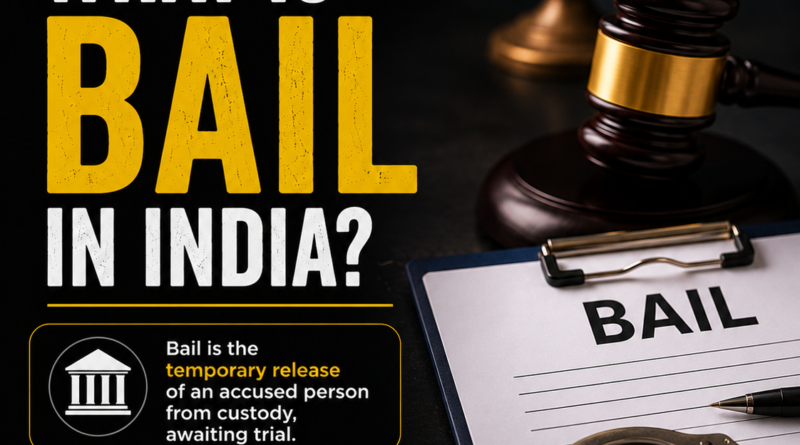
What Is Bail in India?
“Bail” is one of the most commonly used legal terms in India, especially in crime-related news. Whenever a person is arrested, people often ask, “Has the accused got bail?” or “Can the accused apply for bail?”
However, many people are unaware of what bail actually means, who can grant it, or whether every accused person is entitled to it.
Bail is a legal mechanism that allows an accused person to remain out of custody while the criminal case continues, subject to the conditions imposed by the court or the applicable legal authority. Granting bail does not mean that the accused has been declared innocent. Likewise, refusal of bail does not amount to a finding of guilt.
The purpose of bail is to balance the individual’s liberty with the need to ensure a fair investigation and trial.
Quick Facts About Bail
| Particular | Details |
|---|---|
| Meaning | Temporary release of an accused person from custody, subject to legal conditions |
| Granted By | Court or, in certain cases, the police as permitted by law |
| Applicable Law | Bharatiya Nagarik Suraksha Sanhita (BNSS), 2023 |
| Purpose | To ensure liberty while the legal process continues |
| Final Decision | Guilt or innocence is decided only after trial |
Why Does the Bail System Exist?
The Indian criminal justice system follows the principle that every accused person is presumed innocent until proven guilty.
Because criminal trials may take time, bail exists to ensure that people are not unnecessarily kept in custody while their cases are being investigated or tried, unless the law and circumstances justify continued detention.
Courts also consider factors such as:
- Nature and seriousness of the alleged offence.
- Possibility of the accused absconding.
- Risk of influencing witnesses.
- Possibility of tampering with evidence.
- Need for custodial investigation.
Every bail application is decided on its own facts.
What Happens After an Arrest?
After a lawful arrest, the accused is generally informed of the grounds for arrest and produced before the appropriate judicial authority within the time prescribed by law.
Depending on the nature of the offence, the accused may:
- Be released on bail if legally permissible.
- Apply for bail before the competent court.
- Remain in judicial or police custody if bail is not granted.
Types of Bail in India
Indian law recognises different forms of bail depending on the circumstances of the case.
The most common types are:
1. Regular Bail
Regular bail is sought by a person who has already been arrested and is in custody.
The court considers the facts, evidence, applicable law, and other relevant factors before deciding whether to grant bail.
2. Anticipatory Bail
Anticipatory bail is a legal remedy available in certain situations where a person apprehends arrest in connection with a non-bailable offence.
If granted, it provides protection against arrest subject to the conditions imposed by the court.
Whether anticipatory bail is available depends on the applicable law and the facts of the case.
3. Interim Bail
Interim bail is temporary relief granted for a limited period until the court hears and decides the main bail application.
The court may impose specific conditions during this period.
4. Default Bail
Default bail may become available in certain situations if the investigating agency does not complete the investigation and file the charge sheet within the statutory time limit prescribed by law.
The availability of default bail depends on the legal requirements being satisfied.
Bailable vs Non-Bailable Offences
Understanding this distinction is essential.
Bailable Offence
In a bailable offence, bail is generally available according to the applicable legal provisions.
Examples may include certain less serious offences.
Non-Bailable Offence
In non-bailable offences, bail is not automatic.
The court examines the facts and legal considerations before deciding whether bail should be granted.
Many serious offences fall into this category.
Who Can Apply for Bail?
Depending on the circumstances, a bail application may be filed by:
- The accused person.
- The accused person’s lawyer.
- An authorised representative acting on behalf of the accused, where legally permissible.
The court then considers the application according to law.
Can Bail Be Rejected?
Yes.
A court may refuse bail after considering factors such as:
- Seriousness of the alleged offence.
- Strength of the available evidence.
- Possibility of absconding.
- Risk of threatening witnesses.
- Risk of destroying evidence.
- Previous criminal history, where relevant.
- Public interest and other legal considerations.
The decision always depends on the facts of the particular case.
Common Myths About Bail
Myth: Bail means the accused is innocent.
Fact: Bail is only temporary release from custody. Guilt or innocence is determined by the court after trial.
Myth: Every arrested person automatically gets bail.
Fact: Whether bail is granted depends on the type of offence, the applicable law, and the court’s assessment of the case.
Myth: Police always decide bail.
Fact: While police may grant bail in certain legally permitted situations, many bail decisions are made by the courts.
Myth: Bail ends the criminal case.
Fact: The case continues through investigation and trial even after bail is granted.
How to Apply for Bail in India
The process of applying for bail depends on the type of offence and the stage of the criminal case. Generally, the following steps are involved:
Step 1: Arrest or Apprehension of Arrest
The process begins when:
- A person is arrested by the police, or
- A person fears arrest and seeks anticipatory bail, where legally available.
Step 2: Filing the Bail Application
A bail application is usually filed before the appropriate court through a lawyer.
The application may include:
- Details of the accused.
- FIR number.
- Sections of law invoked.
- Facts of the case.
- Grounds for seeking bail.
- Reasons why custody is not necessary.
Step 3: Notice to the Prosecution
In many cases, the prosecution is given an opportunity to present its arguments before the court decides the bail application.
The prosecution may oppose or support bail depending on the facts and applicable law.
Step 4: Court Hearing
During the hearing, both sides present their submissions.
The court may consider:
- Nature of the allegations.
- Available evidence.
- Investigation status.
- Criminal history (if relevant).
- Risk of absconding.
- Risk of influencing witnesses.
- Possibility of tampering with evidence.
Every case is decided on its own merits.
Step 5: Court Order
After hearing both sides, the court may:
- Grant bail.
- Reject bail.
- Grant interim bail.
- Impose conditions while granting bail.
Conditions That May Be Imposed While Granting Bail

Courts often impose conditions to ensure the accused cooperates with the investigation and trial.
Common conditions may include:
- Appearing before the court whenever required.
- Cooperating with the investigation.
- Not threatening or influencing witnesses.
- Not leaving India without permission (where applicable).
- Informing the court before changing residence.
- Complying with any other lawful conditions imposed by the court.
Failure to follow these conditions may have legal consequences.
Can Bail Be Cancelled?
Yes.
A court may cancel bail if there is sufficient legal basis, such as:
- Violation of bail conditions.
- Attempting to influence witnesses.
- Tampering with evidence.
- Committing another offence while on bail.
- Misusing the liberty granted by the court.
- Absconding or avoiding court proceedings.
Cancellation of bail is decided by the competent court based on the facts of the case.
Difference Between Bail and Parole
Many people confuse bail with parole, but they are different.
| Bail | Parole |
|---|---|
| Applies before conviction or during criminal proceedings | Generally applies after conviction to a person serving a sentence |
| Temporary release from custody during investigation or trial | Temporary release from prison under specific legal conditions |
| Granted by a court or other competent authority, depending on the law | Granted according to prison rules and applicable legal provisions |
| Case continues before the court | Sentence continues subject to the conditions of parole |
Difference Between Bail and Acquittal
| Bail | Acquittal |
|---|---|
| Temporary release from custody | Final judgment declaring the accused not guilty of the charges before the court |
| Trial continues | Trial concludes with acquittal |
| Does not determine guilt or innocence | Court reaches a final conclusion on the criminal charges |
| Subject to conditions | Ends the prosecution unless challenged through legal remedies |
Rights of the Accused During Bail Proceedings
An accused person generally has the right to:
- Apply for bail where permitted by law.
- Be represented by a lawyer.
- Present arguments before the court.
- Challenge an adverse order through available legal remedies.
- Receive a fair hearing.
These rights are part of the broader principles of due process and fair trial.
Rights of Victims
Victims also have important rights during criminal proceedings.
Depending on the applicable law and circumstances, victims may:
- Be informed about important developments.
- Be heard in appropriate proceedings.
- Oppose bail through the prosecution where legally permissible.
- Seek protection if required.
- Access victim assistance mechanisms.
Common Reasons Courts May Grant Bail
Courts evaluate every case individually, but factors that may support bail include:
- Cooperation with the investigation.
- Stable residence.
- No risk of fleeing.
- No risk of influencing witnesses.
- Long duration of investigation or trial (where relevant).
- Medical grounds, where appropriate.
These are not automatic grounds; the decision depends on the complete facts of the case.
Common Reasons Courts May Refuse Bail
A court may decline bail if it finds concerns such as:
- Serious allegations supported by available material.
- Risk of absconding.
- Possibility of threatening witnesses.
- Likelihood of destroying evidence.
- Need for custodial interrogation.
- Repeated violation of earlier court orders.
Again, each decision depends on the individual facts and the applicable law.
Common Misconceptions
Myth: Rich people always get bail.
Fact: Courts decide bail based on law and facts, not on wealth or social status.
Myth: Bail means the case is over.
Fact: The criminal case continues after bail is granted.
Myth: Bail guarantees acquittal.
Fact: Bail only concerns temporary liberty during the legal process. The court decides guilt or innocence after considering the evidence.
Myth: Bail can never be cancelled.
Fact: Courts may cancel bail if legal grounds exist.
Frequently Asked Questions (FAQs)
What is bail?
Bail is the temporary release of an accused person from custody, subject to conditions imposed by the competent authority, while the criminal case continues.
Who grants bail?
Depending on the nature of the offence and applicable law, bail may be granted by a court or, in certain situations, by the police.
Can bail be denied?
Yes. Courts may refuse bail after considering the facts, evidence, and legal principles applicable to the case.
What is anticipatory bail?
Anticipatory bail is a legal remedy that may protect a person from arrest in certain situations involving non-bailable offences, subject to the applicable law.
What is regular bail?
Regular bail is sought after a person has been arrested and is in custody.
What happens if bail conditions are violated?
The court may take appropriate action, which can include cancellation of bail depending on the circumstances.
Can a person apply for bail more than once?
In many situations, a fresh bail application may be filed if circumstances change or as otherwise permitted by law.
Does every criminal case involve bail?
No. Bail depends on the type of offence, the stage of proceedings, and the applicable legal provisions.
Is legal representation important during bail proceedings?
Yes. Legal advice can help an accused person understand the applicable procedure and present their case before the court.
Does granting bail mean the accused is innocent?
No. Bail is not a declaration of innocence. The final decision is made by the court after trial.
Conclusion
Bail is an essential part of India’s criminal justice system because it balances the individual’s right to liberty with the interests of justice. It allows courts to ensure that an accused person remains available for investigation and trial without assuming guilt before a final judgment.
Understanding the bail process helps citizens interpret legal news accurately and recognize that every bail decision depends on the facts of the case, the applicable law, and judicial discretion. Bail is a procedural safeguard—not a verdict on the merits of the criminal case.
Also see related article How Does an FIR Work in India?, How Does an FIR Work in India, Difference Between Murder and Culpable Homicide