
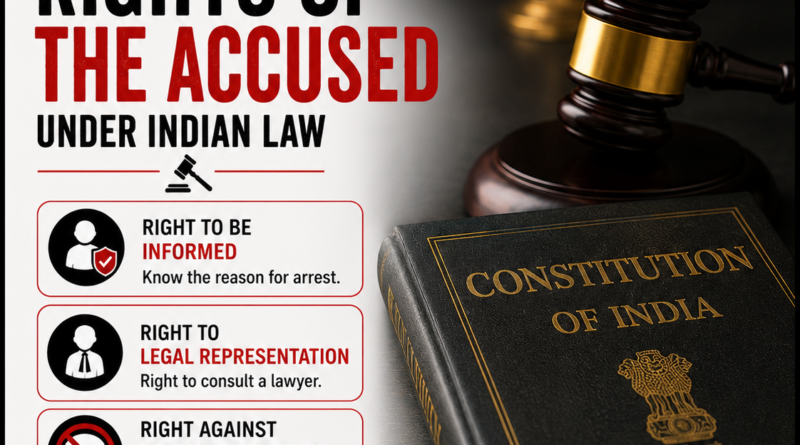
Rights of the Accused Under Indian Law
Whenever a criminal case is reported, public attention usually focuses on the victim and the allegations. However, India’s legal system also protects the rights of the accused person. These protections are essential because every individual is presumed innocent until proven guilty by a competent court.
The Constitution of India and criminal laws ensure that investigations and trials are conducted fairly. These safeguards are not intended to protect criminals but to prevent wrongful arrests, unlawful detention, and unfair convictions.
This article explains the legal rights available to an accused person during arrest, police investigation, bail proceedings, and criminal trial in simple language.
Quick Overview
| Particular | Details |
|---|---|
| Applies To | Every accused person |
| Main Purpose | Ensure a fair investigation and trial |
| Protected By | Constitution of India and criminal laws |
| Includes | Fair trial, legal representation, protection against unlawful detention, and other legal safeguards |
| Final Decision | Only the court decides guilt or innocence |
Why Are These Rights Important?
The criminal justice system is based on an important principle:
Every accused person is presumed innocent until proven guilty in a court of law.
These rights help:
- Prevent wrongful convictions.
- Ensure fair investigations.
- Protect individual liberty.
- Maintain public confidence in the justice system.
- Balance the rights of victims and accused persons.
Constitutional Protection
The Constitution guarantees several important protections.
These include:
- Equality before the law.
- Protection of life and personal liberty.
- Protection against arbitrary action.
- Access to legal remedies.
- Fair legal procedures.
These constitutional guarantees apply regardless of the nature of the allegations.
Right to Know the Grounds of Arrest
When a person is lawfully arrested, they are generally entitled to be informed of the reasons for the arrest.
Understanding the allegations allows the accused to:
- Contact a lawyer.
- Prepare a defence.
- Exercise available legal rights.
Right to Remain Silent
An accused person has important legal protections during questioning.
No person can be compelled to incriminate themselves in violation of constitutional protections.
However, accused persons should cooperate with lawful investigations and seek legal advice where appropriate.
Right to a Lawyer
Every accused person has the right to consult and be represented by a lawyer.
A lawyer helps by:
- Explaining legal rights.
- Advising during proceedings.
- Representing the accused before the court.
- Preparing legal documents.
- Presenting arguments.
Legal representation is one of the most important safeguards in criminal proceedings.
Right to Be Produced Before a Magistrate
After a lawful arrest, the accused must generally be produced before the appropriate judicial authority within the time prescribed by law.
This requirement helps prevent unlawful or prolonged detention.
Right to Apply for Bail
Where the law permits, an accused person may apply for bail.
The court considers:
- Nature of the alleged offence.
- Available evidence.
- Investigation status.
- Applicable legal provisions.
Granting or refusing bail does not determine guilt.
Right to a Fair Investigation
Police investigations must be conducted fairly and impartially.
Investigators are expected to:
- Collect all relevant evidence.
- Record witness statements.
- Preserve important materials.
- Follow legal procedures.
- Avoid bias.
The purpose of the investigation is to discover the truth, not merely to secure a conviction.
Right to a Fair Trial
Every accused person is entitled to a fair trial.
This includes:
- Hearing by a competent court.
- Opportunity to defend themselves.
- Cross-examination of witnesses.
- Presentation of defence evidence.
- Judicial decision based on evidence.
Right Against Illegal Detention
No person should be detained contrary to the procedures established by law.
Courts closely supervise detention and custody through judicial oversight.
Common Misconceptions
Myth: The accused has no rights.
Fact: Every accused person has legal and constitutional protections until the court reaches a final decision.
Myth: Arrest means guilt.
Fact: Arrest is part of the legal process. Guilt is decided only after trial.
Myth: Bail means the accused is innocent.
Fact: Bail is temporary release from custody. It does not determine guilt or innocence.
Myth: Police alone decide criminal cases.
Fact: Police investigate. Courts decide guilt based on the evidence.
Rights During Police Interrogation
Police questioning is an important part of a criminal investigation, but it must be carried out according to the law. An accused person is entitled to legal safeguards during this stage.
These include:
- Being informed of the grounds of arrest where applicable.
- Seeking legal advice.
- Protection against unlawful coercion.
- Humane treatment while in custody.
- Questioning in accordance with legal procedures.
Confessions and statements are governed by the rules of evidence and criminal procedure, and courts assess their admissibility based on the applicable law.
Protection Against Self-Incrimination
One of the most important constitutional safeguards is the protection against being compelled to incriminate oneself.
This means an accused person cannot be forced to make statements against themselves in violation of constitutional protections.
This safeguard helps ensure that criminal investigations rely on lawful evidence rather than compelled admissions.
Right to Receive Copies of Important Documents
After the court takes cognizance of a case, the accused is generally entitled to receive copies of important documents relied upon by the prosecution, such as:
- Charge sheet
- Witness statements, where required by law
- Medical reports
- Forensic reports
- Documentary evidence
- Other relevant records
Access to these documents enables the accused to prepare an effective defence.
Right to Cross-Examine Witnesses
Cross-examination is a fundamental feature of a fair criminal trial.
Through cross-examination, the defence may:
- Test the accuracy of witness testimony.
- Highlight contradictions.
- Challenge credibility.
- Clarify disputed facts.
The court considers the entire evidence before reaching a conclusion.
Right to Present a Defence

An accused person has the opportunity to present evidence in their defence.
This may include:
- Defence witnesses
- Documents
- Expert opinions
- Electronic evidence
- Medical records
- Other admissible material
The prosecution bears the burden of proving the charges according to the applicable legal standard.
Right to Appeal
If a court convicts an accused person, the law may provide the right to appeal before a higher court, subject to the applicable legal provisions.
An appellate court may:
- Uphold the judgment.
- Modify the sentence.
- Set aside the conviction.
- Order further proceedings where appropriate.
Appeals help ensure that judicial decisions can be reviewed.
Rights of Women During Arrest
Special legal safeguards apply in many situations involving the arrest and investigation of women.
Depending on the applicable law and circumstances, these safeguards may include:
- Procedures designed to protect dignity and privacy.
- Search by authorised female personnel where required.
- Additional protections during investigation and custody.
The exact procedure depends on the facts of each case and the governing legal provisions.
Rights of Children in Conflict with Law
Children alleged to have committed offences are generally dealt with under the juvenile justice framework rather than the ordinary criminal process.
The objective is to balance accountability with rehabilitation and reintegration into society.
Proceedings involving children differ significantly from those involving adults.
Duties of the Accused
While the accused enjoys important legal rights, there are also responsibilities.
These include:
- Cooperating with lawful investigations.
- Appearing before the court when required.
- Following bail conditions.
- Avoiding interference with witnesses or evidence.
- Respecting court orders.
Failure to comply with lawful directions may have legal consequences.
Why These Rights Matter
Legal protections for accused persons are essential because they help:
- Prevent wrongful convictions.
- Ensure investigations are fair and impartial.
- Protect constitutional liberties.
- Promote public confidence in the justice system.
- Ensure that convictions are based on reliable evidence rather than assumptions.
A fair justice system protects everyone by applying the law equally.
Common Misconceptions
Myth: An accused person loses all legal rights after arrest.
Fact: Arrest does not take away constitutional and legal protections. The accused continues to have important rights throughout the investigation and trial.
Myth: Hiring a lawyer means the accused is guilty.
Fact: Every person has the right to legal representation. Exercising this right does not imply guilt.
Myth: Police can decide whether someone is guilty.
Fact: Police investigate allegations. Only a competent court can determine guilt after considering the evidence.
Myth: An accused must prove innocence.
Fact: In criminal proceedings, the prosecution is generally required to prove the charges according to the applicable legal standard.
Frequently Asked Questions (FAQs)
Who is considered an accused person?
An accused person is someone against whom allegations of a criminal offence have been made and who is facing investigation or criminal proceedings.
Does an arrest mean the person is guilty?
No. An arrest is part of the legal process. Guilt is determined only after a court evaluates the evidence.
Can an accused person hire a lawyer?
Yes. Every accused person has the right to legal representation.
Can an accused apply for bail?
Where permitted by law, an accused may apply for bail. The court decides the application based on the facts and the applicable legal provisions.
Can an accused remain silent?
The Constitution provides protection against compelled self-incrimination. Individuals should seek legal advice regarding the exercise of their rights in specific situations.
What happens if the police violate legal procedures?
Courts may examine allegations of procedural violations and pass appropriate orders in accordance with the law.
Can an accused challenge a conviction?
Yes. Subject to the applicable law, a convicted person may have the right to file an appeal before a higher court.
Do these rights apply to everyone?
Yes. Legal safeguards generally apply to all accused persons, regardless of the allegations against them.
What is the purpose of a fair trial?
A fair trial ensures that decisions are based on evidence, legal principles, and due process rather than assumptions or public pressure.
Why are these rights important?
They protect individual liberty, reduce the risk of wrongful conviction, and strengthen confidence in the rule of law.
Conclusion
The rights of the accused are a cornerstone of India’s criminal justice system. They are designed to ensure that every person receives fair treatment during arrest, investigation, and trial, while allowing the courts to determine guilt based on evidence and the law. Protecting these rights benefits not only accused persons but also society by promoting fairness, accountability, and confidence in the justice system.
Also See Related Article Charge Sheet, How Do Criminal Trials Work in India?, How Does an FIR Work in India?, What Happens After an FIR Is Filed?