
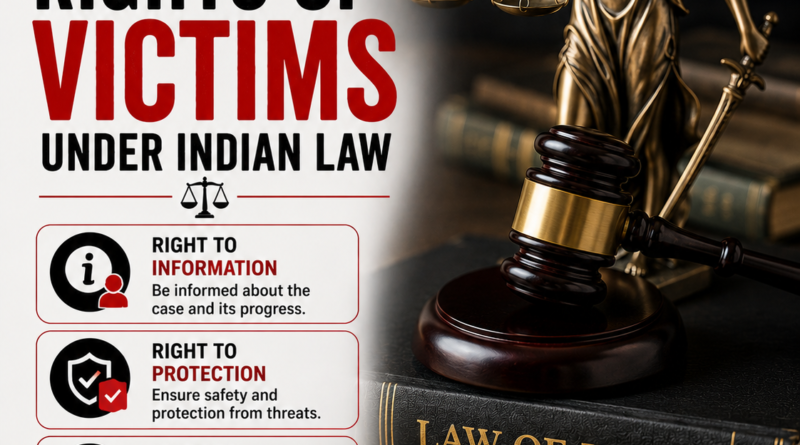
Rights of Victims Under Indian Law: Compensation, Legal Protections & Court Process Explained (2026)
Rights of Victims Under Indian Law
A criminal offence affects not only society but also the individual who suffers harm. Indian law recognizes that victims should be treated with dignity, fairness, and respect throughout the criminal justice process.
Over the years, legal reforms have strengthened the role of victims by providing greater participation in criminal proceedings, access to compensation in appropriate cases, and protection during investigations and trials.
This article explains the rights available to victims under Indian law in simple language.
Quick Overview
| Particular | Details |
|---|---|
| Applies To | Victims of criminal offences |
| Purpose | Protect victims and ensure fair participation in the justice process |
| Includes | Police assistance, court participation, compensation, legal protections, and support services |
| Final Decision | Criminal cases are decided by competent courts based on evidence |
Who Is a Victim?
A victim is generally a person who has suffered physical, emotional, psychological, or financial harm because of an alleged criminal offence.
Depending on the circumstances, a victim may be:
- The person directly affected.
- A family member in certain cases.
- A legal representative where permitted by law.
The exact legal definition depends on the applicable legislation.
Why Are Victims’ Rights Important?
Victims’ rights help ensure that people affected by crime are treated fairly throughout the legal process.
These rights aim to:
- Protect dignity and privacy.
- Encourage reporting of offences.
- Promote fair investigations.
- Improve access to justice.
- Provide support during court proceedings.
A balanced criminal justice system protects the rights of both victims and accused persons.
Right to Report a Crime
A victim has the right to approach the appropriate law enforcement authority to report a criminal offence.
Depending on the nature of the offence, the police may:
- Register the information.
- Begin an investigation where required by law.
- Collect evidence.
- Record statements.
- Take further lawful action.
Providing accurate information helps investigators understand the incident.
Right to a Fair Investigation
Victims are entitled to expect that investigations will be conducted:
- Fairly.
- Impartially.
- Promptly.
- According to legal procedures.
Investigating agencies are expected to collect all relevant evidence rather than focusing only on information that supports one side.
Right to Be Treated with Dignity
Victims should be treated respectfully throughout the criminal justice process.
This includes:
- Courteous interaction.
- Respect for privacy where appropriate.
- Sensitivity during questioning.
- Protection from unnecessary harassment.
Special care may be required in cases involving vulnerable persons.
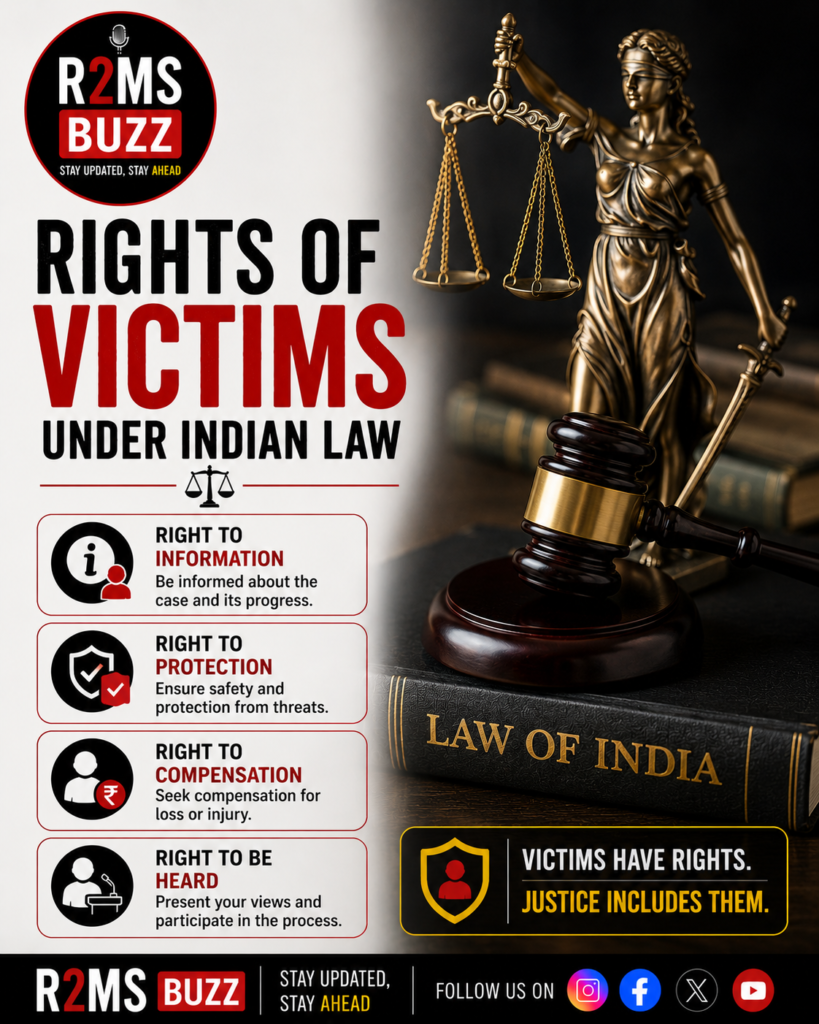
Right to Information About the Case
Victims may be entitled to receive information about significant developments in the case, subject to applicable legal provisions.
This may include updates regarding:
- Investigation progress.
- Court proceedings.
- Bail hearings, where relevant.
- Important judicial orders.
Keeping victims informed promotes transparency and confidence in the legal process.
Right to Participate in Court Proceedings
In certain situations and subject to the applicable law, victims may participate in criminal proceedings through lawful procedures.
This participation may include:
- Being heard where permitted.
- Engaging legal representation where applicable.
- Presenting relevant information to the court.
- Seeking remedies available under the law.
The extent of participation depends on the nature of the case and the governing legal framework.
Right to Seek Compensation
Indian law provides mechanisms through which victims may seek compensation in appropriate cases.
Compensation may be considered for:
- Physical injuries.
- Financial loss.
- Rehabilitation needs.
- Other harm recognized by law.
The availability, amount, and procedure depend on the facts of each case and the applicable legal provisions.
Right to Protection
In appropriate circumstances, victims and witnesses may receive protection measures intended to safeguard their safety and well-being.
These measures depend on:
- Nature of the alleged offence.
- Level of risk.
- Court directions.
- Applicable legal framework.
Protection mechanisms vary from case to case.
Common Misconceptions
Myth: Victims have no role after filing an FIR.
Fact: Victims may have various rights during the investigation and court proceedings, depending on the applicable law.
Myth: Compensation is automatic in every criminal case.
Fact: Compensation depends on the facts, applicable legal provisions, and decisions made by the competent authority.
Myth: Police decide compensation.
Fact: Compensation is governed by legal procedures and may involve decisions by courts or other competent authorities, depending on the circumstances.
Myth: Victims cannot hire a lawyer.
Fact: Victims may engage legal representation where permitted by law.
Victim Compensation Schemes
In addition to the criminal trial, Indian law provides mechanisms through which eligible victims may seek compensation in appropriate cases. The purpose of compensation is to help address the harm suffered due to a criminal offence and support rehabilitation where required.
Depending on the facts and the applicable legal framework, compensation may be considered for:
- Physical injuries
- Medical expenses
- Loss of income
- Property damage
- Rehabilitation needs
- Other losses recognized by law
The amount and eligibility vary from case to case and are determined according to the applicable legal provisions.
Rights of Victims During Trial
Victims continue to have important rights after the investigation is complete.
Depending on the law and the facts of the case, victims may:
- Attend court proceedings where permitted.
- Be informed about important hearings.
- Engage legal representation where applicable.
- Present relevant information through lawful procedures.
- Seek remedies available under law.
These rights help ensure that victims remain informed and involved throughout the judicial process.
Witness Protection
Victims and witnesses may face threats or intimidation in some criminal cases.
To protect the fairness of the justice process, authorities may adopt protective measures where legally justified.
Such measures may include:
- Protecting personal identity where permitted.
- Police protection in appropriate cases.
- Security arrangements during court appearances.
- Other measures ordered by the competent authority.
The availability of protection depends on the circumstances of each case.
Legal Aid for Victims
Not every victim can afford private legal representation.
Eligible persons may receive legal assistance through legal aid services provided under the applicable legal framework.
Legal aid may help victims with:
- Understanding legal rights.
- Court procedures.
- Filing applications.
- Accessing compensation mechanisms.
- Legal representation where available.
Access to legal assistance promotes equal access to justice.
Rights of Women Victims
Women who are victims of crime are entitled to legal protections intended to safeguard their dignity and privacy.
Depending on the nature of the offence, these protections may include:
- Privacy during investigation.
- Sensitive recording of statements.
- Medical examination according to legal procedures.
- Protection from harassment during proceedings.
- Additional safeguards provided by law.
The exact procedure depends on the facts of the case and the applicable legislation.
Rights of Child Victims
Children require special care during criminal proceedings.
The legal system seeks to protect child victims by promoting:
- Child-friendly procedures.
- Confidentiality where required.
- Protection from intimidation.
- Appropriate support during investigation and trial.
- Rehabilitation measures where applicable.
The best interests of the child remain an important consideration throughout the process.
Rights of Senior Citizens and Vulnerable Victims
Older persons, persons with disabilities, and other vulnerable individuals may require additional assistance during criminal proceedings.
Authorities may provide support appropriate to their circumstances, such as:
- Easier access to legal processes.
- Assistance during investigations.
- Measures to reduce hardship during court proceedings.
These protections aim to ensure meaningful access to justice.
Duties of Victims During Criminal Proceedings
While victims have important legal rights, they also have responsibilities during the judicial process.
These include:
- Providing truthful information.
- Cooperating with lawful investigations.
- Appearing before the court when required.
- Preserving relevant evidence where possible.
- Following lawful directions issued by the court.
Cooperation with investigators and the judiciary helps ensure that the case is decided fairly.
Importance of Victims’ Rights
Protecting victims’ rights helps:
- Improve public confidence in the justice system.
- Encourage reporting of crimes.
- Promote fair investigations.
- Support rehabilitation.
- Balance the interests of victims, accused persons, and society.
A justice system that respects victims while ensuring fair trials strengthens the rule of law.
Common Misconceptions
Myth: Victims lose all rights once the police file a charge sheet.
Fact: Victims may continue to have important rights during court proceedings, subject to the applicable law.
Myth: Every victim automatically receives compensation.
Fact: Compensation depends on legal eligibility, the facts of the case, and the applicable statutory provisions.
Myth: Only wealthy victims can hire lawyers.
Fact: Eligible persons may receive legal aid where provided under the law.
Myth: Victims cannot appeal against court decisions.
Fact: The availability of appeals and other legal remedies depends on the applicable law and the circumstances of the case.
Frequently Asked Questions (FAQs)
Who is considered a victim under Indian law?
A victim is generally a person who has suffered harm because of an alleged criminal offence. The legal definition depends on the applicable legislation.
Can a victim receive compensation?
Yes. Compensation may be available in appropriate cases through the legal mechanisms provided under the law.
Can victims hire their own lawyer?
Yes. Victims may engage legal representation where permitted by law.
Are victims informed about court proceedings?
Victims may receive information about important developments in the case, subject to the applicable legal provisions.
Can victims request protection?
Where circumstances justify it, protective measures may be available through the competent authorities or courts.
What happens if a victim cannot afford legal representation?
Eligible persons may obtain legal assistance through legal aid services, subject to the applicable legal framework.
Do child victims receive special protection?
Yes. Child victims are generally entitled to additional safeguards designed to protect their welfare and dignity.
Is compensation guaranteed after every conviction?
No. Compensation depends on the facts of the case, applicable legal provisions, and the decision of the competent authority.
Can victims attend court hearings?
In many cases, victims may attend proceedings or participate through lawful procedures, subject to court rules and applicable law.
Why are victims’ rights important?
They help ensure fairness, dignity, participation, and access to justice for those affected by crime.
Conclusion
Victims play a central role in the criminal justice system, and the law seeks to protect their dignity, safety, and access to justice throughout the investigation and trial. Rights such as fair treatment, information about the case, participation in proceedings, legal assistance, protection where necessary, and access to compensation contribute to a more balanced and humane justice system.
Understanding these rights empowers victims to navigate legal processes with greater confidence while reinforcing the principle that justice must protect everyone affected by crime.
Also See related Article How Do Criminal Trials Work in India?, How Does an FIR Work in India?, What Happens After an FIR Is Filed?, Charge Sheet Process, Difference Between Murder and Culpable Homicide