
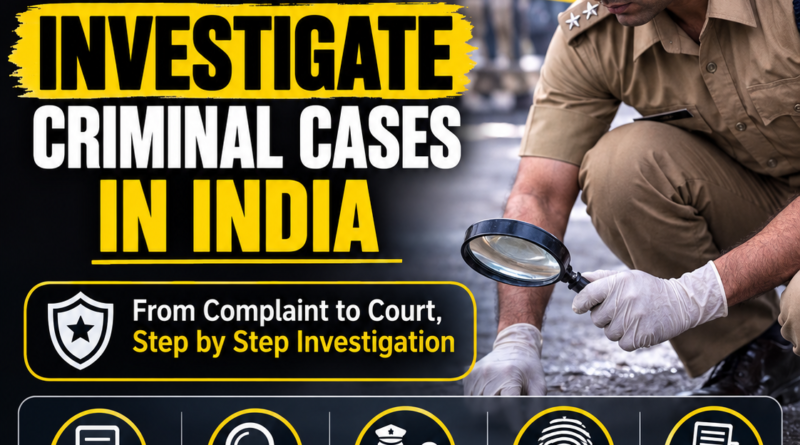
How Police Investigate Criminal Cases in India: Step-by-Step Investigation Process Explained (2026)
How Police Investigate Criminal Cases in India?
Whenever a criminal offence is reported, one of the first questions people ask is, “How do the police investigate the case?” While television shows often portray investigations as quick and dramatic, real-life investigations follow a structured legal process designed to gather evidence fairly and objectively.
The primary goal of a police investigation is to discover the facts of the case, identify those responsible if an offence has been committed, collect legally admissible evidence, and present the findings before a court. Investigators are expected to remain impartial and examine all relevant evidence, whether it supports or contradicts the allegations.
This guide explains the investigation process in India step by step in simple language.
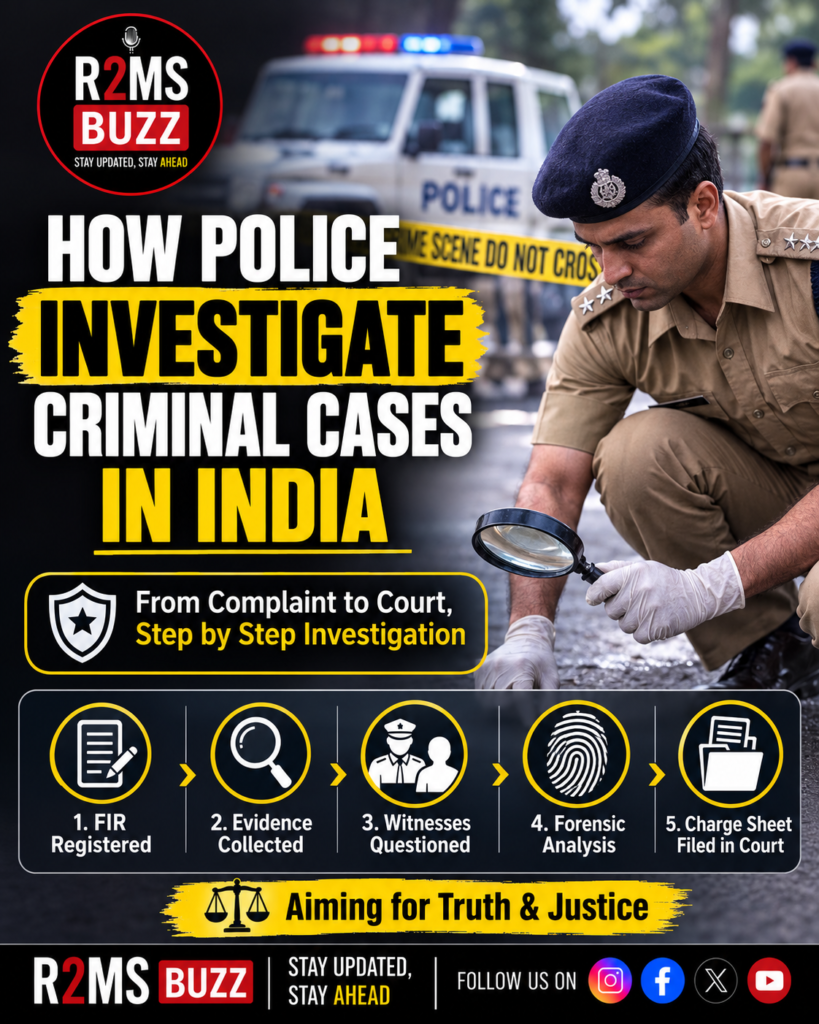
Quick Overview
| Stage | Investigation Process |
|---|---|
| 1 | Complaint or Information Received |
| 2 | FIR Registered (where required) |
| 3 | Crime Scene Secured |
| 4 | Evidence Collected |
| 5 | Witness Statements Recorded |
| 6 | Forensic Examination |
| 7 | Suspect Identification |
| 8 | Arrest (if legally justified) |
| 9 | Digital & Documentary Evidence Analysis |
| 10 | Charge Sheet or Appropriate Final Report |
What Is a Police Investigation?
A police investigation is the official process through which law enforcement officers gather facts relating to an alleged criminal offence.
The investigation generally aims to:
- Establish what happened.
- Identify those involved.
- Collect evidence lawfully.
- Verify witness accounts.
- Recover relevant materials where possible.
- Assist the court in reaching a just decision.
Importantly, the investigation is not meant to prove someone guilty at any cost. Its purpose is to uncover the truth based on available evidence.
Step 1: Receiving Information About a Crime
An investigation usually begins when the police receive information about an alleged offence.
This information may come from:
- A victim.
- A witness.
- A member of the public.
- Another government agency.
- Information received during another investigation.
The police first assess the nature of the information to determine the appropriate legal procedure.
Step 2: Registration of an FIR
For many cognizable offences, the police register a First Information Report (FIR).
The FIR generally contains:
- Date and time of the incident.
- Place of occurrence.
- Names of persons involved, if known.
- Nature of the alleged offence.
- Brief description of events.
The FIR marks the beginning of the formal investigation. It is not evidence of guilt.
Step 3: Visiting and Securing the Crime Scene
One of the earliest tasks for investigators is to visit the place where the alleged offence occurred.
At the scene, officers may:
- Secure the area.
- Prevent contamination of evidence.
- Photograph and document the location.
- Prepare site sketches where required.
- Identify potential witnesses.
- Look for physical evidence.
Preserving the crime scene is essential because damaged or contaminated evidence may affect the investigation.
Step 4: Collection of Physical Evidence
Investigators collect evidence that may help establish the facts of the case.
Depending on the nature of the offence, this may include:
- Clothing.
- Weapons.
- Blood samples.
- Fingerprints.
- Documents.
- Mobile phones.
- Electronic devices.
- CCTV storage devices.
- Vehicles.
- Other relevant objects.
Evidence is documented and handled according to legal procedures to maintain its integrity.
Step 5: Recording Statements of Witnesses
Witnesses often provide important information about the incident.
Police may record statements from:
- Victims.
- Eyewitnesses.
- Family members.
- Neighbours.
- Independent witnesses.
- Medical professionals.
- Other persons with relevant knowledge.
Investigators compare witness accounts with the available evidence to identify consistencies or discrepancies.
Step 6: Medical Examination
In cases involving injuries or death, medical examination plays a significant role.
Medical professionals may prepare reports relating to:
- Nature of injuries.
- Cause of injuries.
- Medical treatment provided.
- Cause of death, where applicable.
These reports can become important pieces of evidence during the trial.
Step 7: Forensic Examination
Modern criminal investigations often rely on forensic science.
Experts may analyse:
- DNA samples.
- Fingerprints.
- Ballistic evidence.
- Biological materials.
- Digital devices.
- Handwriting.
- Toxicology samples.
Scientific analysis helps investigators understand the evidence more accurately.
Common Misconceptions
Myth: Police always solve criminal cases immediately.
Fact: Some investigations are completed quickly, while others may take considerable time depending on the evidence, number of witnesses, forensic reports, and complexity of the case.
Myth: An arrest must happen immediately after an FIR.
Fact: Arrest depends on the facts, evidence, and legal requirements. Not every FIR results in an immediate arrest.
Myth: Confessions alone decide a case.
Fact: Courts evaluate the entire body of admissible evidence, including documents, witness testimony, forensic findings, and other material.
Myth: Police investigations end with an arrest.
Fact: Even after an arrest, investigators may continue collecting evidence until the investigation is complete.
Step 8: Analysis of Digital Evidence
In today’s digital age, electronic evidence plays a major role in many criminal investigations. Investigating agencies may examine digital records in accordance with the law.
Digital evidence may include:
- CCTV footage
- Mobile phone data
- Emails
- Text messages
- Social media activity
- GPS location records
- Computer files
- Cloud storage data
- Call Detail Records (CDRs), where lawfully obtained
Such evidence is collected and analysed using legally prescribed procedures so that it can be evaluated by the court.
Step 9: Identifying Suspects
After collecting evidence, investigators work to identify the person or persons who may be connected with the alleged offence.
This process may involve:
- Reviewing witness statements
- Examining CCTV recordings
- Comparing forensic findings
- Analysing digital evidence
- Conducting identification procedures where permitted
- Verifying alibis and timelines
Investigators must assess all available evidence objectively before reaching conclusions.
Step 10: Arrest (Where Legally Justified)
An arrest is not automatic in every criminal case.
Police may make an arrest only when it is legally justified and necessary under the applicable law.
Factors that may be considered include:
- Nature and seriousness of the alleged offence
- Available evidence
- Risk of absconding
- Possibility of influencing witnesses
- Risk of destroying evidence
- Need for custodial investigation
After arrest, the accused is entitled to the legal safeguards provided under the Constitution and criminal laws.
Step 11: Maintaining the Case Diary
During the investigation, the Investigating Officer maintains an official case diary.
The case diary generally records:
- Dates of investigation
- Places visited
- Witnesses examined
- Evidence collected
- Steps taken during the investigation
- Progress of the case
The case diary helps maintain a record of the investigation and assists the court where permitted by law.
Step 12: Reviewing the Evidence
Before concluding the investigation, the Investigating Officer reviews all available material, including:
- Witness statements
- Medical reports
- Forensic reports
- Digital evidence
- Documentary evidence
- Physical exhibits
The purpose is to determine whether the available evidence supports further prosecution or another legally appropriate outcome.
Step 13: Filing the Charge Sheet or Appropriate Final Report
After completing the investigation, the police submit the outcome before the competent court.
Depending on the findings:
- A charge sheet may be filed if the investigation indicates sufficient material to proceed.
- An appropriate final report may be submitted if the investigation reaches a different conclusion under the law.
The court independently examines the material before deciding the next stage of the proceedings.
Role of Forensic Science in Modern Investigations
Scientific evidence has become increasingly important in criminal investigations.
Common forensic disciplines include:
- DNA profiling
- Fingerprint examination
- Ballistics
- Toxicology
- Cyber forensics
- Voice analysis
- Handwriting examination
- Digital device analysis
Scientific findings often help corroborate or clarify other evidence collected during the investigation.
Rights of Individuals During Investigation
The investigation process must respect legal and constitutional safeguards.
Depending on the circumstances, individuals may have rights such as:
- Fair treatment by investigating authorities
- Legal representation where applicable
- Protection against unlawful detention
- Access to judicial remedies
- Fair procedures during investigation
Investigators are expected to follow the law while balancing the interests of victims, accused persons, and society.
Why Investigations Sometimes Take Time
Many investigations cannot be completed quickly.
Factors that may affect the timeline include:
- Large number of witnesses
- Complex forensic examinations
- Digital evidence analysis
- Multiple accused persons
- Interstate or international links
- Financial or cybercrime investigations
- Court directions
- Pending expert reports
The duration of an investigation varies according to the facts and complexity of each case.
Common Misconceptions
Myth: Every criminal case results in a charge sheet.
Fact: The outcome depends on the evidence collected during the investigation and the applicable legal provisions.
Myth: Police can decide whether someone is guilty.
Fact: Police investigate allegations. Only a competent court determines guilt after evaluating the evidence.
Myth: Digital evidence alone is always sufficient.
Fact: Courts assess digital evidence together with all other admissible evidence in the case.
Myth: Once a charge sheet is filed, the case is over.
Fact: Filing a charge sheet generally marks the end of the investigation and the beginning of the judicial process. The trial and court proceedings follow.
Frequently Asked Questions (FAQs)
What is the purpose of a police investigation?
The purpose is to collect facts and evidence relating to an alleged offence so that the court can make an informed decision.
Can police investigate without an FIR?
The procedure depends on the nature of the information and the alleged offence. Different legal provisions apply in different situations.
What happens after the investigation is complete?
The investigating agency submits the outcome, such as a charge sheet or another legally appropriate report, before the competent court.
Do police rely only on witness statements?
No. Investigations may involve physical evidence, forensic reports, digital records, documents, medical evidence, and other admissible material.
Can forensic reports change the direction of an investigation?
Yes. Scientific evidence may confirm, contradict, or clarify other evidence collected during the investigation.
What if new evidence is found later?
Where permitted by law, further investigation may be conducted and additional material may be placed before the court.
Are all criminal investigations the same?
No. The investigation process varies depending on the nature of the alleged offence, available evidence, and the complexity of the case.
How long does a police investigation take?
There is no fixed timeline. The duration depends on the facts of the case, the evidence involved, expert reports, and legal procedures.
Can the court monitor an investigation?
In certain cases and circumstances, courts may exercise powers available under the law regarding investigations.
Why is evidence important?
Evidence enables courts to determine the facts of a case through a fair and lawful process rather than relying on assumptions.
Conclusion
A police investigation is the foundation of every criminal case. From registering an FIR and securing the crime scene to collecting evidence, examining witnesses, using forensic science, and submitting a charge sheet or appropriate final report, each step is intended to ensure that the truth is established through lawful and objective methods. While investigations can be complex and time-consuming, following proper legal procedures helps protect the rights of everyone involved and supports fair administration of justice.
Also See related Article How Criminal Trials Work in India, Victim Compensation India, How Does an FIR Work in India?, Charge Sheet After FIR, What Happens After an FIR Is Filed?