
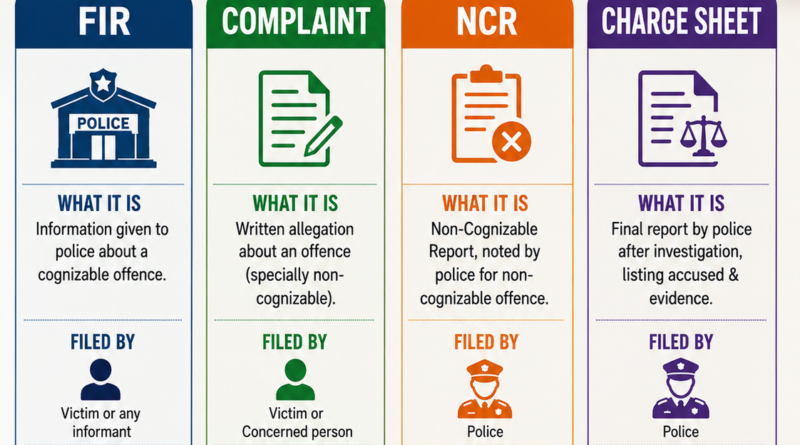
Difference Between FIR, Complaint, NCR & Charge Sheet
Many people use the terms FIR, Complaint, NCR, and Charge Sheet interchangeably. However, these are different legal concepts that serve different purposes in India’s criminal justice system.
Understanding the difference helps people better interpret police actions, court proceedings, and news reports. It also clarifies what happens at each stage of a criminal case.
This guide explains each term in simple language and highlights how they fit into the overall criminal justice process.
Quick Comparison Table
| Term | Meaning | Who Files It? | Purpose | Stage |
|---|---|---|---|---|
| Complaint | Information given about an alleged offence | Victim or any person with knowledge | Inform authorities about an incident | First Stage |
| FIR | First Information Report for many cognizable offences | Police after receiving qualifying information | Start a formal police investigation | Investigation Begins |
| NCR | Non-Cognizable Report | Police record information relating to a non-cognizable matter | Record the complaint and proceed according to the applicable legal procedure | Initial Stage |
| Charge Sheet | Police investigation report | Investigating Officer | Present investigation findings before the court | After Investigation |
What Is a Complaint?
A complaint is information given to the police or another competent authority regarding an alleged offence or incident.
A complaint may be made by:
- The victim.
- A family member.
- A witness.
- Any person who has knowledge of the incident, where permitted by law.
Not every complaint results in an FIR. The next steps depend on the nature of the information and the applicable legal provisions.
Purpose of a Complaint
The primary purpose of a complaint is to:
- Inform authorities about an incident.
- Enable preliminary assessment.
- Request appropriate legal action.
- Initiate the legal process where applicable.
A complaint is often the first step before any formal investigation begins.
What Is an FIR?
An FIR (First Information Report) is a formal document recorded by the police upon receiving information about many cognizable offences.
Once an FIR is registered, the police generally have the authority to begin a formal investigation in accordance with the law.
An FIR usually includes:
- Date and time of the incident.
- Place of occurrence.
- Details of the complainant.
- Nature of the alleged offence.
- Brief facts of the incident.
An FIR is not proof that an offence has been committed. It is the starting point of the investigation.
Purpose of an FIR
The FIR helps to:
- Officially record information.
- Start the investigation process.
- Preserve the earliest version of the allegations.
- Assist investigating agencies.
- Create an official record for future proceedings.
What Is an NCR?
An NCR (Non-Cognizable Report) relates to information about a non-cognizable offence, where the police follow the procedure prescribed by law before proceeding further.
Examples may include certain offences that are classified as non-cognizable under the applicable legal framework.
An NCR records the complaint and ensures there is an official record of the information received.
Purpose of an NCR
An NCR serves several purposes:
- Records the complaint.
- Maintains official documentation.
- Helps preserve information relating to the incident.
- Enables further legal action where permitted under the law.
It is important to note that the legal procedure applicable to an NCR differs from that applicable to an FIR.
What Is a Charge Sheet?
A charge sheet is the report prepared by the Investigating Officer after completing the police investigation.
It generally contains:
- Summary of the investigation.
- Witness list.
- Documentary evidence.
- Medical reports.
- Forensic reports.
- Relevant legal provisions.
- Details of the accused.
The charge sheet is submitted before the competent court.
It does not determine guilt. The court independently evaluates the evidence during the trial.
Timeline of a Criminal Case
Complaint
      ↓
FIR or NCR (depending on the nature of the matter and applicable law)
      ↓
Police Investigation
      ↓
Evidence Collection
      ↓
Charge Sheet or Appropriate Final Report
      ↓
Court Proceedings
      ↓
Judgment
Common Misconceptions
Myth: Complaint and FIR are the same.
Fact: A complaint provides information about an incident. An FIR is a formal record that generally initiates the investigation of many cognizable offences.
Myth: Every complaint becomes an FIR.
Fact: Whether an FIR is registered depends on the facts presented and the applicable legal provisions.
Myth: An NCR is less important.
Fact: An NCR is an official police record relating to a non-cognizable matter and may play an important role depending on the circumstances.
Myth: Filing a charge sheet means the accused is guilty.
Fact: A charge sheet is an investigation report. Only the court determines guilt after examining the evidence.
Detailed Comparison Table
| Feature | Complaint | FIR | NCR | Charge Sheet |
|---|---|---|---|---|
| Purpose | Inform authorities about an alleged incident | Formally record information relating to many cognizable offences | Record information relating to a non-cognizable matter | Present investigation findings before the court |
| Prepared By | Complainant | Police | Police | Investigating Officer |
| Stage | Beginning of the process | Start of investigation | Initial reporting stage | After investigation |
| Starts Police Investigation? | Not always | Generally yes, for cognizable offences | Procedure depends on applicable law | No |
| Filed Before | Police or competent authority | Police | Police | Criminal Court |
| Determines Guilt? | No | No | No | No |
FIR vs Complaint
Although people often use these terms interchangeably, they are not the same.
Complaint
A complaint is information provided about an alleged offence or incident.
It may be given:
- Orally
- In writing
- By the victim
- By a witness
- By another person with knowledge of the incident, where permitted
Its purpose is to inform the authorities.
FIR
An FIR is a formal police record relating to information about many cognizable offences.
Once registered, it generally enables the police to begin an investigation according to law.
Key Difference
| Complaint | FIR |
|---|---|
| Provides information | Officially records qualifying information for many cognizable offences |
| Does not always lead to investigation | Usually begins a formal investigation |
| Can relate to different types of incidents | Generally relates to cognizable offences |
FIR vs NCR
This is another area where confusion is common.
FIR
- Relates to many cognizable offences.
- Police generally begin investigation after registration.
NCR
- Relates to non-cognizable matters.
- The legal procedure differs and is governed by the applicable law.
Comparison
| FIR | NCR |
|---|---|
| Cognizable offence | Non-cognizable matter |
| Investigation generally begins after registration | Procedure depends on legal requirements |
| More serious category of offences (generally) | Less serious category under the legal classification |
FIR vs Charge Sheet
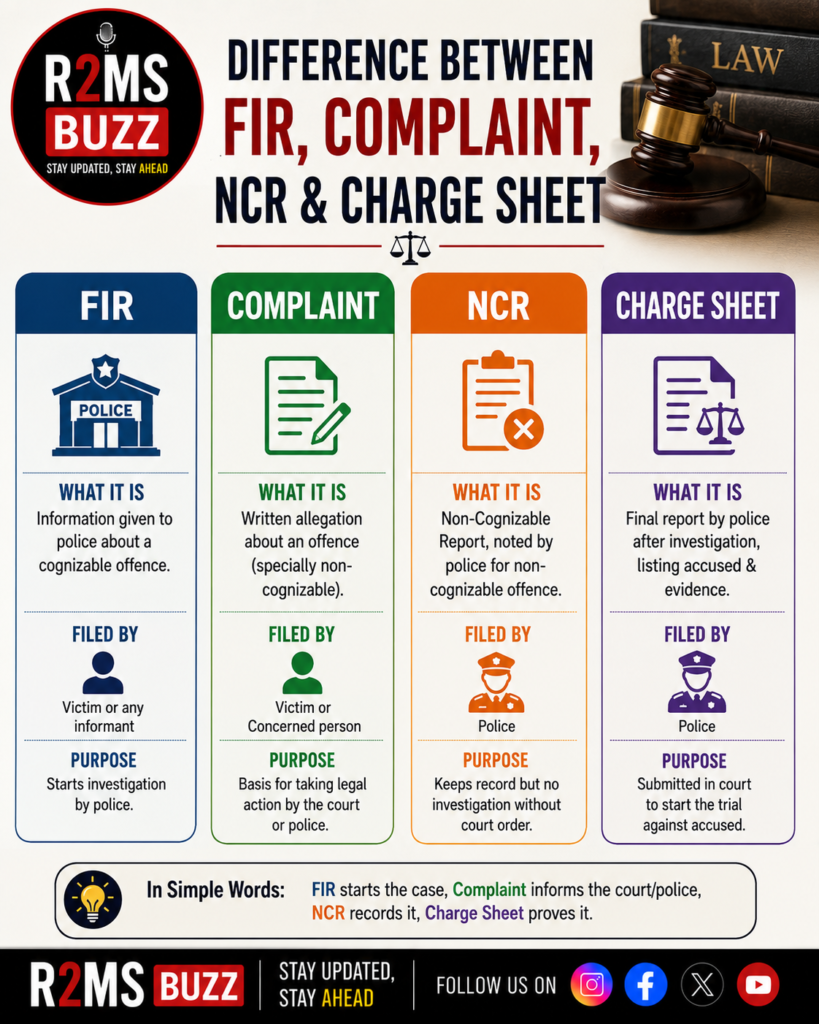
These two documents are created at completely different stages.
FIR
- Prepared at the beginning.
- Starts the investigation.
Charge Sheet
- Prepared after investigation.
- Summarizes the evidence collected.
- Submitted before the court.
Comparison
| FIR | Charge Sheet |
|---|---|
| Beginning of investigation | End of investigation |
| Initial information | Investigation findings |
| Registered by police | Prepared by Investigating Officer |
| No evidence analysis | Contains evidence gathered during investigation |
Complaint vs NCR
Although both may involve reporting an incident, they are different.
Complaint
A complaint is the information provided by a person regarding an alleged incident.
NCR
An NCR is the official police record prepared in relation to a non-cognizable matter after receiving such information.
A complaint may lead to an NCR depending on the facts and applicable law.
Which Document Starts a Police Investigation?
In many cases involving cognizable offences:
Complaint → FIR → Investigation
For non-cognizable matters, the procedure is different and follows the legal framework applicable to those offences.
Not every complaint leads to an FIR, and not every investigation results in a charge sheet.
Can There Be a Charge Sheet Without an FIR?
The answer depends on the nature of the proceedings and the applicable legal provisions.
While many criminal investigations begin with an FIR, some criminal cases may commence through other legally recognized procedures. The exact process varies according to the facts and the law governing the case.
Why Understanding These Terms Matters
Knowing the difference between these legal terms helps people:
- Understand news reports accurately.
- Avoid spreading misinformation.
- Know what stage a criminal case has reached.
- Better understand police and court procedures.
- Exercise legal rights more effectively.
Legal awareness also promotes greater confidence in the justice system.
Common Misconceptions
Myth: FIR means the accused is guilty.
Fact: An FIR only records information and begins the investigation. Guilt is decided by the court.
Myth: Every complaint becomes an FIR.
Fact: The legal response depends on the facts and the applicable provisions of law.
Myth: An NCR has no legal value.
Fact: An NCR is an official record and may be important depending on the circumstances.
Myth: Filing a charge sheet ends the case.
Fact: Filing a charge sheet usually marks the end of the investigation and the beginning of court proceedings.
Frequently Asked Questions (FAQs)
What is the difference between a complaint and an FIR?
A complaint is information provided about an incident. An FIR is a formal police record that generally initiates the investigation of many cognizable offences.
What does NCR stand for?
NCR stands for Non-Cognizable Report, which relates to information about a non-cognizable matter.
Who prepares a charge sheet?
The Investigating Officer prepares the charge sheet after completing the investigation.
Does every FIR result in a charge sheet?
No. The outcome depends on the evidence collected and the findings of the investigation.
Can police refuse to register every complaint as an FIR?
The procedure depends on the facts of the case and the applicable legal provisions. Different rules apply to different categories of offences.
Is an FIR evidence?
No. An FIR records the initial information about an alleged offence. It is not, by itself, proof of guilt.
Can a court reject a charge sheet?
Courts examine the material placed before them and may pass appropriate orders according to the law.
Is a complaint always written?
Not necessarily. Depending on the legal procedure, information may initially be provided orally or in writing and recorded by the authorities.
What happens after a charge sheet?
The court examines the report and, where appropriate, proceeds with the next stages of the criminal case, including consideration of charges and trial.
Why should citizens understand these legal terms?
Understanding these concepts helps people interpret criminal cases more accurately and avoid common misunderstandings about the justice process.
Conclusion
Although the terms Complaint, FIR, NCR, and Charge Sheet are closely connected, they perform different functions within the criminal justice system. A complaint brings an alleged incident to the attention of the authorities, an FIR formally records information relating to many cognizable offences and generally starts the investigation, an NCR records information relating to non-cognizable matters, and a charge sheet presents the findings of the completed investigation before the court.
Knowing these distinctions helps readers better understand legal news, police procedures, and court proceedings while reducing confusion caused by inaccurate use of legal terminology.
Also See Related Article How Do Criminal Trials Work in India?, FIR Meaning, What Happens After an FIR Is Filed?,Charge Sheet After FIR