
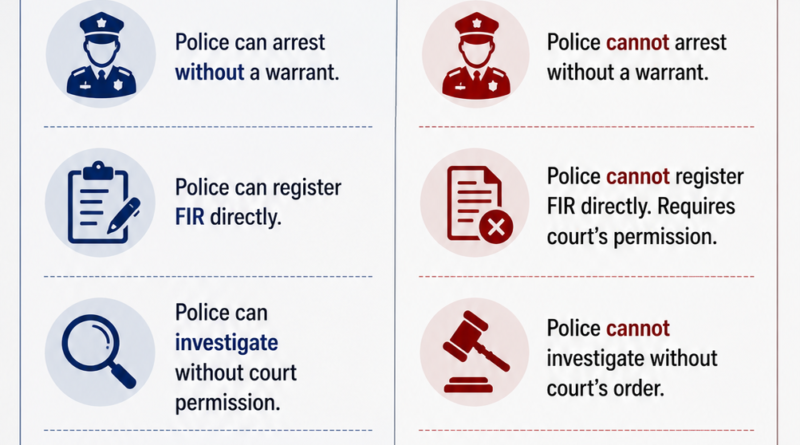
Cognizable vs Non-Cognizable Offences in India: Complete Guide with Examples (2026)
One of the most common questions people ask after hearing about a criminal case is:
“Why did the police register an FIR in one case but not in another?”
The answer often depends on whether the alleged offence is classified as cognizable or non-cognizable under Indian law.
This distinction is important because it affects the powers of the police, the investigation process, and the legal procedure that follows. Understanding these two categories helps citizens better understand police actions, criminal cases, and court proceedings.
This guide explains the difference between cognizable and non-cognizable offences in simple language.
Quick Comparison
| Particular | Cognizable Offence | Non-Cognizable Offence |
|---|---|---|
| Nature | Generally more serious | Generally less serious |
| Police Investigation | Can generally begin according to law after registration of an FIR | Procedure follows the applicable legal provisions for non-cognizable offences |
| FIR | Commonly registered where required by law | The procedure differs depending on the legal framework |
| Court Permission | Depends on the applicable law | Certain procedural steps may require judicial involvement before investigation proceeds |
| Examples | Murder, robbery, kidnapping | Defamation, public nuisance, simple hurt (depending on the applicable legal classification) |
Note: The classification of an offence depends on the law in force and the specific facts of the case.
What Is a Cognizable Offence?
A cognizable offence is a category of offence for which the law generally authorizes the police to take investigative steps in accordance with the applicable legal procedure after receiving qualifying information.
These offences are generally considered more serious because they may involve:
- Violence
- Threats to life
- Serious bodily harm
- Sexual offences
- Kidnapping
- Organized crime
- Serious financial crimes
- Terror-related offences
The exact procedure is governed by the relevant criminal laws.
Features of Cognizable Offences
Some common features include:
- Generally involve serious allegations.
- Police may register an FIR where required by law.
- Investigation follows the legal procedure prescribed for such offences.
- Evidence is collected through a formal investigation.
- The case may proceed to court after completion of the investigation.
Examples of Cognizable Offences
Depending on the applicable law and the facts of the case, examples may include:
- Murder
- Attempt to murder
- Kidnapping
- Rape
- Dacoity
- Robbery
- Terror-related offences
- Serious acid attacks
- Certain cybercrimes
- Serious financial frauds
The legal classification of any offence should always be determined by the relevant statute.
What Is a Non-Cognizable Offence?
A non-cognizable offence is a category of offence for which the legal procedure differs from that applicable to cognizable offences.
When information about a non-cognizable matter is received, the police follow the procedure prescribed by law before proceeding with further investigation.
These offences are generally regarded as less serious than cognizable offences, although they are still punishable under the law.
Features of Non-Cognizable Offences
Common characteristics include:
- Generally involve less serious allegations.
- Information may be recorded by the police.
- Further legal steps follow the applicable statutory procedure.
- Judicial oversight may be required for certain investigative actions.
Examples of Non-Cognizable Offences
Depending on the applicable law, examples may include:
- Defamation
- Public nuisance
- Certain instances of simple hurt
- Minor mischief
- Other offences classified as non-cognizable by law
The classification depends on the relevant legislation and should not be assumed without referring to the law.
Why Does This Classification Matter?
The distinction between cognizable and non-cognizable offences affects:
- The police investigation process.
- The registration of an FIR.
- The legal powers available to investigating authorities.
- The role of the courts at different stages.
- The rights and obligations of the parties involved.
Understanding the classification helps citizens know why different procedures may apply in different cases.
Common Misconceptions
Myth: Every criminal complaint results in an FIR.
Fact: The legal procedure depends on the nature of the alleged offence and the applicable law.
Myth: Non-cognizable offences are not crimes.
Fact: Non-cognizable offences are offences recognized by law. They simply follow a different procedural framework.
Myth: Police can investigate every complaint in the same way.
Fact: Investigation procedures vary depending on the classification of the offence and the governing legal provisions.
Myth: Cognizable offences always lead to conviction.
Fact: A conviction depends on the evidence presented before the court and the outcome of the trial.
Detailed Comparison Table
| Feature | Cognizable Offence | Non-Cognizable Offence |
|---|---|---|
| Nature of Offence | Generally more serious | Generally less serious |
| FIR | Commonly registered where required by law | The procedure differs under the applicable legal framework |
| Police Investigation | Conducted according to the prescribed legal procedure | Governed by the procedure applicable to non-cognizable matters |
| Arrest | Depends on the powers and safeguards provided by law | Governed by the applicable legal provisions |
| Court Role | Judicial oversight continues throughout the process | Certain investigative steps may require judicial authorization, depending on the law |
| Outcome | Investigation may result in a charge sheet or another legally appropriate report | The matter proceeds according to the relevant legal procedure |
Police Powers in Cognizable Offences
For cognizable offences, the law generally gives the police wider investigative powers, subject to constitutional safeguards and statutory requirements.
These powers may include:
- Registering an FIR where required.
- Visiting the crime scene.
- Collecting physical and digital evidence.
- Recording witness statements.
- Conducting searches and seizures where legally permitted.
- Making arrests where justified under the law.
- Seeking forensic examinations.
- Filing a charge sheet or another appropriate report before the court.
All such actions must be carried out in accordance with legal procedures.
Police Procedure in Non-Cognizable Matters
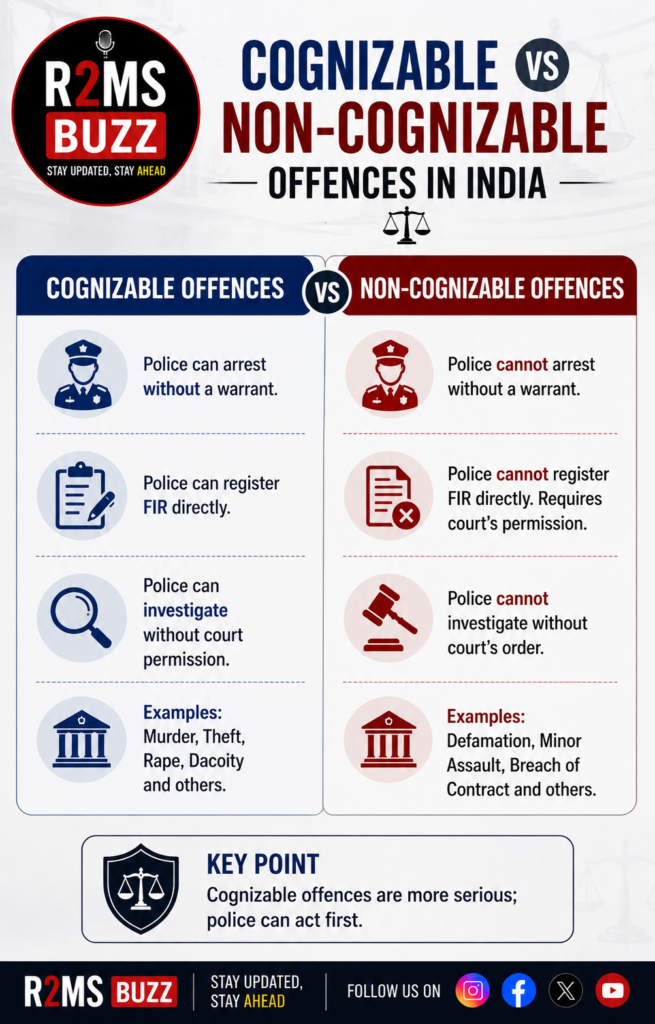
When information relates to a non-cognizable offence, the police follow the procedure prescribed by law.
This may include:
- Recording the information received.
- Advising the complainant about the available legal process.
- Taking further steps where legally authorized.
- Assisting the court as required.
The exact procedure depends on the nature of the offence and the governing legal provisions.
How Does an FIR Fit into the Process?
An FIR is commonly associated with many cognizable offences.
A simplified flow is:
Information Received → FIR (where required) → Investigation → Evidence Collection → Charge Sheet or Appropriate Final Report → Court Proceedings
For non-cognizable matters, the process follows a different statutory framework.
Arrest Powers Explained
One of the biggest differences between these categories relates to police powers during the investigation.
It is important to remember:
- Not every cognizable offence results in an immediate arrest.
- Police must act within the limits of the law and consider the facts of the case.
- Courts oversee the legality of arrests and detention.
- Individuals continue to enjoy constitutional and legal protections during the investigation.
The decision to arrest depends on the legal requirements and the circumstances of each case.
Rights of Citizens
Whether an allegation relates to a cognizable or non-cognizable offence, individuals continue to enjoy important legal protections.
These include:
- Fair treatment by authorities.
- Access to legal representation where applicable.
- Protection against unlawful detention.
- Fair investigation.
- Judicial oversight.
- Opportunity to seek legal remedies.
Respect for these rights is essential to maintaining public confidence in the justice system.
Why Understanding the Difference Is Important
Knowing the distinction between cognizable and non-cognizable offences helps citizens:
- Understand why different police procedures apply.
- Read legal news more accurately.
- Avoid common misconceptions.
- Know what to expect during a criminal investigation.
- Better understand their legal rights and responsibilities.
Legal awareness promotes informed participation in the justice system.
Common Misconceptions
Myth: Every cognizable offence leads to an arrest.
Fact: Arrest depends on the facts of the case and the applicable legal requirements.
Myth: Non-cognizable offences are insignificant.
Fact: They are recognised by law and may have legal consequences, even though the procedural framework differs.
Myth: Police can act without following legal procedures.
Fact: Police investigations and arrests must comply with constitutional safeguards and statutory requirements.
Myth: An FIR proves the allegations are true.
Fact: An FIR records information about an alleged offence. The truth of the allegations is determined through investigation and, where applicable, trial.
Frequently Asked Questions (FAQs)
What is a cognizable offence?
A cognizable offence is generally a more serious category of offence for which the police may take investigative steps in accordance with the applicable law after receiving qualifying information.
What is a non-cognizable offence?
A non-cognizable offence is one for which the legal procedure differs and is governed by the provisions applicable to such offences.
Can police investigate every complaint immediately?
The procedure depends on the nature of the alleged offence and the applicable legal provisions.
Is an FIR registered in every case?
No. Whether an FIR is registered depends on the facts presented and the legal classification of the alleged offence.
Can a non-cognizable matter become more serious?
The legal position depends on the facts and the offences disclosed during the investigation or subsequent proceedings.
Does registration of an FIR mean someone is guilty?
No. Guilt can only be determined by a competent court after evaluating the evidence.
Can the police refuse to act on a complaint?
The police are required to act in accordance with the law. The appropriate legal response depends on the nature of the information received.
Why is the classification of offences important?
It determines the legal procedure, investigative powers, and the steps that follow in the criminal justice process.
Who decides whether an offence is cognizable?
The classification is determined by the relevant criminal laws enacted by the legislature.
Where can citizens learn more about criminal procedures?
Reliable sources include official government publications, legal aid authorities, court websites, and qualified legal professionals.
Conclusion
The distinction between cognizable and non-cognizable offences forms an important part of India’s criminal justice system. It determines how police respond to an allegation, the procedure they follow during an investigation, and the role of the courts at different stages. While cognizable offences generally involve more serious allegations and follow one procedural framework, non-cognizable offences follow another prescribed by law.
Understanding these concepts helps citizens interpret legal developments accurately and appreciate why different criminal cases may proceed differently.
Also See related Article Difference Between FIR, Complaint, NCR & Charge Sheet, How Does an FIR Work in India?, What Happens After an FIR Is Filed?, How Police Investigate Criminal Cases in India: Step-by-Step Investigation Process Explained (2026)