
What Is a Zero FIR? Meaning, Rules, Benefits & When Can You File It? (2026)
Many people believe that an FIR can only be registered at the police station that has jurisdiction over the place where an offence occurred. This misunderstanding can delay reporting of crimes, especially in emergencies.
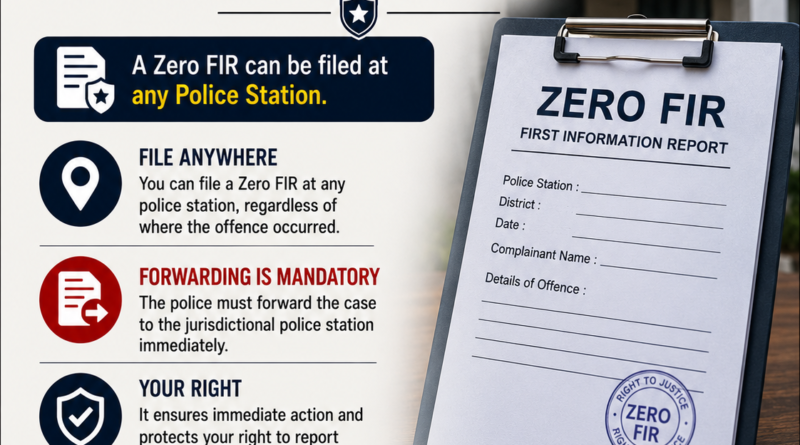
To address this issue, the concept of a Zero FIR allows information about a cognizable offence to be recorded at any police station, regardless of where the alleged offence took place. After registration, the case is transferred to the police station having the appropriate territorial jurisdiction for further investigation.
The objective of a Zero FIR is to ensure that valuable time is not lost, particularly in serious cases where immediate police action may be necessary.
Quick Overview
| Particular | Details |
|---|---|
| Meaning | FIR registered at a police station that does not have territorial jurisdiction |
| Purpose | Ensure immediate reporting and timely police action |
| Applicable To | Information relating to cognizable offences |
| Investigation | Conducted by the police station having jurisdiction after transfer |
| Benefit | Prevents delay in reporting serious offences |
Why Was Zero FIR Introduced?
Before the concept of Zero FIR became widely recognized, people were often directed from one police station to another because the incident had occurred outside the local jurisdiction.
This sometimes resulted in:
- Delay in reporting offences.
- Loss of crucial evidence.
- Difficulty in tracing suspects.
- Increased hardship for victims.
Zero FIR helps reduce these delays by allowing the first police station approached to record the information and initiate the legal process.
What Does “Zero” Mean?
The word “Zero” refers to the fact that the FIR is initially registered without assigning it the regular jurisdictional serial number of the police station responsible for investigating the case.
After it is transferred to the police station with territorial jurisdiction, it is processed according to the applicable legal procedures.
When Can a Zero FIR Be Filed?
A Zero FIR may be used when information relates to a cognizable offence and the informant approaches a police station that does not have territorial jurisdiction over the place where the incident occurred.
Examples where prompt reporting may be especially important include situations involving:
- Serious assaults
- Kidnapping
- Robbery
- Sexual offences
- Road accidents involving criminal allegations
- Other cognizable offences requiring immediate attention
The specific legal procedure depends on the facts and applicable law.
Who Can File a Zero FIR?
Information leading to a Zero FIR may be provided by:
- The victim.
- A family member.
- A witness.
- Any person who has knowledge of the alleged offence, where permitted by law.
The information should be as accurate and complete as possible.
How Does a Zero FIR Work?
The process generally follows these steps:
Step 1: Report the Incident
The person approaches the nearest police station, even if the incident occurred elsewhere.
Step 2: Information Is Recorded
The police record the information relating to the alleged cognizable offence in accordance with the applicable legal procedure.
Step 3: Immediate Action (Where Necessary)
Depending on the circumstances, the police may take urgent lawful steps to:
- Protect victims.
- Preserve evidence.
- Arrange medical assistance.
- Secure the scene where possible.
- Prevent further harm.
Step 4: Transfer to the Appropriate Police Station
The recorded FIR is transferred to the police station that has territorial jurisdiction over the alleged offence.
That police station then conducts the investigation according to law.
Why Is Zero FIR Important?
Zero FIR serves several important purposes:
- Reduces delay in reporting serious offences.
- Helps preserve evidence.
- Enables quicker police response in emergencies.
- Protects the interests of victims.
- Improves access to the criminal justice system.
It ensures that jurisdictional questions do not unnecessarily delay the reporting of serious allegations.
Common Misconceptions
Myth: A Zero FIR can be filed only by the victim.
Fact: Depending on the circumstances and the applicable law, information may also be provided by a witness, a family member, or another person with knowledge of the alleged offence.
Myth: A Zero FIR is different from a normal FIR.
Fact: A Zero FIR follows the same legal process after it is transferred to the police station with territorial jurisdiction. The key difference lies in where it is initially registered.
Myth: Every complaint becomes a Zero FIR.
Fact: Zero FIR is relevant to information about cognizable offences and depends on the facts and applicable legal provisions.
Myth: Police can refuse to record a Zero FIR solely because the incident occurred elsewhere.
Fact: The legal framework provides for recording qualifying information and transferring it to the appropriate police station, subject to the applicable law.
Zero FIR vs Regular FIR
Many people think a Zero FIR and a regular FIR are different legal documents. In reality, both are First Information Reports. The main difference is where they are initially registered.
| Feature | Zero FIR | Regular FIR |
|---|---|---|
| Registered At | Any police station, even if it lacks territorial jurisdiction | Police station having territorial jurisdiction |
| Purpose | Avoid delay in reporting a cognizable offence | Begin investigation within the police station’s jurisdiction |
| Investigation | Conducted after transfer to the appropriate police station | Conducted by the same police station |
| Legal Status | Valid FIR | Valid FIR |
Once transferred, a Zero FIR is handled in the same manner as any other FIR.
How Is a Zero FIR Transferred?
After the information is recorded:
Step 1: Registration
The police station receiving the complaint records the Zero FIR.
Step 2: Preliminary Action (If Needed)
If urgent action is necessary, police may:
- Arrange medical assistance.
- Preserve evidence.
- Secure the scene where possible.
- Take lawful steps to prevent further harm.
Step 3: Transfer
The Zero FIR is forwarded to the police station that has territorial jurisdiction over the place where the alleged offence occurred.
Step 4: Investigation Begins
The police station with jurisdiction continues the investigation according to the applicable legal procedure.
Situations Where Zero FIR Is Especially Useful

A Zero FIR can be particularly important in situations where immediate reporting is necessary, such as:
- A traveller becomes a victim of a serious offence away from home.
- A road accident involving criminal allegations occurs in another district or state.
- A person reports a kidnapping or missing child while away from the place of occurrence.
- Serious assaults or other cognizable offences requiring urgent police response.
In such situations, the nearest police station can record the information without requiring the person to first travel to another jurisdiction.
Benefits of Zero FIR
Zero FIR offers several practical advantages:
- Enables immediate reporting of serious offences.
- Helps preserve important evidence.
- Reduces delays caused by jurisdictional issues.
- Allows quicker police response.
- Makes the justice system more accessible.
- Protects victims during emergencies.
- Supports timely investigation.
Rights of Victims While Filing a Zero FIR
Victims and informants are generally entitled to fair treatment during the reporting process.
Depending on the circumstances, they may expect:
- Respectful treatment.
- Recording of qualifying information according to law.
- Information about the next procedural steps.
- Medical assistance where urgently required.
- Protection of privacy where applicable.
These rights are subject to the applicable legal framework.
Can a Zero FIR Be Filed Online?
The availability of online reporting depends on the State or Union Territory and the services offered by the respective police department.
Many police departments provide online portals or emergency services for certain categories of complaints, while others may require the informant to visit a police station.
Citizens should refer to the official website of the relevant State Police for current procedures.
Common Mistakes to Avoid
When reporting an offence, avoid:
- Delaying the report unnecessarily.
- Providing false or misleading information.
- Concealing important facts.
- Destroying or altering evidence.
- Relying on rumours instead of actual knowledge.
Accurate and timely reporting assists the investigation.
Common Misconceptions
Myth: Zero FIR is only for women.
Fact: Zero FIR is not restricted to any particular gender. It applies to qualifying cognizable offences regardless of who reports them.
Myth: A Zero FIR has less legal value than a regular FIR.
Fact: A Zero FIR is a valid FIR. After transfer, it is processed under the same legal framework as any other FIR.
Myth: A Zero FIR cannot be transferred to another police station.
Fact: Transfer to the police station with territorial jurisdiction is a key feature of the Zero FIR process.
Myth: Police can refuse to record a Zero FIR solely because the offence occurred elsewhere.
Fact: The purpose of Zero FIR is to prevent delays caused by jurisdictional issues in qualifying cases.
Frequently Asked Questions (FAQs)
What is a Zero FIR?
A Zero FIR is an FIR recorded at a police station that does not have territorial jurisdiction over the alleged offence. It is later transferred to the appropriate police station for investigation.
Is a Zero FIR legally valid?
Yes. It is a valid First Information Report and follows the same legal process after transfer.
Who can file a Zero FIR?
Depending on the circumstances, the victim, a family member, a witness, or another person with knowledge of the alleged offence may provide the information, where permitted by law.
Can a Zero FIR be transferred?
Yes. After registration, it is transferred to the police station having territorial jurisdiction.
Does a Zero FIR start the investigation?
Urgent lawful action may be taken where necessary, and the detailed investigation is generally carried out by the police station with jurisdiction after the transfer.
Can a Zero FIR be filed in another state?
Yes. If the incident relates to a qualifying cognizable offence, the nearest police station may record the information and transfer it according to the applicable procedure.
Is there any fee for filing a Zero FIR?
No. Filing an FIR, including a Zero FIR, does not involve a government fee.
Does every complaint become a Zero FIR?
No. Zero FIR is applicable only in appropriate situations involving information about cognizable offences.
Can a Zero FIR be cancelled?
Any further action depends on the investigation, the facts of the case, and the orders of the competent authorities or courts.
Why is Zero FIR important?
It helps ensure that jurisdictional issues do not delay the reporting of serious offences and allows the legal process to begin promptly.
Conclusion
Zero FIR is an important legal mechanism that enables the prompt reporting of cognizable offences without being delayed by questions of territorial jurisdiction. By allowing any police station to record qualifying information and transfer the case to the appropriate jurisdiction, it helps preserve evidence, supports timely police action, and improves access to justice. Understanding how Zero FIR works empowers citizens to respond quickly in emergencies while respecting the legal procedures that govern criminal investigations.
Also See related Article How Does an FIR Work in India?, Difference Between FIR, Complaint, NCR & Charge Sheet, Cognizable vs Non-Cognizable Offences in India: Complete Guide with Examples (2026), How Police Investigate Criminal Cases in India: Step-by-Step Investigation Process Explained (2026)