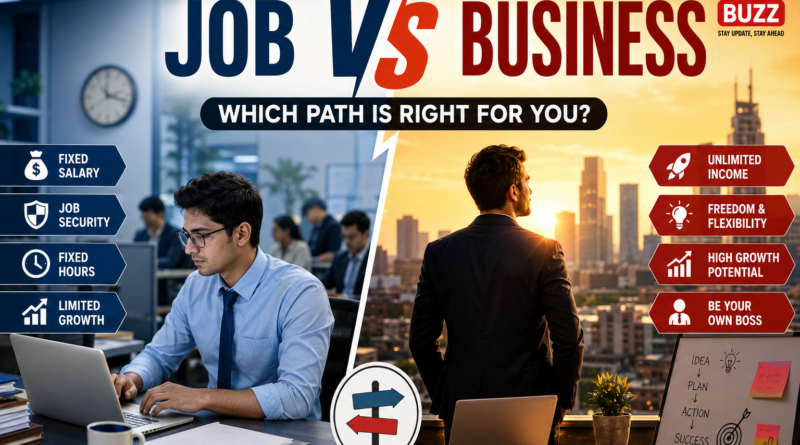
Job vs Business: Which Career Path Is Better in 2026?
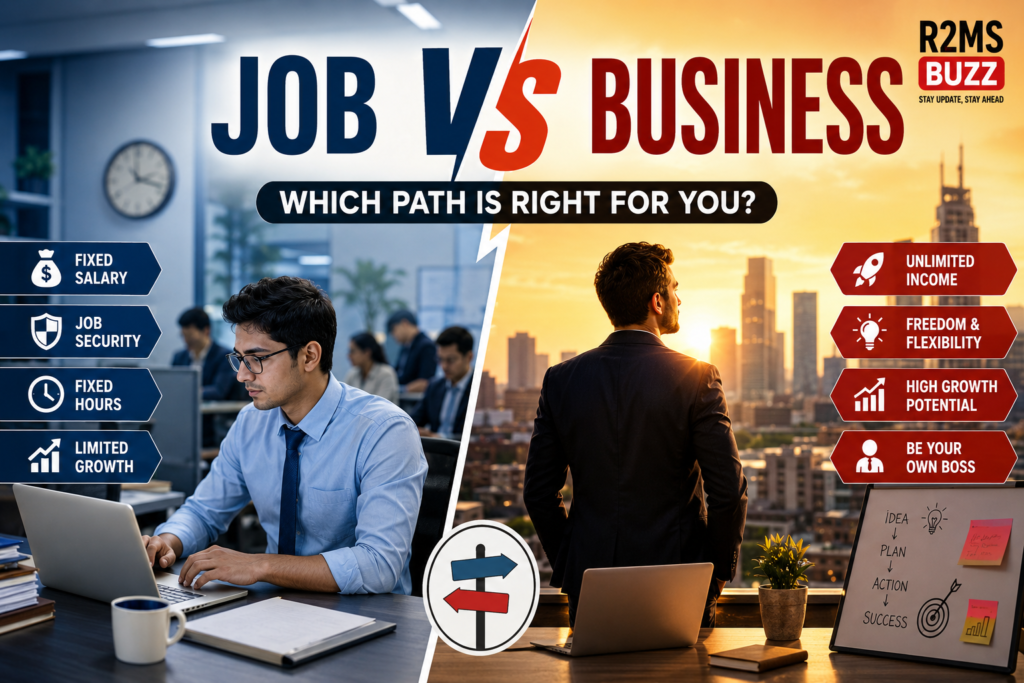
Job vs Business: Which Is Better? My Honest Opinion
One of the biggest questions young people face today is whether they should take a job or start a business.
Some believe a government or private job offers stability and peace of mind. Others dream of becoming entrepreneurs, building their own companies, and creating wealth.
The truth is that there is no single answer. Both paths have advantages and challenges. The right choice depends on your personality, financial situation, skills, and long-term goals.
Let’s compare them in detail.
What Is a Job?
A job means working for an employer in exchange for a salary. It may be in the government or private sector.
Employees usually receive:
- Monthly salary
- Fixed working hours (depending on the role)
- Paid leave
- Job benefits
- Retirement benefits (in some organizations)
A job provides predictable income, making financial planning easier.
What Is a Business?
A business involves offering products or services to customers with the goal of earning a profit.
Business owners are responsible for:
- Finding customers
- Managing finances
- Marketing
- Hiring employees (if needed)
- Taking financial risks
- Growing the company
Unlike a job, business income is not fixed. Earnings can vary from month to month.
Job vs Business Comparison
| Factor | Job | Business |
|---|---|---|
| Income | Fixed salary | Can vary significantly |
| Risk | Generally lower | Usually higher |
| Working Hours | Often fixed | Can be flexible but sometimes longer |
| Financial Security | More predictable | Depends on business performance |
| Growth Potential | Promotions and salary increases | Potential for substantial growth |
| Decision Making | Guided by employer | You make the decisions |
| Responsibility | Limited to assigned role | Responsible for the entire business |
| Holidays | Usually paid | Often depend on business needs |
Advantages of Having a Job
A job offers several benefits.
Stable Income
A regular monthly salary helps cover daily expenses and supports long-term financial planning.
Lower Financial Risk
Employees are not personally responsible for business losses.
Skill Development
Working in a company helps build technical knowledge, teamwork, and communication skills.
Employee Benefits
Many employers provide health insurance, paid leave, bonuses, and retirement plans.
Advantages of Starting a Business
Business ownership has its own rewards.
Unlimited Growth Potential
Unlike a fixed salary, business income can increase as the company grows.
Independence
Business owners decide how to operate and develop their company.
Building an Asset
A successful business can become a valuable long-term asset that may continue generating income.
Job Creation
Businesses contribute to the economy by creating employment opportunities.
Challenges of a Job
Jobs also have limitations.
- Salary growth may be gradual.
- Promotions are not always guaranteed.
- Employees have less control over company decisions.
- Career growth may depend on organizational structure.
Challenges of Business
Running a business is rewarding but demanding.
- Income may fluctuate.
- Competition can be intense.
- Business owners often work long hours, especially in the early stages.
- Financial losses are possible.
- Success requires persistence and careful planning.
Skills Needed for Success
For a Job
- Communication
- Teamwork
- Technical expertise
- Time management
- Professionalism
For Business
- Leadership
- Sales and marketing
- Financial management
- Problem-solving
- Adaptability
Regardless of the path you choose, continuous learning is essential.
Can You Do Both?
Yes.
Many people start with a full-time job to gain experience and financial stability. Later, they launch a business after building savings, skills, and industry knowledge.
This approach can reduce financial risk while providing valuable real-world experience.
My Opinion
In my opinion, neither a job nor a business is inherently better.
A job is well suited to people who value stable income and structured career growth.
A business may be a better fit for those who enjoy solving problems, taking calculated risks, and building something of their own.
The most important decision is choosing a path that matches your strengths and goals—not simply following what others are doing.
Final Thoughts
The debate between job vs business has no universal winner.
Both contribute to society in different ways.
Businesses create opportunities, while employees help organizations succeed.
Instead of asking, “Which is better?” ask yourself:
“Which path matches my skills, interests, and long-term vision?”
The answer to that question is likely to be the right one for you.
FAQs
Is business better than a job?
Not necessarily. Business offers greater growth potential but also higher risk. Jobs generally provide more stable income.
Can I start a business while working?
Yes. Many entrepreneurs begin their businesses while employed, provided they comply with their employer’s policies and can manage both responsibilities.
Which earns more?
A job provides predictable income. A business may earn more over time, but there is no guarantee.
Which is safer?
Generally, a job offers greater financial stability, while a business involves more uncertainty.
Also See related Article Best AI Tools in 2026: 20 Powerful AI Tools That Can Save Time and Boost Productivity, Can AI Take Over Jobs in the IT Sector? The Truth Every Tech Professional Should Know, 💼 Business, Best Graduation Course for UPSC: A Complete Decision Guide for IAS Aspirants