
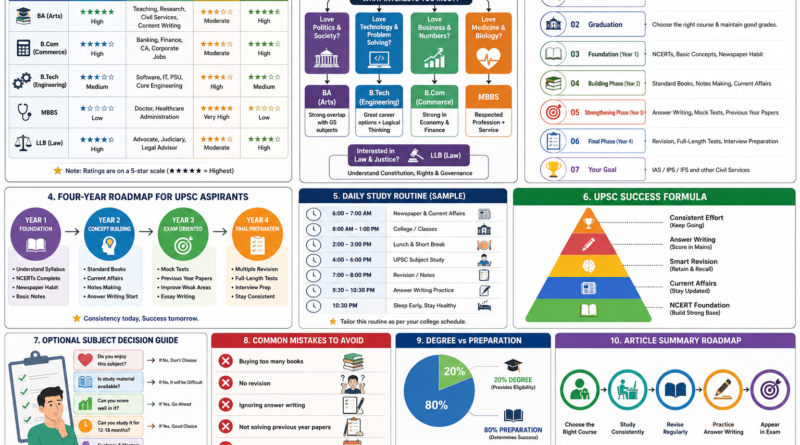
Best Graduation Course for UPSC: A Complete Decision Guide for IAS Aspirants
Every year, thousands of students search Google for one question:
“Which graduation course is best for UPSC?”
The internet is filled with opinions. Some people say only Arts students become IAS officers, while others believe engineers dominate the UPSC exam.
The reality is different.
Every year, candidates from Engineering, Medicine, Commerce, Arts, Science, Law, Agriculture, and many other academic backgrounds successfully clear the Civil Services Examination.
The UPSC does not award extra marks based on your graduation degree. It evaluates your knowledge, analytical ability, answer-writing skills, and personality.
So instead of asking,
“Which degree is best?”
Ask yourself,
“Which degree will help me stay consistent for the next three to four years while also giving me a strong career backup?”
That question usually leads to the right decision.
What Does UPSC Officially Say?
According to the UPSC Civil Services Examination eligibility criteria, a candidate must possess a recognized bachelor’s degree from a university established by law.
This means that whether you study:
- BA
- B.Tech
- B.Com
- B.Sc.
- MBBS
- LLB
- Agriculture
- Pharmacy
- Nursing
…you are equally eligible to appear for the Civil Services Examination after graduation.
Key Takeaway: UPSC does not have a “preferred degree.”
Real-Life Example 1: Tina Dabi (Political Science Background)
One of the most well-known UPSC success stories is Tina Dabi, who completed her graduation in Political Science from Lady Shri Ram College, University of Delhi.
Political Science naturally helped her understand topics such as:
- Indian Constitution
- Parliament
- Governance
- Public Administration
- International Relations
However, her success was not because she chose Political Science alone. In interviews, she has highlighted the importance of discipline, revision, and consistency throughout preparation.
Lesson for Students
Choosing a subject that overlaps with the UPSC syllabus can help, but consistent preparation matters much more than the degree itself.
Real-Life Example 2: Shubham Kumar (Engineering Background)
Shubham Kumar, who secured AIR 1 in the UPSC Civil Services Examination 2020, graduated in Civil Engineering from IIT Bombay.
Many students assume Engineering is a disadvantage because it has less overlap with the UPSC syllabus.
His journey proved otherwise.
Despite a demanding technical background, he succeeded through:
- Limited study resources
- Regular mock tests
- Continuous revision
- Self-analysis after every test
Lesson
Your graduation stream does not decide your rank.
Your preparation strategy does.
Real-Life Example 3: Ishita Kishore (Economics Background)
Ishita Kishore, who secured AIR 1 in the UPSC Civil Services Examination 2022, graduated in Economics from Shri Ram College of Commerce (SRCC).
She has publicly spoken about maintaining consistency, practicing answer writing, and staying focused instead of comparing herself with others.
Lesson
A structured routine followed consistently is often more effective than studying extremely long hours without a plan.
Which Graduation Course Is Right for You?
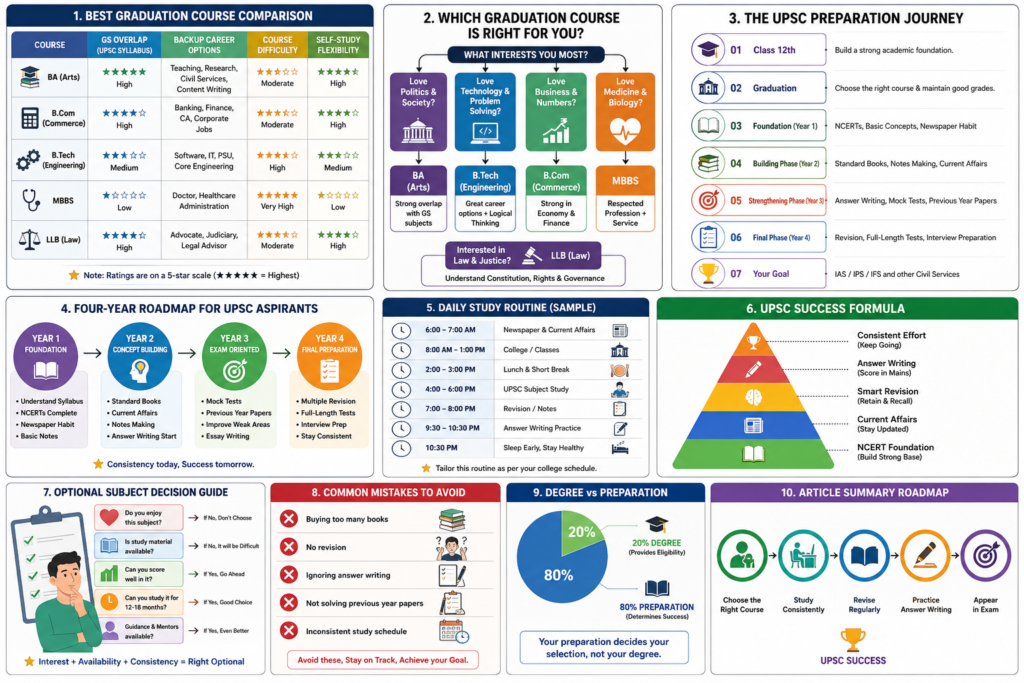
Instead of copying someone else’s decision, choose based on your interests.
| If You Enjoy… | Recommended Graduation Course | Why It Helps |
|---|---|---|
| Politics & Governance | BA Political Science | Strong overlap with Polity and Governance |
| History & Culture | BA History | Excellent foundation for Modern India and Culture |
| Maps & Environment | BA Geography | Useful for Geography and Environment |
| Numbers & Finance | B.Com | Helps with Economy and Financial Awareness |
| Technology & Problem Solving | B.Tech | Builds analytical thinking and offers a strong career backup |
| Science & Research | B.Sc. | Useful for Science & Technology topics |
| Law & Constitution | LLB | Helps in Polity, Governance, and Constitutional understanding |
Common Mistakes Students Make
Mistake #1: Changing Your Stream Only Because Someone Said It Is Better
Many students switch from Science or Commerce to Arts believing it guarantees UPSC success.
Reality: There is no evidence that changing streams alone improves your chances. Students from every academic background clear the examination every year.
Mistake #2: Ignoring Your Backup Career
UPSC is highly competitive, and success may take more than one attempt.
Choose a graduation course that you genuinely enjoy and that also provides employment opportunities if your plans change.
Expert Guidance
The “best” graduation course is not the one with the highest syllabus overlap. It is the one you can study sincerely for three or four years while building a strong UPSC foundation through daily reading, revision, and answer-writing practice.
Your degree opens the door to the exam. Your preparation determines whether you become an IAS officer.
Deep Analysis: Choosing the Right Graduation Course for UPSC
Many students make one common mistake—they choose a graduation course based on YouTube videos or advice from friends.
However, UPSC toppers repeatedly emphasize one thing:
Choose a degree that you can genuinely enjoy and complete successfully.
A degree is not just your eligibility for UPSC; it is also your backup career and the subject you will study for the next three to four years.
Decision Framework: Which Graduation Course Should You Choose?
Instead of asking, “Which course is best for UPSC?”, ask yourself these five questions.
Question 1: What Subjects Do I Enjoy?
If you enjoy reading about history, politics, governance, and international affairs, Arts subjects may naturally keep you engaged.
If you enjoy mathematics, programming, and solving technical problems, Engineering may be a better choice.
If you like accounting, taxation, and business, Commerce can be an excellent option.
Choosing a subject you dislike simply because someone called it “best for UPSC” often leads to burnout.
Question 2: Do I Need a Strong Backup Career?
UPSC has a highly competitive selection process.
Having a graduation degree that also offers strong career opportunities can reduce pressure during preparation.
| Graduation Course | Career Backup |
|---|---|
| B.Tech | Software Engineer, PSU, IT Companies |
| MBBS | Doctor, Hospital Administration |
| B.Com | Banking, Finance, CA, Corporate Jobs |
| BA | Teaching, Research, Public Policy |
| LLB | Advocate, Judiciary, Corporate Law |
Expert Advice: Never choose a degree without considering what you would do if UPSC takes longer than expected.
Real-Life Example: Engineering Student
Rahul completed B.Tech in Computer Science.
During his first year, he realized he wanted to become an IAS officer.
Instead of changing his graduation stream, he followed this strategy:
• College classes during the day.
• Two hours of UPSC preparation every evening.
• Newspaper reading every morning.
• Weekend revision.
By graduation, Rahul had already completed the NCERT books, standard reference books, and current affairs notes.
Lesson: You don’t have to change your degree to prepare for UPSC effectively.
Real-Life Example: Commerce Student
Priya pursued B.Com because she enjoyed finance and accounting.
Initially, she worried that Commerce students might be at a disadvantage.
She focused on:
- Reading NCERT History and Geography.
- Building a strong understanding of Economics.
- Improving answer-writing skills.
- Revising consistently.
Her Commerce background later helped her understand topics such as budgeting, taxation, banking, and the Indian economy.
Lesson: Every stream has strengths. The key is identifying and strengthening your weak areas.
Real-Life Example: Arts Student
Anjali joined BA Political Science because she was interested in governance.
Instead of relying only on her college syllabus, she:
- Read the Constitution alongside her classes.
- Followed parliamentary debates.
- Read newspapers daily.
- Practiced answer writing every Sunday.
By the time she graduated, she had already built a strong General Studies foundation.
Lesson: Syllabus overlap helps, but consistency creates success.
Which Course Requires the Most Extra Effort?
| Graduation Course | Strong Areas | Areas Requiring Extra Preparation |
| BA Political Science | Polity, IR | Economy |
| BA History | Modern History | Science & Technology |
| B.Tech | CSAT, Logical Ability | History, Sociology |
| B.Com | Economy | History, Geography |
| MBBS | Science | History, Polity |
| LLB | Constitution | Geography, Environment |
Every graduation course has strengths and weaknesses.
UPSC rewards balanced preparation—not one strong subject.
Reality Check: There Is No “Perfect Degree”
Every year, successful UPSC candidates come from:
- Engineering
- Commerce
- Arts
- Medicine
- Science
- Law
- Agriculture
What do they have in common?
✔ Consistency
✔ Smart revision
✔ Newspaper reading
✔ Mock tests
✔ Answer writing
✔ Patience
Not their graduation degree.
Expert Checklist Before Choosing Your Degree
Before taking admission, ask yourself:
□ Can I study this subject for the next 3–4 years?
□ Does it provide a career backup?
□ Am I genuinely interested in it?
□ Can I balance it with UPSC preparation?
□ Will I stay motivated during difficult periods?
If you answer “Yes” to all five questions, you have likely found the right course.
Final Expert Advice
Choosing the right graduation course is important.
But choosing the right daily routine is even more important.
A student who studies consistently for three years will usually outperform a student who keeps searching for the “perfect” degree.
UPSC doesn’t reward the smartest degree.
It rewards the smartest preparation.
Should Your Graduation Subject Be Your UPSC Optional?
This is one of the most frequently asked questions by UPSC aspirants.
The answer is:
Not necessarily.
Many candidates choose their graduation subject as their optional because they already have a basic understanding of it. However, others select a different optional based on their interest, availability of study material, previous performance, or guidance.
Before Choosing an Optional Subject, Ask Yourself:
- Do I genuinely enjoy this subject?
- Can I study it for 12–18 months without losing interest?
- Is quality study material available?
- Can I write analytical answers on this subject?
- Am I comfortable revising it multiple times?
Choosing an optional only because someone else scored well with it is rarely a good strategy.
Graduation Subject vs Optional Subject
| Graduation Subject | Common Optional Choice | Is It Mandatory? |
|---|---|---|
| BA Political Science | Political Science | No |
| BA History | History | No |
| BA Geography | Geography | No |
| B.Com | Commerce & Accountancy | No |
| B.Tech | Mathematics or another optional | No |
| MBBS | Medical Science | No |
| LLB | Law | No |
Key Takeaway
Your graduation subject can be a good optional, but it is not compulsory to choose it.
Real-Life Example: Different Paths Can Work
Imagine two students.
Student A
- BA in Political Science
- Chooses Political Science as Optional
- Already familiar with the subject
- Needs deeper analysis and answer-writing practice
Student B
- B.Tech in Mechanical Engineering
- Chooses Sociology as Optional
- Starts from scratch
- Studies consistently for a year
If both prepare well, either student can perform well in UPSC. Success depends on preparation quality, not academic background.
Can You Balance College and UPSC Preparation?
Yes, but only if you follow a realistic schedule.
Many students fail because they copy study plans designed for full-time aspirants.
Instead, create a routine that fits your college timetable.
Sample Weekly Plan for College Students
| Day | Focus |
| Monday | NCERT + Current Affairs |
| Tuesday | Polity |
| Wednesday | Geography |
| Thursday | History |
| Friday | Economy |
| Saturday | Revision + MCQs |
| Sunday | Mock Test + Answer Writing |
This approach allows steady progress without neglecting graduation.
Time Management Strategy
During Semester Classes
- Read the newspaper for 30–45 minutes.
- Study one UPSC subject for 1–2 hours.
- Revise before sleeping.
During Semester Breaks
- Increase study time.
- Complete pending topics.
- Practice previous-year questions.
- Take sectional mock tests.
Instead of aiming for very long study sessions every day, focus on maintaining consistency.
Common Mistakes Students Make
Mistake 1: Ignoring Graduation
Some students become so focused on UPSC that they neglect their college studies.
A good academic record can still be valuable for future opportunities.
Mistake 2: Buying Too Many Books
Owning many books does not improve preparation.
Study a limited set of trusted resources thoroughly and revise them repeatedly.
Mistake 3: Watching Endless Strategy Videos
Learning from experienced mentors can be helpful, but constantly changing your strategy often leads to confusion.
Spend more time studying than consuming preparation content.
Mistake 4: Ignoring Writing Practice
UPSC Mains is a descriptive examination.
Even strong knowledge needs to be expressed clearly within a limited time.
Start with one or two answers per week and gradually increase your practice.
Expert Advice for First-Year Students
Month 1–3
- Understand the UPSC syllabus.
- Read NCERT books.
- Develop a newspaper-reading habit.
Month 4–6
- Begin standard reference books.
- Make concise notes.
- Revise every weekend.
Month 7–12
- Solve previous-year questions.
- Start basic answer writing.
- Improve current affairs preparation.
By the end of the first year, you should have a solid conceptual foundation rather than trying to finish the entire syllabus.
One-Year Milestone Checklist
By the end of your first year, aim to complete the following:
- ✅ Read the UPSC syllabus thoroughly.
- ✅ Finish core NCERT books.
- ✅ Build a daily current affairs routine.
- ✅ Create your own revision notes.
- ✅ Solve previous-year questions.
- ✅ Practice basic answer writing.
- ✅ Maintain consistency.
Final Thoughts
Choosing the right graduation course is only the beginning of your UPSC journey.
The real difference is created by your daily habits:
- Reading with understanding.
- Revising regularly.
- Writing answers.
- Learning from mistakes.
- Staying consistent over months and years.
A degree gives you eligibility.
Your preparation builds your capability.
And your consistency creates your results.
A 4-Year UPSC Roadmap (Starting After Class 12)
Many students ask,
“If I start preparing after Class 12, what should I do every year?”
The biggest mistake beginners make is trying to complete the entire UPSC syllabus in the first few months.
Instead, think of your preparation as a long-term project.
Year 1: Build Strong Fundamentals
Primary Goal
Understand the examination rather than rushing through study material.
Focus Areas
- Read the complete UPSC syllabus.
- Complete NCERT books.
- Develop a daily newspaper habit.
- Learn basic answer-writing techniques.
- Create short revision notes.
Weekly Goal
- One subject
- One revision session
- One answer-writing practice
- One previous-year question analysis
Expected Outcome
A strong conceptual foundation.
Year 2: Expand Your Knowledge
During your second year of graduation, begin connecting static subjects with current affairs.
Study Goals
- Read standard reference books.
- Solve previous-year papers.
- Practice writing two to three answers every week.
- Build subject-wise notes.
Skills to Improve
- Analytical thinking
- Writing quality
- Time management
- Revision techniques
Year 3: Exam-Oriented Preparation
This is the stage where preparation becomes more focused.
Priorities
- Multiple revisions
- Regular mock tests
- Essay practice
- Current affairs integration
- Improving weak subjects
Start identifying recurring mistakes and work on them systematically.
Final Year / Graduation Completed
Now your preparation should become test-oriented.
Focus on:
- Full-length mock tests
- Revision cycles
- Improving answer presentation
- Interview awareness
- Maintaining physical and mental well-being
Monthly Preparation Checklist
Every month, ask yourself:
✔ Did I complete my study targets?
✔ Did I revise everything I studied?
✔ Did I solve previous-year questions?
✔ Did I improve my answer-writing?
✔ Did I learn something new from current affairs?
✔ Did I avoid unnecessary distractions?
Small improvements every month lead to significant progress over time.
Skills Every UPSC Aspirant Should Develop
UPSC preparation is not only about reading books.
Successful preparation also requires:
Reading Skills
Understand concepts instead of memorizing facts.
Writing Skills
Present ideas clearly, logically, and within the word limit.
Analytical Thinking
Ask questions such as:
- Why did this happen?
- What are the causes?
- What are the possible solutions?
- What could be the long-term impact?
Communication Skills
These become especially valuable during the Personality Test (Interview).
Decision-Making Ability
Develop the habit of evaluating different viewpoints before forming conclusions.
Common Questions Students Ask
Can I Crack UPSC Without Coaching?
Many successful candidates prepare primarily through self-study.
Coaching can provide structure for some learners, but disciplined self-study with reliable resources is also a valid path.
How Many Hours Should I Study?
There is no fixed number that guarantees success.
A realistic schedule that you can follow consistently is generally more effective than aiming for very long study hours that are difficult to sustain.
Which Newspaper Should I Read?
Many aspirants read national newspapers such as The Hindu or The Indian Express along with official government sources like PIB for important updates.
Choose one reliable newspaper and read it consistently rather than switching between multiple sources.
Should I Read Every Book Recommended Online?
No.
A limited set of high-quality resources, revised multiple times, is usually more effective than collecting dozens of books.
Final Action Plan
If you are in Class 12 or the first year of graduation, here is a practical starting plan:
Step 1
Understand the UPSC syllabus and examination pattern.
Step 2
Complete the relevant NCERT books.
Step 3
Develop a habit of reading current affairs daily.
Step 4
Begin making concise notes in your own words.
Step 5
Practice answer writing gradually.
Step 6
Revise regularly.
Step 7
Stay consistent and evaluate your progress every month.
Final Thoughts
Many students spend months searching for the “best graduation course.”
In reality, the degree is only one part of the journey.
Your daily routine, willingness to learn, regular revision, and disciplined preparation will have a much greater impact on your performance than the title of your degree.
Whether you study Engineering, Commerce, Arts, Science, Law, or Medicine, your chances of success depend on how effectively you prepare—not on the stream you choose.
UPSC is a demanding examination, but with patience, smart planning, and sustained effort, you can build a strong foundation for your goal of joining the Civil Services.
Key Takeaways
- Choose a graduation course based on your interests and career goals.
- Understand the UPSC syllabus early.
- Build strong fundamentals before moving to advanced material.
- Follow a realistic and sustainable study routine.
- Revise consistently and practice answer writing.
- Use a limited set of trusted resources.
- Focus on long-term progress rather than quick results.
- Remember: your degree provides eligibility, but your preparation determines your performance.
Also see related Article UPSC Eligibility, How to Start UPSC Preparation After 12th: A Complete Beginner’s Guide (2026)