
How the British Came to India: The Story Behind British Rule
How the British Came to India: From Traders to Rulers
When we think about British rule in India, one question naturally comes to mind:
How did a small trading company from England end up ruling one of the richest civilizations in the world for nearly 200 years?
The answer isn’t as simple as “they invaded India.” The British first arrived as traders. Over time, they took advantage of political divisions, military technology, and economic opportunities to expand their influence. What started as trade gradually turned into one of history’s largest colonial empires.
Let’s explore how it all began.
India Before the British
Long before the British arrived, India was one of the world’s wealthiest regions.
Indian merchants traded spices, silk, cotton, indigo, precious stones, and other goods with countries across Asia, the Middle East, and Europe. Cities like Surat, Agra, Delhi, and Lahore were major commercial centers.
At the beginning of the 17th century, the Mughal Empire was one of the most powerful empires in the world. Emperor Akbar had strengthened the empire, and his successors inherited vast territories and enormous wealth.
This prosperity attracted European traders.
Why Did Europeans Want to Reach India?
Europe had a huge demand for Indian goods.
Some of the most valuable products included:
- Black pepper
- Cardamom
- Cinnamon
- Cotton textiles
- Silk
- Indigo dye
- Tea (later)
- Precious stones
Earlier, these goods reached Europe through Arab and Venetian traders, making them very expensive.
European countries wanted to trade directly with India to increase profits.
Portugal was the first major European power to establish a sea route to India after Vasco da Gama reached Calicut in 1498.
Soon, the Dutch, French, and British followed.
Formation of the East India Company
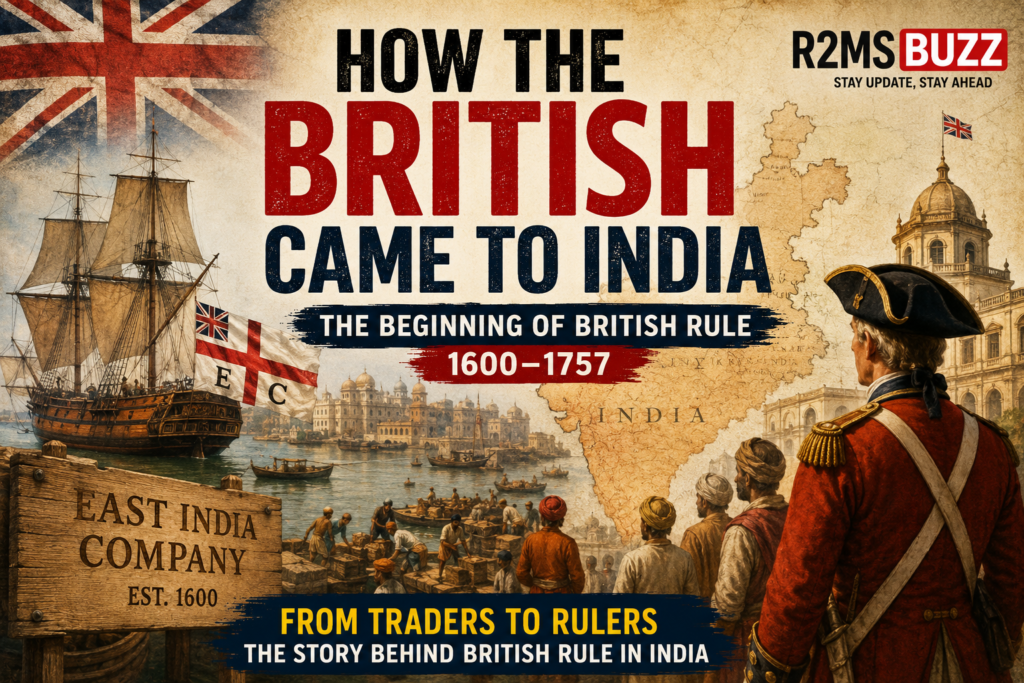
On 31 December 1600, Queen Elizabeth I granted a royal charter to the English East India Company.
The company’s original goal was simple:
Buy goods from Asia and sell them in Europe for profit.
It was not created to rule India.
Initially, it was only a trading company.
The British Arrive in India
The East India Company established its first trading post at Surat in present-day Gujarat.
Emperor Jahangir allowed the British to trade in parts of his empire after negotiations with English representatives.
Over time, the company established trading centers called factories in places such as:
- Surat
- Madras (Chennai)
- Bombay (Mumbai)
- Calcutta (Kolkata)
These were not manufacturing factories. They were warehouses and trading offices where goods were stored and shipped.
Competition Among European Powers
The British were not alone.
Several European nations wanted control over Indian trade.
Major competitors included:
| Country | Main Trading Company |
|---|---|
| Portugal | Portuguese Estado da Índia |
| Netherlands | Dutch East India Company (VOC) |
| France | French East India Company |
| Britain | English East India Company |
For many years, these powers competed for influence along India’s coastline.
Eventually, the British gained an advantage through stronger naval power, financial resources, and political strategy.
Decline of the Mughal Empire
One of the biggest reasons for British success was the weakening of the Mughal Empire.
After the death of Aurangzeb in 1707:
- Regional kingdoms became stronger.
- Internal conflicts increased.
- Central authority weakened.
- Provincial rulers gained independence.
This political instability created opportunities for the East India Company to interfere in local affairs.
Instead of conquering a united empire, the British often dealt with divided rulers.
The Battle of Plassey (1757)
A major turning point came on 23 June 1757.
The East India Company, led by Robert Clive, fought the Battle of Plassey against Nawab Siraj-ud-Daulah of Bengal.
Although the Nawab’s army was much larger, several of his commanders, including Mir Jafar, did not support him during the battle.
This betrayal helped the British secure victory.
The Battle of Plassey changed Indian history forever.
It gave the East India Company control over Bengal, one of India’s richest provinces.
Why Was the Battle of Plassey So Important?
Historians consider Plassey one of the most significant battles in Indian history because it marked the beginning of British political dominance.
After the victory:
- The Company gained enormous wealth.
- It increased its military strength.
- It influenced local rulers.
- It expanded its political power beyond trade.
The East India Company was no longer just a business—it had become a political force.
Robert Clive: The Man Behind British Expansion
Robert Clive played a major role in establishing British influence in India.
His military leadership, political negotiations, and alliances helped the East India Company strengthen its position after Plassey.
However, his methods remain controversial.
Some historians credit him with building British power, while others criticize him for exploiting India’s wealth and encouraging corruption.
From Trade to Rule
After Plassey, the East India Company gradually shifted its priorities.
Instead of focusing only on commerce, it began:
- Collecting taxes.
- Maintaining large armies.
- Appointing administrators.
- Influencing succession disputes.
- Expanding territory.
This transformation laid the foundation for British colonial rule.
Timeline
| Year | Event |
|---|---|
| 1498 | Vasco da Gama reaches India |
| 1600 | East India Company established |
| 1608 | First English ship reaches Surat |
| 1613 | First English factory established at Surat |
| 1639 | Madras trading settlement established |
| 1668 | Bombay transferred to the East India Company |
| 1690 | Calcutta established as a trading center |
| 1707 | Death of Aurangzeb |
| 1757 | Battle of Plassey |
Interesting Facts
- The East India Company started as a private company, not the British government.
- Bengal was among the richest regions in Asia before British control.
- The Company eventually maintained one of the world’s largest private armies.
- Initially, the British sought profits through trade rather than territorial expansion.
My Opinion
The British did not become rulers of India overnight.
Their rise resulted from a combination of economic ambition, political strategy, military strength, and divisions among Indian powers.
At the same time, it’s important to recognize that history is complex. The East India Company benefited from opportunities created by internal conflicts within India, but it also reshaped the country’s political and economic systems in ways that had lasting consequences.
Understanding this early period helps explain how a trading company evolved into a colonial power.
Conclusion
The story of British rule in India did not begin with a massive invasion.
It began with ships carrying traders, merchants seeking profit, and agreements with local rulers.
Over time, trade turned into political influence, influence became military control, and military victories such as the Battle of Plassey marked the beginning of British dominance in India.
This was only the first chapter in India’s long journey toward independence.
Frequently Asked Questions
Why did the British first come to India?
The British came to trade in valuable goods such as spices, cotton, silk, and indigo through the East India Company.
What was the East India Company?
It was an English trading company founded in 1600 that later became a major political and military power in India.
Why is the Battle of Plassey important?
The British victory at Plassey in 1757 gave the East India Company control over Bengal and marked the beginning of British political dominance in India.
Who was Robert Clive?
Robert Clive was an officer of the East India Company who led British forces at the Battle of Plassey and played a key role in expanding British influence.
Also see related Article education in india,Higher Education,current affairs for upsc, Education News education importance