
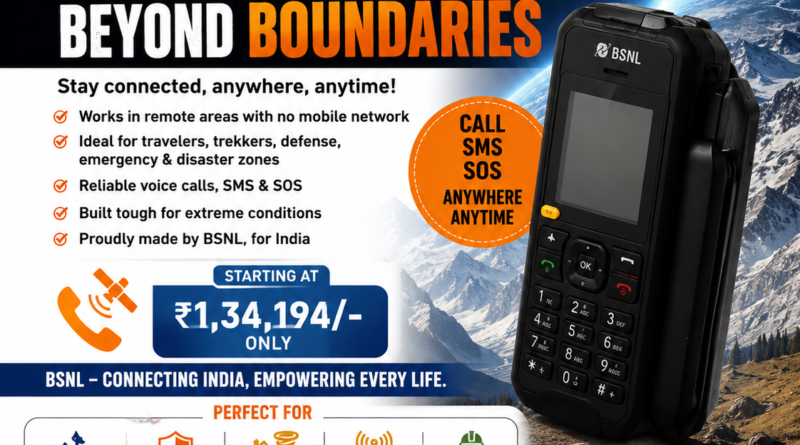
BSNL Satellite Phone: Communication Beyond Boundaries – Everything You Need to Know About India’s Rugged Satellite Connectivity Solution
In a major step toward strengthening communication in remote and disaster-prone regions, Bharat Sanchar Nigam Limited (BSNL) has introduced satellite phone communication services designed to provide connectivity where conventional mobile networks fail. Whether it is a remote Himalayan village, a dense forest, offshore waters, or a disaster-hit region where cellular towers are damaged, satellite phones ensure that communication remains uninterrupted.

Unlike traditional mobile phones that rely on nearby telecom towers, satellite phones communicate directly with satellites orbiting the Earth. This allows users to make voice calls, send SMS messages, and access emergency SOS services even in places where there is absolutely no mobile network coverage.
The launch of BSNL’s satellite communication solution is expected to benefit defense personnel, disaster management teams, trekkers, researchers, industrial workers, and emergency responders who often work in isolated locations. With growing concerns over natural disasters and communication failures during emergencies, satellite connectivity has become an essential part of modern communication infrastructure.
What Is a Satellite Phone?
A satellite phone is a specialized communication device that connects directly to satellites instead of terrestrial mobile towers. Unlike regular smartphones that depend on cellular networks such as 4G or 5G, satellite phones remain operational even in remote deserts, mountains, forests, and oceans.
These devices are designed for environments where reliable communication is critical. Because they communicate directly with satellites, they offer significantly wider coverage than conventional mobile networks.
Satellite phones are widely used by military forces, search-and-rescue teams, shipping companies, oil and gas industries, scientists, and government agencies across the world.
Why BSNL’s Satellite Phone Matters
India has thousands of villages located in difficult terrains where mobile network coverage remains inconsistent or completely unavailable. In addition, floods, earthquakes, landslides, cyclones, and other natural disasters often damage communication infrastructure, making rescue operations more challenging.
BSNL’s satellite communication service addresses these challenges by providing dependable connectivity regardless of the availability of mobile towers.
Some of the key benefits include:
- Voice calling from remote locations
- SMS communication
- Emergency SOS functionality
- Connectivity during natural disasters
- Reliable communication for government agencies
- Support for defense and border security operations
This initiative supports India’s broader goal of improving digital connectivity across every corner of the country.
Key Features of BSNL Satellite Phones
Works Without Mobile Towers
Perhaps the biggest advantage of satellite communication is that it does not require traditional cellular towers. As long as the device has a clear view of the sky, it can establish communication with satellites.
This makes the phone suitable for locations where mobile networks have never been available.
Reliable Voice Calls
The primary function of the device is secure and dependable voice communication. Whether someone is trekking in the Himalayas or working in a remote mining project, users can stay connected with colleagues and family members.
SMS Support
Besides voice calls, satellite phones also allow users to send and receive text messages, ensuring communication even when voice calls are not practical.
SOS Emergency Assistance
Many satellite phones include dedicated SOS functions that can immediately alert emergency response agencies with the user’s location.
This feature can prove life-saving during accidents, avalanches, floods, earthquakes, or other emergencies.
Rugged Design
Satellite phones are designed to withstand harsh weather conditions, dust, rain, and rough handling. Unlike ordinary smartphones, they are built specifically for field operations.
Long Battery Life
Since users often remain away from electricity for extended periods, satellite phones are equipped with larger batteries capable of lasting several days on standby.
Who Can Benefit from BSNL Satellite Phones?
Adventure Travelers
Trekkers, mountaineers, wildlife photographers, and expedition teams frequently travel into areas without cellular coverage. Satellite phones provide peace of mind by ensuring communication remains available throughout the journey.
Disaster Management Teams
During floods, cyclones, earthquakes, or landslides, conventional telecom infrastructure may collapse. Satellite communication enables rescue teams to coordinate operations without interruption.
Defense and Security Forces
Border regions often lack reliable mobile connectivity. Satellite phones allow military personnel and security agencies to communicate securely across difficult terrain.
Industrial Operations
Mining companies, oil exploration teams, power projects, railway construction sites, and infrastructure companies working in remote locations can maintain uninterrupted communication with headquarters.
Government Agencies
Survey teams, forest departments, geological researchers, and emergency officials frequently operate in isolated areas where satellite phones become an essential communication tool.
Advantages Over Traditional Mobile Phones
Traditional smartphones are powerful but depend entirely on nearby telecom towers. When those towers become unavailable due to geographical limitations or disasters, communication stops completely.
Satellite phones eliminate this dependency.
Some major advantages include:
- Nationwide remote connectivity
- Communication during disasters
- Better reliability in isolated regions
- Emergency SOS capability
- Greater operational safety for field personnel
However, satellite phones are generally more expensive than standard smartphones due to the technology involved.
Price and Availability
According to the information shared, the BSNL satellite phone is priced at approximately ₹1,34,194.
The pricing reflects the specialized satellite communication hardware and rugged construction required for operation in extreme conditions.
Potential users should also verify service subscription plans, activation charges, and regulatory requirements before purchasing.
Role in Disaster Response
India experiences numerous natural disasters every year, including floods, cyclones, earthquakes, landslides, and cloudbursts.
One of the biggest challenges during such emergencies is the failure of communication networks.
Satellite phones can:
- Coordinate rescue teams
- Connect isolated communities
- Share emergency medical information
- Maintain communication between disaster response agencies
- Assist evacuation planning
For this reason, satellite communication has become an important component of disaster preparedness worldwide.
Strengthening Digital India
The Government of India has been working to improve digital connectivity through initiatives such as BharatNet, 4G expansion, 5G deployment, and rural broadband projects.
Satellite communication complements these efforts by extending connectivity beyond the reach of traditional telecom infrastructure.
Rather than replacing conventional mobile services, satellite phones provide a reliable backup for situations where terrestrial communication is unavailable.
Challenges and Limitations
Despite their advantages, satellite phones also have certain limitations.
They are significantly more expensive than ordinary mobile phones, making them unsuitable for everyday users. Signal quality may occasionally be affected by dense forests, tunnels, or indoor environments where the satellite cannot be clearly accessed.
Additionally, users may require specific permissions or licensing depending on the applicable regulations governing satellite communication services in India.
Future of Satellite Communication in India
India’s growing focus on space technology, satellite infrastructure, and digital inclusion indicates a promising future for satellite communication.
As technology advances, satellite devices are expected to become smaller, more affordable, and more capable. Future integration between smartphones and satellite connectivity may allow users to access emergency communication even without dedicated satellite phones.
The expansion of satellite-based internet services and communication networks could significantly improve connectivity across remote villages, border regions, islands, and disaster-prone areas.
Conclusion
BSNL’s satellite phone communication service represents an important advancement in India’s communication infrastructure. By enabling voice calls, SMS services, and emergency SOS functionality in locations beyond the reach of conventional mobile networks, the service provides a dependable solution for individuals and organizations operating in challenging environments.
Although the technology is primarily intended for specialized users such as defense personnel, disaster management agencies, industrial workers, and adventure travelers, its broader significance lies in strengthening national resilience during emergencies and extending communication to previously inaccessible regions.
As India continues investing in digital infrastructure and satellite technology, services like these will play an increasingly important role in ensuring that no location remains disconnected when communication matters the most.