
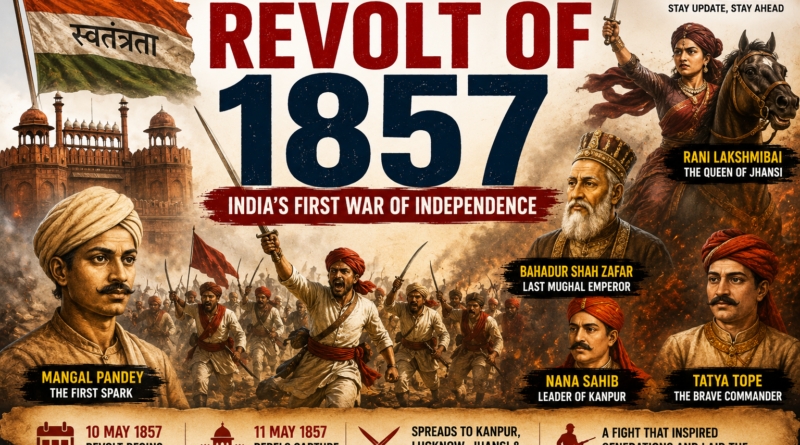
The Revolt of 1857: The First Spark of India’s Freedom Struggle
1857 Revolt | India’s First War of Independence
Before India achieved independence in 1947, there was a historic uprising that shook the foundations of British rule. It was the Revolt of 1857, often called the First War of Independence by many Indian historians.
Although the revolt did not succeed in ending British rule, it changed India’s history forever. It united soldiers, kings, queens, farmers, and ordinary people against a common enemy and inspired future generations to continue the fight for freedom.
Why Did the Revolt of 1857 Happen?
The revolt was not caused by a single incident. It was the result of years of political, economic, military, and religious dissatisfaction.
1. Political Reasons
The British East India Company expanded its control over Indian kingdoms through policies such as the Doctrine of Lapse, introduced by Governor-General Lord Dalhousie.
According to this policy, if an Indian ruler died without a biological male heir, the British annexed the kingdom.
This policy angered many rulers.
Some of the states affected included:
- Jhansi
- Satara
- Nagpur
- Sambalpur
Indian rulers feared losing their kingdoms.
2. Economic Exploitation
The British imposed heavy taxes on farmers and encouraged the export of raw materials while importing finished goods from Britain.
As a result:
- Indian handicrafts declined.
- Many artisans lost their livelihoods.
- Farmers struggled with high land revenue.
- Poverty increased in several regions.
3. Military Grievances
Indian soldiers, known as sepoys, faced discrimination.
Some common complaints included:
- Lower salaries than British soldiers.
- Limited promotion opportunities.
- Unequal treatment.
- Restrictions based on religion and traditions.
These grievances created growing dissatisfaction within the Bengal Army.
4. The Enfield Rifle Controversy
The immediate trigger for the revolt was the introduction of the Pattern 1853 Enfield rifle.
Soldiers had to bite open cartridges before loading them.
Rumours spread that the cartridges were greased with cow fat and pig fat.
For Hindu soldiers, cows were sacred.
For Muslim soldiers, pigs were considered unclean.
Many sepoys believed this was an attempt to disrespect their religious beliefs.
Mangal Pandey: The First Hero of the Revolt
One of the earliest and most remembered figures of the uprising was Mangal Pandey, a sepoy of the 34th Bengal Native Infantry.
On 29 March 1857, at Barrackpore, he attacked British officers in protest against the new rifle cartridges.
Although he was arrested and executed on 8 April 1857, his actions inspired many soldiers across northern India.
Today, Mangal Pandey is remembered as one of the earliest heroes of India’s freedom struggle.
The Revolt Begins
The large-scale uprising officially began on 10 May 1857 at Meerut.
Indian soldiers rebelled against British officers, released imprisoned comrades, and marched toward Delhi.
There, they declared Bahadur Shah Zafar, the last Mughal emperor, as the symbolic leader of the revolt.
Although elderly and politically weak, Bahadur Shah Zafar became a unifying figure for the rebels.
Major Leaders of the Revolt
Rani Lakshmibai of Jhansi
Perhaps the most famous leader of the revolt.
She refused to surrender Jhansi after the British annexed it.
Her courage on the battlefield became legendary.
She fought bravely until her death in 1858.
Today she remains one of India’s greatest symbols of bravery.
Nana Sahib
The adopted son of the last Peshwa, Nana Sahib led the rebellion in Kanpur.
He opposed British policies after being denied his pension.
Tatya Tope
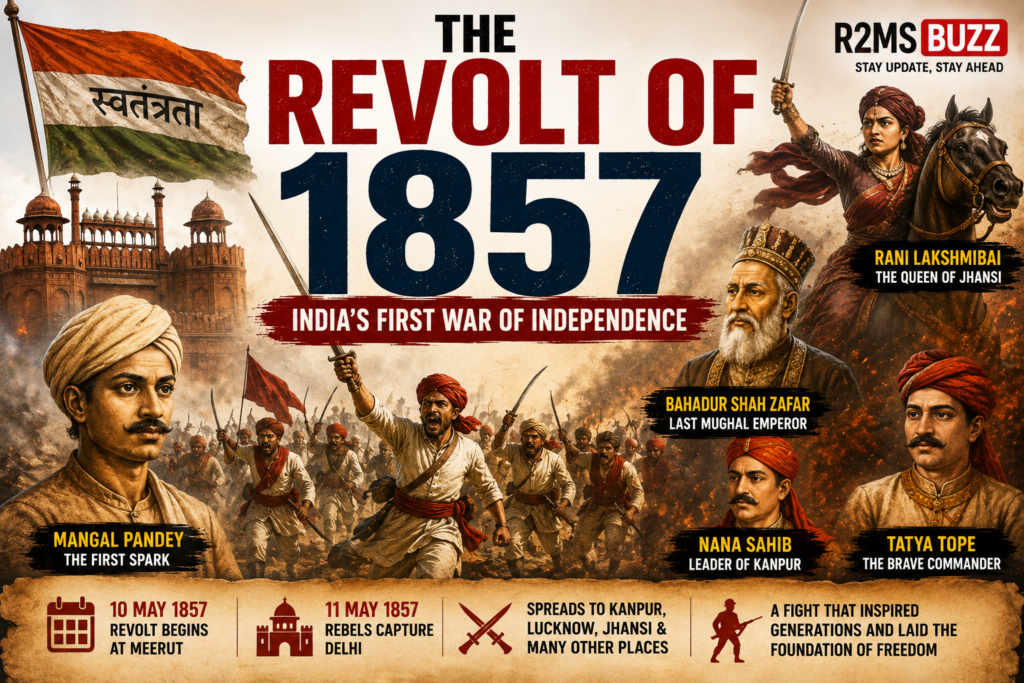
A close associate of Nana Sahib.
He became one of the most skilled military commanders during the revolt.
Even after several defeats, he continued guerrilla warfare against the British.
Begum Hazrat Mahal
She led resistance in Lucknow after the British annexed Awadh.
She played a major role in organizing rebel forces.
Major Centres of the Revolt
| City | Leader |
|---|---|
| Meerut | Indian Sepoys |
| Delhi | Bahadur Shah Zafar |
| Jhansi | Rani Lakshmibai |
| Kanpur | Nana Sahib |
| Lucknow | Begum Hazrat Mahal |
| Gwalior | Tatya Tope |
Why Did the Revolt Fail?
Although the revolt was courageous, several reasons led to its failure.
Lack of Unity
Not every Indian kingdom joined the uprising.
Some rulers supported the British.
Limited Communication
There was no central command.
Different regions fought independently.
Better British Resources
The British had:
- Better weapons
- Stronger communication
- Railways
- Telegraph
- Organized military command
Limited Participation
The revolt was mainly concentrated in North and Central India.
Many southern and eastern regions remained relatively unaffected.
Timeline of the Revolt
| Date | Event |
|---|---|
| 29 March 1857 | Mangal Pandey attacks British officers |
| 8 April 1857 | Mangal Pandey executed |
| 10 May 1857 | Revolt begins at Meerut |
| 11 May 1857 | Rebels capture Delhi |
| June 1857 | Revolt spreads to Kanpur and Lucknow |
| March 1858 | British recapture Lucknow |
| June 1858 | Rani Lakshmibai dies in battle |
| July 1859 | British officially declare the revolt over |
Consequences of the Revolt
Even though the revolt failed militarily, its impact was enormous.
End of East India Company Rule
The British government abolished the East India Company.
India came under direct control of the British Crown through the Government of India Act 1858.
Administrative Changes
The British promised to respect Indian traditions and religions more carefully.
Policies toward Indian rulers also changed.
Military Reforms
The British reorganized the Indian Army.
They reduced the proportion of Indian soldiers and increased British military presence.
Rise of Nationalism
Perhaps the biggest impact was psychological.
The revolt showed that Indians from different regions and communities could unite against colonial rule.
Future freedom fighters learned valuable lessons from 1857.
Interesting Facts
- The revolt lasted for nearly two years.
- Bahadur Shah Zafar was exiled to Rangoon (present-day Yangon, Myanmar).
- Rani Lakshmibai fought wearing military attire and became a symbol of courage.
- The British later called the uprising the “Sepoy Mutiny,” while many Indian historians refer to it as the “First War of Independence.”
My Opinion
The Revolt of 1857 was much more than a military rebellion.
It was the first large-scale expression of India’s desire for freedom.
Although it did not achieve independence, it awakened a sense of national identity that would continue to grow over the next 90 years.
Without the courage shown in 1857, the later freedom movements led by Mahatma Gandhi, Subhas Chandra Bose, Bhagat Singh, and countless others might have looked very different.
Conclusion
The Revolt of 1857 marked the beginning of India’s organized resistance against British rule.
Its leaders came from different backgrounds, but they shared one dream—to protect their land and dignity.
Even though the revolt ended in defeat, it planted the seeds of nationalism that eventually led to India’s independence in 1947.
It remains one of the most important chapters in Indian history.
FAQs
Why is the Revolt of 1857 called the First War of Independence?
Many Indian historians use this term because it was the first major uprising involving soldiers, rulers, and civilians against British rule.
Who started the Revolt of 1857?
The uprising began with sepoys at Meerut, while Mangal Pandey’s earlier actions became an important symbol of resistance.
Who was the main leader of the revolt?
There was no single leader. Prominent figures included Mangal Pandey, Rani Lakshmibai, Nana Sahib, Tatya Tope, Begum Hazrat Mahal, and Bahadur Shah Zafar.
Why did the revolt fail?
It lacked unified leadership, was limited geographically, and the British had superior military resources and communication.
Also See Related Article How the British Came to India: The Story Behind British Rule, What Is Bail in India?, AI Scams Explained: How Criminals Use Artificial Intelligence to Trick People and How You Can Stay Safe, crime news India