Supreme Court Seeks UP SIT Report in Ram Temple Donation Case, Orders Trust to Respond
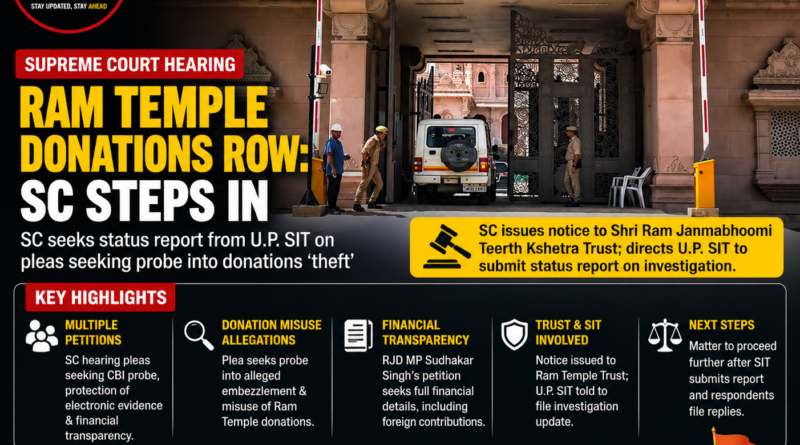
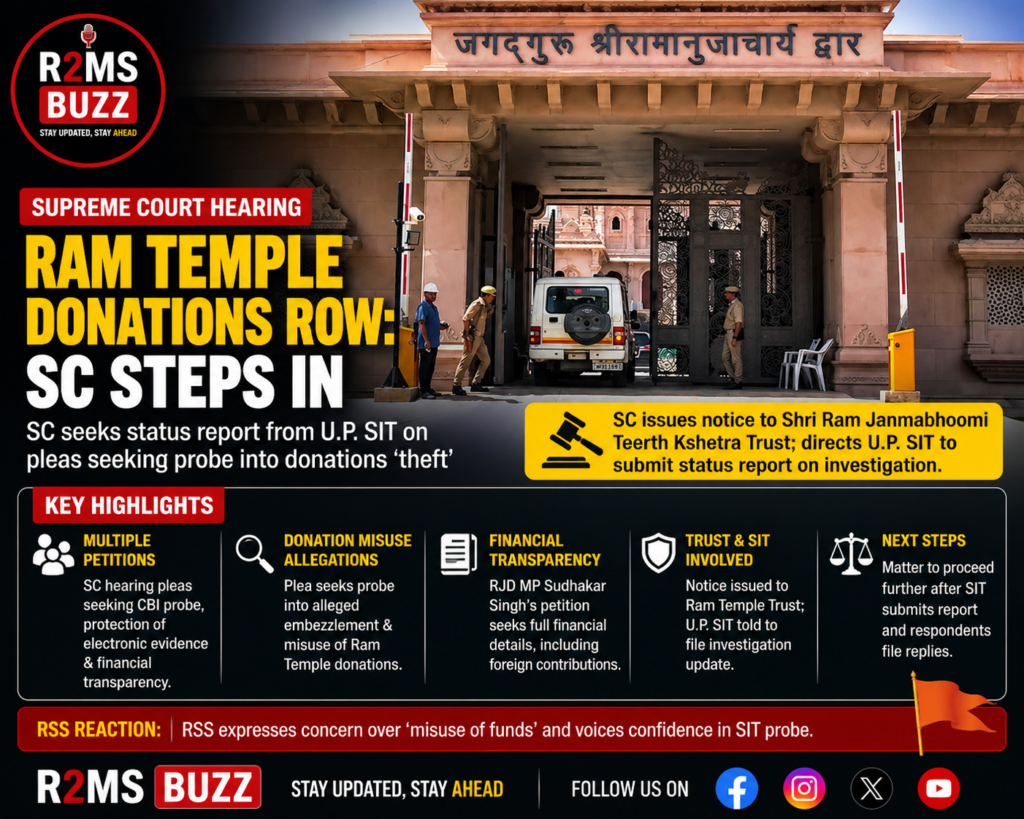
The Supreme Court of India has taken an important step in the ongoing legal proceedings concerning allegations of financial irregularities linked to donations received by the Shri Ram Janmabhoomi Teerth Kshetra Trust. In its latest hearing, the apex court sought a status report from the Uttar Pradesh Special Investigation Team (SIT) and issued a notice to the Trust, signaling that it intends to closely monitor the progress of the investigation.
The matter was heard by a three-judge Bench headed by Chief Justice of India Surya Kant, which considered multiple petitions raising concerns about the management and utilization of public donations made for the construction and administration of the Ram Temple in Ayodhya.
It is important to note that the Supreme Court has not made any findings on the merits of the allegations, and the case remains under judicial consideration. The Court’s latest directions are procedural and aimed at obtaining information before taking any further decision.
Supreme Court Seeks Status Report From UP SIT
During the hearing, the Supreme Court directed the Uttar Pradesh Special Investigation Team (SIT) to submit a detailed status report explaining the progress made in its investigation.
The Bench sought to understand the steps taken by investigators, the evidence collected so far, and the present stage of the inquiry.
By requesting the report, the Court has indicated that it wants to stay informed about developments before considering the issues raised in the petitions.
Legal experts note that such directions are common in cases involving public institutions and allegations concerning the management of funds collected from citizens.
The status report is expected to provide the Court with a clearer picture of the investigation before further hearings take place.
Notice Issued to Ram Temple Trust
Along with seeking the SIT report, the Supreme Court also issued a formal notice to the Shri Ram Janmabhoomi Teerth Kshetra Trust.
The Trust has been asked to respond to the allegations raised in the petitions filed before the Court.
Issuing a notice does not imply that the Court has accepted or rejected any allegation. Instead, it provides the respondents an opportunity to present their version before judicial proceedings continue.
The Trust is expected to file its response within the time prescribed by the Court.
Multiple Petitions Clubbed Together
The Supreme Court heard three separate petitions relating to the controversy and decided to hear them together because they concern similar issues.
Clubbing multiple petitions allows the Court to examine all related legal questions in a coordinated manner rather than conducting separate hearings.
The petitions collectively raise concerns regarding:
- Transparency in handling temple donations
- Financial accountability
- Preservation of evidence
- Investigation into alleged irregularities
The Court observed that considering the matters together would help avoid duplication of proceedings.
Demand for CBI Investigation
One of the petitions requests that the Court order an investigation by the Central Bureau of Investigation (CBI) into the alleged financial irregularities.
The petitioner argues that an independent central agency should examine the allegations surrounding the management of donations received by the Trust.
However, the Supreme Court has not ordered a CBI investigation at this stage.
Instead, it has chosen first to obtain an update from the Uttar Pradesh SIT before deciding whether any additional directions are necessary.
Whether the Court eventually considers transferring the investigation remains to be seen.
Plea to Preserve Electronic Evidence
Another petition before the Court seeks directions for the protection and preservation of electronic evidence connected with the case.
The petitioner argues that digital records, financial documents, communication records, and electronic data could become important during the investigation.
Preservation of electronic evidence is a common request in cases involving financial transactions because digital records often help investigators verify timelines, approvals, and money movement.
The Supreme Court is expected to examine this request after receiving responses from the concerned parties.
Petition Seeks Financial Transparency
Among the petitioners is RJD MP Sudhakar Singh, who has sought greater public transparency regarding the Trust’s financial management.
According to his petition, the Trust should publicly disclose:
- Complete financial records
- Details of donations received
- Information regarding expenditure
- Details of foreign contributions, if any
- Other financial statements related to temple administration
The petition argues that since the Temple has received significant public contributions, transparency is necessary to maintain public confidence.
The Trust will have an opportunity to respond to these demands before the Court.
Focus on Public Donations
At the heart of the case lies the management of donations received from devotees for the construction and administration of the Ram Temple.
The petitions question whether all financial procedures relating to these public contributions have been properly followed.
Temple donations represent contributions made voluntarily by millions of devotees across India and abroad.
Because such contributions involve public trust, the petitioners have argued that accountability and transparency should remain central principles in financial management.
The Court is expected to examine these concerns only after considering the material placed before it.
Hearing After Summer Vacation
The matter came up for hearing shortly after the Supreme Court resumed functioning following its annual summer vacation.
The reopening of the Court allowed pending public interest matters and constitutional cases to be listed again before different benches.
The Ram Temple donation case attracted considerable public attention because of both the religious significance of the temple and the legal questions raised in the petitions.
The hearing primarily focused on procedural directions rather than final legal conclusions.
RSS Earlier Expressed Confidence in SIT Probe
Prior to the latest hearing, the Rashtriya Swayamsevak Sangh (RSS) had commented on the controversy.
The organization expressed concern regarding the allegations while also stating that it had confidence in the investigation being conducted by the Uttar Pradesh SIT.
The RSS emphasized that the investigation should proceed independently and that appropriate action should be taken if any wrongdoing is established through legal procedures.
These remarks form part of the broader public discussion surrounding the issue but are separate from the judicial proceedings.
No Findings Against Anyone Yet
The Supreme Court has made it clear through its procedural approach that no conclusions have been reached regarding the allegations.
The Court has not held any person or institution guilty.
Similarly, no judicial finding has been made regarding alleged embezzlement, misuse of donations, or financial irregularities.
The current proceedings are limited to examining the petitions, receiving replies from respondents, and reviewing the investigation conducted by the SIT.
Any future findings will depend on evidence presented before the Court.
Importance of Transparency in Religious Institutions
The case has also renewed discussion regarding financial governance within religious institutions.
Across India, many temples, trusts, and charitable organizations receive donations from millions of devotees every year.
Financial experts note that transparent accounting systems generally include:
- Regular audits
- Documented approval procedures
- Public financial disclosures where applicable
- Independent oversight
- Compliance with legal requirements
Supporters of greater transparency argue that such measures strengthen public confidence in institutions managing public donations.
What Happens Next?
The next stage of the proceedings will depend on two important developments.
First, the Uttar Pradesh SIT will submit the status report requested by the Supreme Court.
Second, the respondents, including the Shri Ram Janmabhoomi Teerth Kshetra Trust, will file their replies addressing the allegations made in the petitions.
After reviewing these materials, the Supreme Court will decide the future course of the proceedings.
Possible outcomes could include additional directions regarding the investigation, consideration of pending requests made by the petitioners, or further hearings to examine legal issues raised in the case.
At this stage, no timeline has been announced for the final disposal of the matter.
Why This Case Matters
The Ram Temple is one of India’s most significant religious and cultural projects, supported by contributions from millions of devotees.
As a result, any legal proceedings concerning its administration naturally attract widespread public interest.
The current case is not about the construction of the temple itself but about allegations concerning the handling of donations and financial management.
The Supreme Court’s decision to closely monitor the investigation reflects the importance of ensuring that legal processes remain transparent and impartial.
Ultimately, the outcome will depend on evidence gathered during the investigation and the arguments presented before the Court.
Conclusion
The Supreme Court’s latest order in the Ram Temple donation case marks an important procedural development rather than a final verdict. By directing the Uttar Pradesh SIT to submit a status report and issuing notice to the Shri Ram Janmabhoomi Teerth Kshetra Trust, the Court has indicated its intention to carefully oversee the progress of the investigation before reaching any conclusions.
As the legal process continues, all allegations remain under investigation, and no findings have been made against any individual or institution. The upcoming SIT report and the responses filed by the Trust are expected to shape the next phase of the proceedings. Until then, the case remains a matter of judicial examination, with transparency, accountability, and due process at the centre of the debate.
Frequently Asked Questions (FAQs)
Why did the Supreme Court seek a status report?
The Court asked the Uttar Pradesh SIT to provide an update on the progress of its investigation into allegations concerning the management of donations received by the Shri Ram Janmabhoomi Teerth Kshetra Trust.
Has the Supreme Court found the Trust guilty?
No. The Supreme Court has not made any findings on the allegations. The case is still under consideration.
What do the petitions seek?
The petitions seek a status update on the investigation, preservation of electronic evidence, greater financial transparency, and, in one petition, a CBI investigation into the alleged irregularities.
Who is one of the petitioners?
One of the petitioners is RJD MP Sudhakar Singh, who has sought disclosure of the Trust’s financial records and details of foreign contributions.
What happens next?
The UP SIT will submit its status report, the respondents will file their replies, and the Supreme Court will then decide the next steps in the proceedings.