
How to Start UPSC Preparation After 12th: A Complete Beginner’s Guide (2026)
Every year, millions of students complete Class 12 and begin planning their careers. Some choose engineering, some pursue medicine, while others dream of serving the nation as an IAS, IPS, IFS, or IRS officer.
A common question among aspirants is:
“Can I start preparing for UPSC right after Class 12?”
The answer is yes—and in many cases, starting early gives you a significant advantage.
Although you cannot appear for the UPSC Civil Services Examination until you complete your graduation, the years between Class 12 and graduation are the perfect time to build a strong foundation. Instead of rushing your preparation after college, you can gradually develop the knowledge, analytical thinking, and discipline required to succeed in one of India’s most competitive examinations.
This comprehensive guide explains exactly how to begin your UPSC journey after Class 12, what to study, which mistakes to avoid, and how to stay consistent throughout your preparation.
What Is UPSC?
The Union Public Service Commission (UPSC) is India’s central recruiting agency responsible for conducting the Civil Services Examination (CSE).
Through this examination, candidates are selected for prestigious services such as:
- Indian Administrative Service (IAS)
- Indian Police Service (IPS)
- Indian Foreign Service (IFS)
- Indian Revenue Service (IRS)
- Indian Railway Management Service (IRMS)
- Other Group A and Group B Central Services
The Civil Services Examination consists of three stages:
- Preliminary Examination (Objective)
- Main Examination (Descriptive)
- Personality Test (Interview)
Success in UPSC requires much more than memorization. It tests your understanding, analytical ability, decision-making skills, communication, and overall awareness of national and international issues.
Should You Start UPSC Preparation After Class 12?
Absolutely.
Starting your preparation during graduation provides several long-term benefits.
Instead of studying under pressure during your final year, you get enough time to:
- Build strong conceptual knowledge.
- Develop the habit of reading newspapers daily.
- Improve your writing and analytical skills.
- Understand the UPSC syllabus gradually.
- Read standard reference books without rushing.
- Balance college studies with UPSC preparation.
Many successful civil servants began preparing in the first year of college rather than waiting until graduation.
Why Starting Early Gives You an Advantage
Students often believe that UPSC preparation should begin only after graduation. In reality, the earlier you start, the stronger your foundation becomes.
Early preparation helps you:
- Learn concepts instead of memorizing facts.
- Develop critical thinking over several years.
- Build consistency and discipline.
- Avoid last-minute stress.
- Improve answer-writing skills gradually.
- Gain confidence before your first attempt.
Remember, UPSC is not a race of speed—it is a test of consistency.
Five Things Every Beginner Must Understand
1. UPSC Is Not About Studying More—It’s About Studying Smart
Reading hundreds of books will not guarantee success. Understanding concepts, revising regularly, and practicing answer writing are far more valuable than simply collecting study material.
2. Build Strong Basics First
Before reading advanced reference books, focus on strengthening your fundamentals. A strong foundation in History, Geography, Polity, Economics, Science, and Environment will make advanced topics much easier later.
3. Current Affairs Matter Every Day
Develop the habit of reading reliable news sources daily. Understanding current events will improve both your Preliminary and Main Examination preparation.
4. Consistency Beats Motivation
Studying for two hours every day for three years is far more effective than studying twelve hours a day for one month.
5. Patience Is Essential
UPSC preparation is a marathon, not a sprint. Progress may feel slow initially, but consistent learning produces remarkable results over time.
What You Will Learn in This Complete Guide
In the upcoming sections, you’ll discover:
- The best graduation courses for UPSC aspirants.
- A month-by-month study roadmap.
- Recommended NCERT books.
- Standard reference books for every subject.
- Daily and weekly study plans.
- Time management strategies.
- Common mistakes beginners should avoid.
- Frequently asked questions.
This roadmap is designed to help beginners build a strong foundation before moving to advanced UPSC preparation.
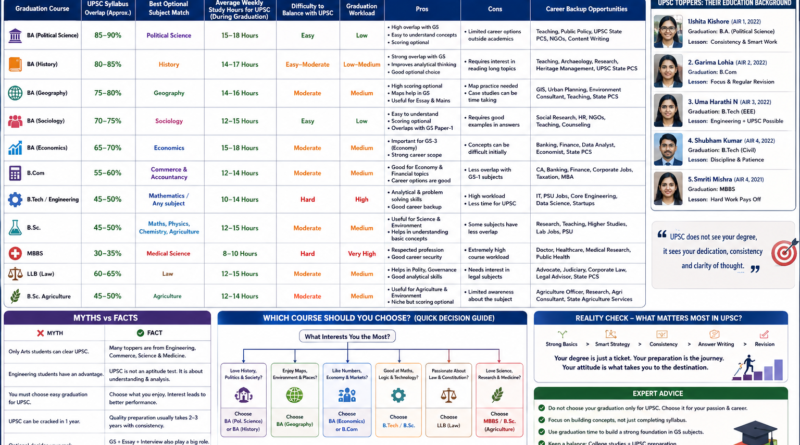
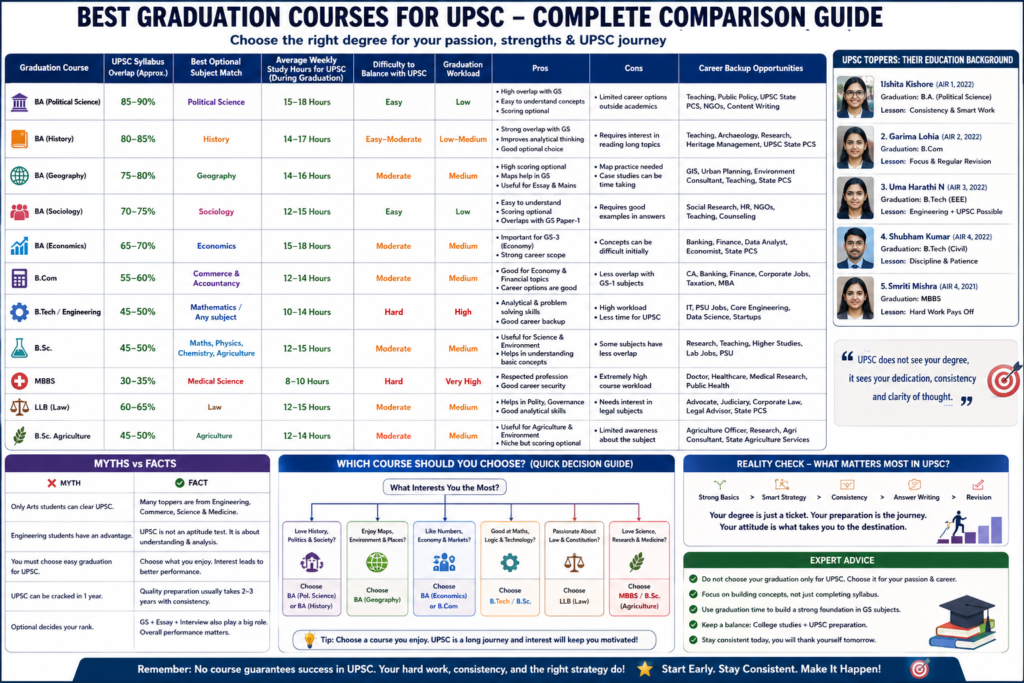
Which Graduation Course Is Best for UPSC?
| Graduation Course | Overlap with UPSC GS | Best Optional Subject Match | Difficulty Level | Career Backup | Recommended For |
|---|---|---|---|---|---|
| BA (Political Science) | ⭐⭐⭐⭐⭐ | Political Science | Easy–Moderate | Teaching, Research, Public Policy | Students interested in governance and politics |
| BA (History) | ⭐⭐⭐⭐⭐ | History | Moderate | Teaching, Archaeology, Research | Aspirants who enjoy history and culture |
| BA (Geography) | ⭐⭐⭐⭐☆ | Geography | Moderate | GIS, Urban Planning, Research | Students interested in maps, environment, and geography |
| BA (Sociology) | ⭐⭐⭐⭐☆ | Sociology | Easy | Social Research, NGOs, HR | Beginners looking for a scoring optional |
| BA (Economics) | ⭐⭐⭐⭐☆ | Economics | Moderate–Difficult | Banking, Finance, Analytics | Students with an interest in economics and policymaking |
| B.Com | ⭐⭐⭐☆☆ | Commerce & Accountancy | Moderate | Banking, CA, Finance, Corporate Jobs | Commerce students |
| B.Tech / Engineering | ⭐⭐⭐☆☆ | Mathematics (optional) or any subject of interest | Difficult | IT, Engineering, PSU Jobs | Students with strong analytical skills |
| B.Sc. | ⭐⭐⭐☆☆ | Mathematics, Physics, Chemistry, Agriculture | Moderate | Research, Teaching, Higher Studies | Science students |
| MBBS | ⭐⭐☆☆☆ | Medical Science | Difficult | Doctor, Healthcare | Medical students aiming for civil services |
| LLB | ⭐⭐⭐⭐☆ | Law | Moderate | Legal Practice, Judiciary, Corporate Law | Students interested in law and governance |
| Agriculture | ⭐⭐⭐☆☆ | Agriculture | Moderate | Agriculture Officer, Research | Students from agricultural backgrounds |
Quick Recommendations
| Goal | Best Choice |
|---|---|
| Maximum UPSC syllabus overlap | BA (Political Science, History, Geography) |
| Strong backup career | B.Tech, MBBS, B.Com |
| High-scoring optional potential | Sociology, Geography, Political Science |
| Best for working professionals later | B.Com, B.Tech |
| Best for beginners | BA (Political Science) or BA (History) |
One of the biggest myths among beginners is that only certain degrees help in UPSC.
The truth is that UPSC does not give preference to any particular graduation course. Whether you pursue Engineering, Medicine, Commerce, Arts, Law, Agriculture, or any other recognized bachelor’s degree, you are equally eligible for the Civil Services Examination.
Instead of choosing a degree solely for UPSC, select a course based on:
- Your genuine interest
- Career opportunities
- Academic strengths
- Long-term career goals
If you enjoy your graduation subject, balancing college studies with UPSC preparation becomes much easier.
Best Graduation Courses for UPSC Aspirants
While every degree is acceptable, some subjects naturally overlap with the UPSC syllabus.
BA (Political Science, History, Geography, Sociology)
Advantages:
- Significant overlap with General Studies.
- Helps in understanding governance, history, and society.
- Useful if you later choose one of these subjects as your Optional.
B.Com
Advantages:
- Strong foundation in economics, finance, and taxation.
- Helpful for Economy and Government Schemes.
B.Tech / Engineering
Advantages:
- Improves logical thinking and analytical ability.
- Many successful IAS officers have engineering backgrounds.
B.Sc.
Advantages:
- Useful for Science & Technology and Environment.
- Helps in understanding scientific concepts asked in UPSC.
Law
Advantages:
- Builds knowledge of the Constitution and legal systems.
- Useful for Polity and Governance.
Remember: Your graduation degree does not determine your UPSC success. Your preparation strategy does.
First-Year UPSC Preparation Roadmap
Your first year should focus on building a strong foundation rather than completing the entire syllabus.
Month 1–2: Understand the Examination
Goals:
- Read the complete UPSC syllabus.
- Analyze previous years’ question papers.
- Learn the exam pattern.
- Create a study schedule.
Avoid buying too many books at this stage.
Month 3–5: Build Strong Fundamentals
Focus on NCERT textbooks first.
Subjects:
- Ancient History
- Medieval History
- Modern Indian History
- Geography
- Indian Constitution
- Basic Economics
- Environment
- Science
Take notes in your own words.
Month 6–8: Start Standard Reference Books
Once your basics are clear, begin reading standard books.
Examples include:
- Indian Polity
- Modern History
- Physical Geography
- Economy
- Environment
At this stage, prioritize understanding over speed.
Month 9–12: Revision & Current Affairs
Now start connecting static subjects with current events.
Develop the habit of:
- Revising weekly.
- Solving previous-year questions.
- Reading editorials.
- Practicing answer writing once or twice a week.
- Making concise revision notes.
By the end of the first year, your concepts should be clear even if the syllabus is not fully completed.
Real-Life UPSC Success Stories and Lessons
1. Tina Dabi (AIR 1, UPSC Civil Services Examination 2015)
Tina Dabi graduated in Political Science from Lady Shri Ram College, University of Delhi. Rather than waiting until graduation to begin her preparation, she built a strong foundation during college by reading newspapers, understanding the Constitution, and following current affairs consistently.
She has spoken publicly about the importance of discipline, revision, and maintaining a balanced routine instead of chasing unrealistic study hours.
What We Can Learn
- Build strong fundamentals before reading advanced books.
- Stay consistent instead of studying irregularly for long hours.
- Make revision a weekly habit.
- Focus on understanding concepts rather than memorizing facts.
Quote (widely attributed in interviews):
“Consistency is more important than studying for very long hours occasionally.”
2. Shubham Kumar (AIR 1, UPSC Civil Services Examination 2020)
Shubham Kumar completed his Civil Engineering degree from IIT Bombay before securing AIR 1. He has discussed the importance of self-analysis, improving mistakes after every mock test, and avoiding unnecessary study material.
What We Can Learn
- Analyze every mock test carefully.
- Limit your study resources.
- Revise the same books multiple times.
- Quality of preparation matters more than quantity.
Key Advice:
Identify your weak areas and work on them consistently instead of changing your strategy every few weeks.
3. Ishita Kishore (AIR 1, UPSC Civil Services Examination 2022)
Ishita Kishore graduated in Economics from Shri Ram College of Commerce (SRCC), University of Delhi. During her preparation, she focused on consistency, current affairs, answer writing, and regular revision.
What We Can Learn
- Develop a habit of reading newspapers every day.
- Practice answer writing regularly.
- Keep short revision notes.
- Stay patient throughout the preparation journey.
Key Advice:
A well-planned routine followed consistently is more effective than studying randomly for long hours.
What UPSC Toppers Say About Timetables
Although every topper has a different routine, several common themes appear across interviews.
1. Don’t Copy Someone Else’s Timetable
Your schedule should match your college, job, health, and responsibilities.
2. Revision Is More Important Than Reading New Books
Most successful candidates revise the same material multiple times instead of collecting dozens of resources.
3. Daily Newspaper Reading Builds Long-Term Success
Reading quality news consistently improves your understanding of governance, economics, international relations, and essay writing.
4. Mock Tests Reveal Your Real Preparation Level
Regular testing helps identify weak areas and improves time management.
5. Consistency Wins
Studying six focused hours every day for one year is generally more effective than studying fourteen hours only occasionally.
Sample Timetable Inspired by Common Topper Practices
| Time | Activity |
|---|---|
| 6:30 AM – 7:00 AM | Read important headlines |
| 7:00 AM – 8:00 AM | Newspaper analysis & notes |
| College Hours | Attend classes and revise short notes |
| 5:00 PM – 7:00 PM | General Studies subject |
| 7:00 PM – 7:30 PM | Break |
| 7:30 PM – 9:00 PM | Standard reference book |
| 9:00 PM – 9:30 PM | Revision and planning for the next day |
Final Message
The common thread among UPSC toppers is not extraordinary intelligence or extremely long study hours. It is a combination of clarity, consistency, disciplined revision, and patience maintained over months and years.
Recommended NCERT Books
These books build the foundation for almost every UPSC subject.
History
- Our Past I
- Our Past II
- Our Past III
- Themes in Indian History (XI & XII)
Geography
- The Earth: Our Habitat
- Our Environment
- India: Physical Environment
- Fundamentals of Physical Geography
- India: People and Economy
Political Science
- Democratic Politics
- Indian Constitution at Work
- Political Theory
Economics
- Understanding Economic Development
- Introductory Microeconomics
- Introductory Macroeconomics
Science
- Class VI–X Science NCERTs
Do not rush through these books. Understanding concepts is far more important than finishing them quickly.
Study Plan for College Students
If you’re studying in college, a practical schedule is better than an unrealistic one.
Monday–Friday
Morning (1 Hour)
- Read newspaper
- Make short notes
Evening (2 Hours)
- Study one core subject
Night (1 Hour)
- Revise what you studied
- Solve 10–15 MCQs
Saturday
- Weekly revision
- Current Affairs revision
- Practice one answer-writing question
Sunday
- Solve a sectional test
- Analyze mistakes
- Plan the next week
Consistency matters more than the number of study hours.
Mistakes Beginners Must Avoid
Many aspirants slow their progress by making avoidable mistakes.
Do not:
- Buy dozens of books.
- Depend entirely on coaching material.
- Ignore NCERTs.
- Skip revision.
- Compare yourself constantly with others.
- Change your study strategy every few weeks.
- Chase every new YouTube strategy.
A simple and consistent approach usually works better than a complicated one.
Key Takeaways
During your first year of preparation:
- Understand the UPSC syllabus thoroughly.
- Complete NCERT books carefully.
- Develop newspaper-reading habits.
- Make your own notes.
- Stay consistent.
- Focus on understanding concepts rather than memorizing facts.
This strong foundation will make advanced preparation significantly easier in the coming years.
Also See Related Article What Is Zero FIR, What Is Remand, Complaint vs FIR, What Happens After an FIR Is Filed?