Former Qatar Emir Sheikh Thani Dies at 74
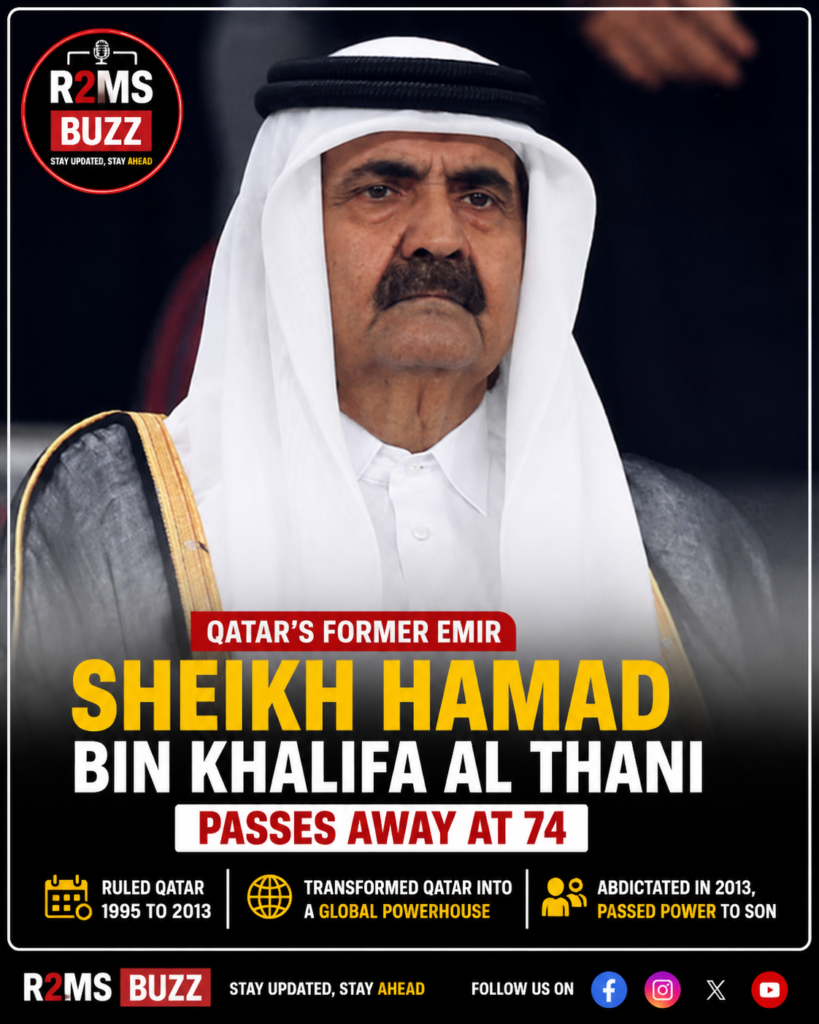
Former Qatar Emir Sheikh Hamad bin Khalifa Al Thani, the visionary leader credited with transforming Qatar from a relatively small Gulf nation into one of the world’s most influential energy and diplomatic powers, has died at the age of 74. The announcement was made by the Amiri Diwan, Qatar’s official government body, which paid tribute to his decades of service and leadership.
Sheikh Hamad’s death marks the end of an era in Qatar’s modern history. During his 18-year reign, he reshaped the country’s economy, expanded its global influence, strengthened its international diplomacy, and laid the foundation for Qatar’s emergence as a major political, economic, and sporting power.
From developing the world’s largest liquefied natural gas (LNG) industry to establishing Al Jazeera as a globally respected media organization and securing the 2022 FIFA World Cup, Sheikh Hamad’s leadership permanently changed Qatar’s place on the world stage.
A Leader Who Changed Qatar’s Future
When Sheikh Hamad assumed power in 1995, Qatar was a wealthy but relatively quiet Gulf state whose international influence remained limited.
Within less than two decades, that picture changed dramatically.
His government invested heavily in infrastructure, education, healthcare, diplomacy, aviation, energy, and international finance, creating the foundation for Qatar’s rapid modernization.
Today, Qatar is recognized as one of the world’s wealthiest countries per capita, an achievement many observers attribute largely to the reforms initiated during Sheikh Hamad’s rule.
His leadership helped diversify Qatar’s international presence far beyond its geographical size.
Came to Power in 1995
Sheikh Hamad became Emir after a bloodless palace coup in June 1995, replacing his father, Sheikh Khalifa bin Hamad Al Thani, while the latter was abroad.
The transition took place without widespread violence or prolonged political instability.
Although the move initially attracted attention across the Gulf region, Sheikh Hamad quickly consolidated his leadership and introduced reforms aimed at modernizing the country’s governance and economy.
His administration focused on long-term planning rather than short-term political gains, a strategy that would significantly reshape Qatar over the following years.
Transforming Qatar into an Energy Superpower
Perhaps Sheikh Hamad’s most significant achievement was the expansion of Qatar’s energy industry.
Recognizing the enormous potential of the North Field, one of the world’s largest natural gas reserves, his government invested heavily in liquefied natural gas infrastructure.
These investments transformed Qatar into the world’s largest exporter of LNG, supplying energy to countries across Asia, Europe, and other international markets.
Energy revenues dramatically increased government income, allowing Qatar to invest in national development projects while building one of the world’s strongest sovereign wealth funds.
The country’s economic growth during this period became one of the fastest recorded globally.
Building Global Economic Influence
Rather than relying solely on energy exports, Sheikh Hamad encouraged Qatar to become an important international investor.
The Qatar Investment Authority (QIA) expanded its portfolio by acquiring stakes in major companies, financial institutions, luxury hotels, airports, and landmark properties around the world.
Investments across Europe, North America, and Asia strengthened Qatar’s economic presence beyond the Gulf.
This strategy not only generated financial returns but also increased Qatar’s influence within global business and financial circles.
Today, Qatar’s sovereign investment portfolio remains one of the largest in the world.
The Rise of Al Jazeera
One of Sheikh Hamad’s most internationally recognized decisions was supporting the launch and expansion of Al Jazeera.
Established in 1996, the television network rapidly grew into one of the world’s leading international news organizations.
Al Jazeera gained global recognition for its extensive coverage of Middle Eastern affairs and international events, often providing perspectives different from many Western broadcasters.
Its influence expanded across television, digital media, and multilingual journalism.
For many observers, the network became one of Qatar’s most powerful instruments of international influence.
Expanding Qatar’s Diplomatic Role
During Sheikh Hamad’s leadership, Qatar became increasingly active in regional and international diplomacy.
The country frequently hosted negotiations involving governments, political groups, and international organizations.
Qatar positioned itself as a mediator in several regional disputes while strengthening diplomatic relations with countries across the Middle East, Europe, Asia, and North America.
This active foreign policy allowed the small Gulf nation to play an outsized role in international affairs.
Even after Sheikh Hamad stepped down, diplomacy has remained a defining feature of Qatar’s global engagement.
Securing the FIFA World Cup
One of the defining moments of Sheikh Hamad’s reign came when Qatar won the right to host the 2022 FIFA World Cup.
Although the tournament was ultimately held under the leadership of his son, Sheikh Tamim bin Hamad Al Thani, many analysts believe the successful bid reflected years of planning initiated during Sheikh Hamad’s rule.
Hosting the tournament required unprecedented investment in:
- Stadiums
- Metro systems
- Roads
- Airports
- Hotels
- Tourism infrastructure
The event introduced Qatar to billions of viewers worldwide and significantly expanded its global visibility.
A Rare Peaceful Transfer of Power
In 2013, Sheikh Hamad made a decision that surprised many international observers.
Instead of remaining in office indefinitely, he voluntarily abdicated the throne in favour of his son, Sheikh Tamim bin Hamad Al Thani.
The peaceful transfer of power was widely viewed as an example of political stability within the Gulf region.
By carefully preparing the transition, Sheikh Hamad ensured continuity in government policies and national development.
Even after stepping down, he remained an influential figure whose vision continued shaping Qatar’s long-term strategy.
Modernising Education and Healthcare
Economic development under Sheikh Hamad was accompanied by major investments in education and healthcare.
His government supported the creation of Education City, attracting leading international universities to Qatar.
Research institutions, hospitals, and scientific centres also received significant investment.
These initiatives aimed to prepare Qatar for a future less dependent on hydrocarbons by developing human capital and encouraging innovation.
Many of these institutions continue playing an important role in Qatar’s national development today.
Global Recognition and Challenges
Throughout his leadership, Sheikh Hamad received international recognition for modernising Qatar and expanding its diplomatic influence.
At the same time, his government also faced international scrutiny regarding labour rights, regional politics, and media freedom.
Like many world leaders, his legacy includes both achievements and debates surrounding aspects of governance and foreign policy.
Nevertheless, few dispute the scale of Qatar’s transformation during his years in office.
Tributes Pour In
Following the announcement of his death, messages of condolence began arriving from leaders, diplomats, and organizations around the world.
The Amiri Diwan praised Sheikh Hamad’s dedication to Qatar and acknowledged his lasting contributions to the country’s development.
Prayers were offered for his service to the nation and for the legacy he leaves behind.
Many observers described him as one of the most influential Arab leaders of the modern era.
A Lasting Legacy
Sheikh Hamad’s greatest achievement may not be a single policy or project but the overall transformation of Qatar itself.
When he assumed leadership, Qatar was largely known for its energy resources.
By the time he left office, the country had become:
- A global LNG leader
- An international investment powerhouse
- A major diplomatic mediator
- A recognised aviation hub
- A global sports destination
- Home to one of the world’s most influential news organizations
These achievements continue shaping Qatar’s international identity today.
Conclusion
The death of Sheikh Hamad bin Khalifa Al Thani marks the passing of one of the Gulf region’s most influential modern leaders. Through ambitious economic reforms, strategic investments, diplomatic engagement, and long-term planning, he transformed Qatar into a country with global influence far beyond its size.
His decision to peacefully transfer power in 2013 demonstrated a commitment to political stability, while the institutions and policies established during his reign continue to guide Qatar’s development. Whether remembered for expanding the LNG industry, supporting Al Jazeera, promoting international diplomacy, or helping secure the FIFA World Cup, Sheikh Hamad leaves behind a legacy that reshaped both Qatar and its role in global affairs.
As tributes continue to pour in from around the world, history is likely to remember Sheikh Hamad bin Khalifa Al Thani as the leader who laid the foundations of modern Qatar.
Frequently Asked Questions (FAQs)
Who was Sheikh Hamad bin Khalifa Al Thani?
Sheikh Hamad bin Khalifa Al Thani was the Emir of Qatar from 1995 to 2013 and is widely credited with transforming Qatar into a global economic and diplomatic power.
When did he become Emir?
He assumed power in 1995 after a bloodless palace coup.
Why is he considered an important leader?
He expanded Qatar’s LNG industry, strengthened international diplomacy, supported the growth of Al Jazeera, promoted global investments, and helped lay the groundwork for Qatar hosting the 2022 FIFA World Cup.
Who succeeded Sheikh Hamad?
He voluntarily abdicated in 2013, and his son Sheikh Tamim bin Hamad Al Thani became the Emir of Qatar.
How old was Sheikh Hamad when he passed away?
He died at the age of 74.