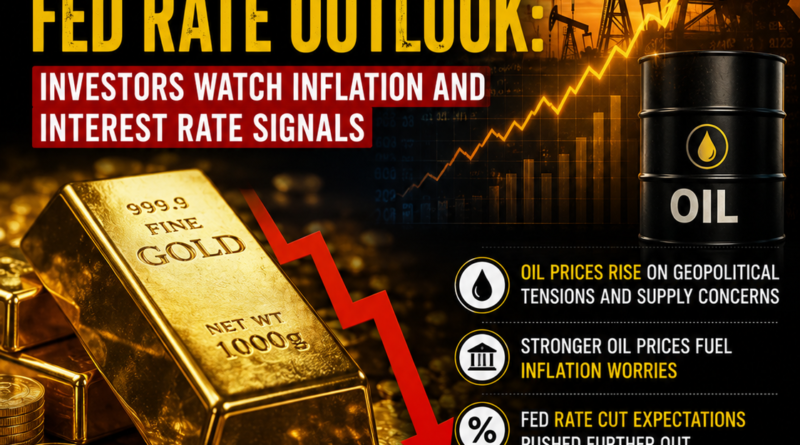
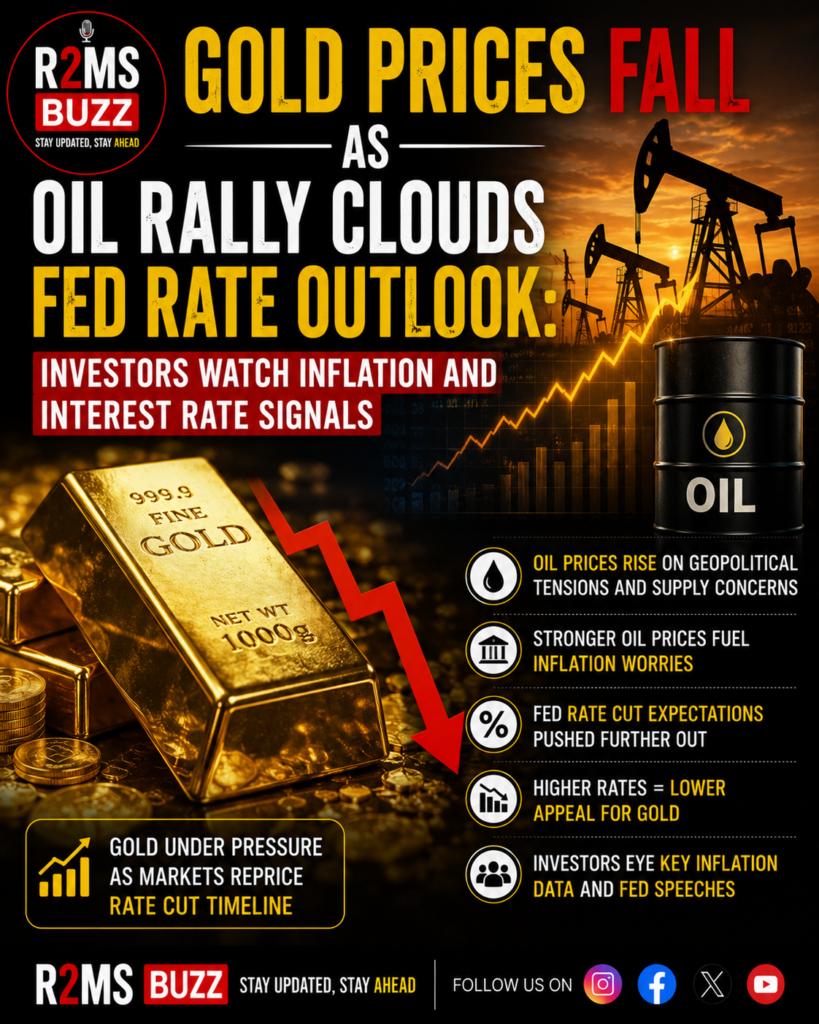
Gold Prices Fall as Oil Rally Clouds Fed Rate Outlook: Investors Watch Inflation and Interest Rate Signals
Gold prices slipped on Thursday as investors shifted their attention from encouraging U.S. inflation data to rising crude oil prices, which have revived concerns that inflation may remain elevated for longer. The renewed surge in energy prices has complicated expectations regarding the U.S. Federal Reserve’s future interest rate decisions, causing investors to reassess their positions in precious metals.
While gold had gained strongly earlier in the week following softer-than-expected inflation figures from the United States, the rally lost momentum as oil prices climbed for a third consecutive session. Market participants now believe that higher energy costs could keep inflation above the Federal Reserve’s target, reducing the likelihood of early interest rate cuts and limiting gold’s short-term gains.
With global financial markets closely watching inflation data, oil prices, and central bank policy, the outlook for gold remains uncertain in the near term.
Gold Prices Decline After Recent Rally
Gold prices gave up part of the gains recorded earlier in the week after investors booked profits and reassessed market conditions.
In international trading:
- Spot gold fell to around $4,039 per ounce.
- Gold futures also declined during the session.
- Silver prices recorded losses, while platinum posted modest gains.
The decline followed a strong rally after the release of U.S. inflation data, which had initially boosted expectations that the Federal Reserve might slow the pace of monetary tightening.
However, changing market sentiment quickly reversed some of those gains.
Softer Inflation Initially Supported Gold
Earlier in the week, investors welcomed the latest U.S. Consumer Price Index (CPI) report.
The data showed that consumer prices declined on a monthly basis, marking the first monthly fall in inflation since 2020.
The report suggested that inflationary pressures may finally be easing after a prolonged period of elevated prices.
Following the release:
- Treasury yields declined.
- The U.S. dollar weakened.
- Gold prices moved higher.
- Expectations for immediate interest rate hikes reduced.
Because gold does not generate interest income, it generally performs better when interest rates remain stable or decline.
Rising Oil Prices Change Market Sentiment
Despite the encouraging inflation report, attention soon shifted toward developments in the global energy market.
Crude oil prices continued rising amid renewed geopolitical tensions in the Middle East.
Investors worry that higher oil prices could increase transportation, manufacturing, and production costs worldwide.
If energy prices remain elevated, inflation could accelerate once again, forcing central banks to maintain tighter monetary policies.
This possibility has reduced investor enthusiasm for gold.
Why Oil Prices Matter for Gold
Oil plays a major role in the global economy.
Higher crude prices often increase the cost of:
- Transportation
- Manufacturing
- Food production
- Logistics
- Industrial goods
As production costs rise, businesses may pass higher expenses on to consumers, resulting in higher inflation.
Persistent inflation makes it more difficult for central banks to reduce interest rates.
Because higher interest rates usually strengthen government bond yields, investors often shift money away from non-interest-bearing assets like gold.
Federal Reserve Remains Cautious
Federal Reserve officials have acknowledged that inflation has moderated compared with previous months.
However, policymakers have indicated that additional evidence is needed before they can confidently conclude that inflation is returning sustainably to the central bank’s target.
The Federal Reserve’s primary objective remains maintaining price stability while supporting economic growth.
As long as inflation risks remain elevated, the central bank is expected to proceed cautiously regarding future monetary policy decisions.
Interest Rates and Gold Have an Inverse Relationship
One of the most important factors influencing gold prices is interest rates.
When interest rates increase:
- Bond yields become more attractive.
- Investors earn higher returns on fixed-income assets.
- Demand for gold often weakens.
Conversely, when interest rates decline:
- Gold becomes relatively more attractive.
- Investors seek safe-haven assets.
- Precious metal prices often strengthen.
This relationship explains why every major inflation report and Federal Reserve statement receives close attention from commodity markets.
Geopolitical Tensions Support Oil Prices
The recent rise in oil prices has also been driven by geopolitical uncertainty.
Concerns regarding energy supply disruptions have increased after tensions in the Middle East intensified.
Markets remain sensitive to any development affecting global oil production or shipping routes because even minor disruptions can influence international energy prices.
Higher energy costs continue adding uncertainty to inflation forecasts.
Safe-Haven Demand Remains
Although gold prices have retreated from recent highs, analysts note that the precious metal continues to benefit from its traditional role as a safe-haven asset.
During periods of:
- Economic uncertainty.
- Geopolitical conflict.
- Financial market volatility.
- Currency weakness.
Investors often increase allocations to gold as a store of value.
This underlying demand continues to provide long-term support for gold prices.
Analysts Expect Range-Bound Trading
Several market analysts believe gold may trade within a relatively narrow range over the coming weeks.
According to market experts:
- Higher interest rate expectations may limit upside.
- Strong long-term demand should support prices during major declines.
- Investors are likely to remain cautious until additional economic data becomes available.
Market participants continue monitoring inflation indicators before making large investment decisions.
Producer Price Index Now in Focus
Following the CPI report, investors are now waiting for the release of the U.S. Producer Price Index (PPI).
Unlike CPI, which measures prices paid by consumers, PPI tracks prices received by producers.
The data provides another important indication of inflation trends throughout the economy.
If producer prices remain elevated, markets may increase expectations that inflation could persist longer than anticipated.
Federal Reserve Expectations Continue to Shift
Financial markets constantly revise expectations regarding future interest rate decisions.
Recent inflation data reduced the probability of immediate policy tightening.
However, rising oil prices have once again complicated those expectations.
Market participants continue analysing every economic indicator to estimate the Federal Reserve’s next move.
Future decisions will likely depend upon:
- Inflation data.
- Employment figures.
- Consumer spending.
- Energy prices.
- Economic growth.
Global Markets Watching Closely
Gold prices influence financial markets across the world.
Countries such as India and China remain among the largest consumers of gold for:
- Jewellery.
- Investment.
- Cultural celebrations.
- Central bank reserves.
Therefore, international developments affecting gold prices receive significant attention globally.
What Investors Should Watch
Experts believe investors should closely monitor:
- U.S. inflation reports.
- Federal Reserve statements.
- Oil prices.
- Treasury yields.
- U.S. dollar movements.
- Global geopolitical developments.
These factors will likely determine gold’s direction during the coming weeks.
Long-Term Outlook Remains Positive
Although short-term volatility continues, many analysts remain optimistic about gold’s long-term prospects.
Several structural factors continue supporting demand, including:
- Central bank purchases.
- Geopolitical uncertainty.
- Inflation concerns.
- Portfolio diversification.
- Safe-haven investment demand.
These factors may continue providing long-term support despite temporary price corrections.
Conclusion
Gold prices have retreated after their recent rally as rising oil prices renewed concerns that inflation may remain higher for longer, reducing expectations of rapid interest rate cuts by the U.S. Federal Reserve. While softer inflation initially boosted investor confidence, the continued increase in energy prices has complicated the outlook for monetary policy and financial markets.
For investors, the coming weeks will be crucial as attention turns to additional U.S. inflation indicators, Federal Reserve commentary, and developments in global energy markets. Although gold faces short-term pressure from higher interest rate expectations, its role as a safe-haven asset and strong long-term fundamentals continue to make it an important component of diversified investment portfolios.
Frequently Asked Questions (FAQs)
1. Why did gold prices fall?
Gold prices declined as rising oil prices increased concerns that inflation could remain elevated, reducing expectations of early interest rate cuts.
2. How do oil prices affect gold?
Higher oil prices can increase inflation, which may prompt central banks to keep interest rates higher. Higher rates generally reduce demand for gold.
3. Why is the Federal Reserve important for gold prices?
The Federal Reserve’s interest rate decisions directly influence bond yields and the U.S. dollar, both of which significantly affect gold prices.
4. Is gold still considered a safe-haven asset?
Yes. Gold remains a preferred investment during periods of economic uncertainty, geopolitical tensions, and market volatility.
5. What economic data are investors watching now?
Markets are closely monitoring the U.S. Producer Price Index (PPI), future inflation reports, and Federal Reserve policy announcements.
See related News US Announces 20% Cargo Fee for Strait of Hormuz