
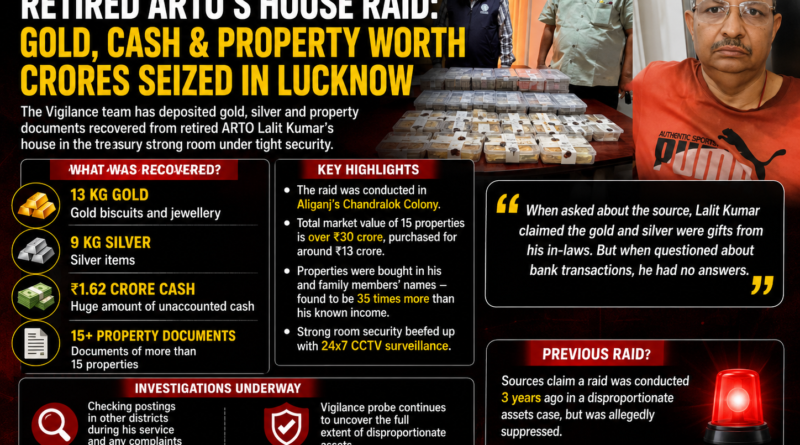
Lucknow Crores in Gold, Cash and Property Documents Seized in Raid
Lucknow Vigilance Raid: Crores in Gold, Cash and Property Documents Seized from Retired ARTO’s Residence
A major vigilance operation in Uttar Pradesh has brought a retired government official under intense scrutiny after authorities allegedly recovered gold, silver, cash and property documents worth crores from his residence in Lucknow. The raid, conducted by the Uttar Pradesh Vigilance Establishment, has sparked fresh debate over disproportionate assets, accountability in public service, and anti-corruption efforts in the state.
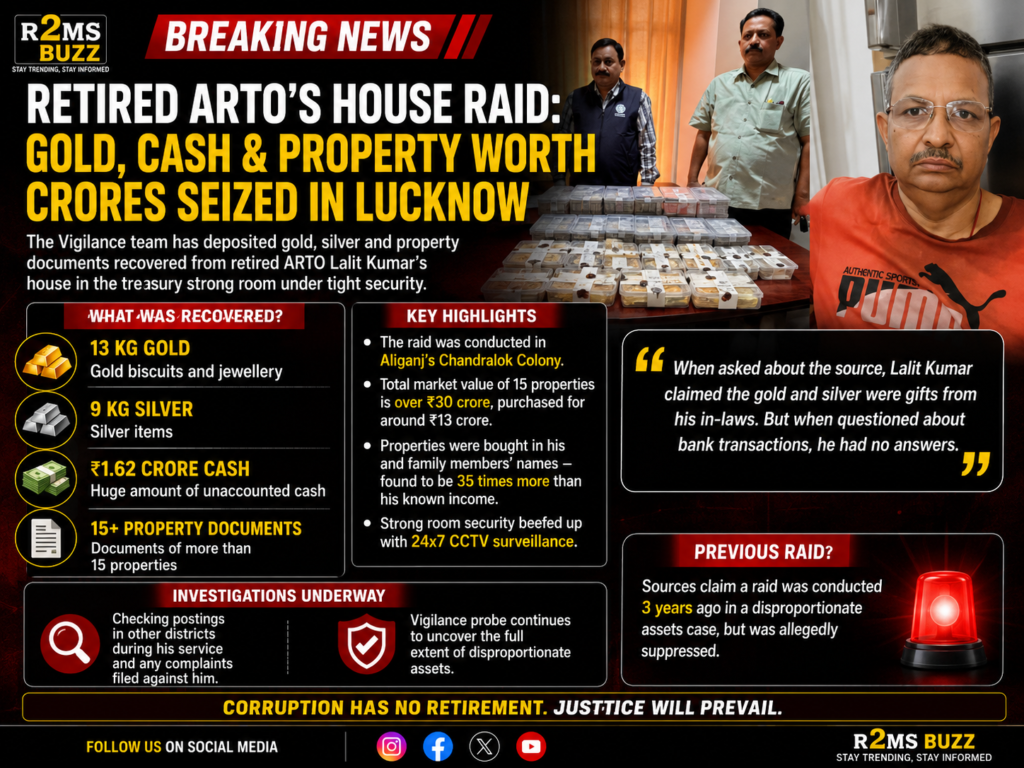
According to officials, the search was carried out at the residence of retired Assistant Regional Transport Officer (ARTO) Lalit Kumar in Lucknow’s Aliganj area. During the operation, investigators reportedly seized 13 kilograms of gold, 9 kilograms of silver, ₹1.62 crore in cash, and documents related to more than 15 properties.
The recovery has triggered a detailed investigation into the source of the assets and whether they are linked to alleged disproportionate income accumulated during the officer’s tenure in government service.
Vigilance Team Conducts Extensive Search
The search operation was carried out after the Vigilance Department obtained information regarding suspected disproportionate assets. Officials reportedly searched multiple rooms of the residence and examined lockers, cupboards, financial records and property-related documents.
The recovered valuables were later deposited in a secured government treasury under tight security. Investigators have also begun documenting every recovered item as part of the official case record.
Officials involved in the investigation described the operation as one of the significant recoveries made in a disproportionate assets inquiry in recent years.
What Was Recovered During the Raid?
According to preliminary information released by investigators, the recovered assets include:
- 13 kilograms of gold, including jewellery and gold biscuits.
- 9 kilograms of silver in the form of ornaments and silver articles.
- ₹1.62 crore in cash, allegedly recovered from the residence.
- Documents related to more than 15 properties located at different places.
Officials are currently verifying ownership records, purchase details and financial transactions connected to these properties.
The exact valuation of the recovered assets will be determined after detailed assessment by authorized government agencies.
Properties Worth Over ₹30 Crore Under Scanner
One of the most significant findings of the investigation reportedly relates to real estate investments.
According to vigilance officials, documents recovered during the search indicate that the retired officer and his family members are linked to more than 15 properties.
Preliminary estimates suggest that the current market value of these properties exceeds ₹30 crore, although they were allegedly purchased for approximately ₹13 crore.
Investigators are examining whether these acquisitions were made using legitimate income or through unexplained financial sources.
Land records, registration documents and bank transactions are being scrutinized as part of the inquiry.
Alleged Disproportionate Assets
Authorities suspect that the total assets linked to the retired official may be significantly higher than his known lawful income during government service.
According to investigators, the recovered wealth appears to be substantially disproportionate when compared to the official salary and declared sources of income.
Officials are calculating the value of movable and immovable assets before determining whether formal charges under anti-corruption laws will be strengthened.
The investigation remains ongoing, and authorities have not yet announced final conclusions.
Official’s Response to the Recovery
During questioning, the retired ARTO reportedly stated that much of the recovered gold and silver had been received as gifts from his in-laws.
However, investigators have indicated that they are independently verifying this claim.
Officials are also examining financial records, income tax filings, property purchase agreements and banking transactions to determine whether the explanation matches available evidence.
Authorities have emphasized that all claims made during questioning will be verified through documentary proof before any conclusions are drawn.
Bank Transactions Under Investigation
Apart from physical assets, vigilance officers are carefully examining financial transactions connected to the retired official and his family members.
Investigators are reviewing:
- Bank account statements.
- Fixed deposits.
- Property purchase payments.
- Loan records.
- Income tax returns.
- Investment details.
- Financial transfers involving close relatives.
Officials hope these records will provide a clearer picture of how the assets were acquired over the years.
If irregularities are found, additional legal action could follow.
Previous Allegations Resurface
Sources familiar with the investigation claim that this is not the first time the retired officer has come under scrutiny.
Reports suggest that a disproportionate assets inquiry had previously been initiated several years ago but did not reach its logical conclusion.
Investigators are now reviewing earlier records to determine whether any previous complaints or inquiries have relevance to the current case.
Authorities have not officially confirmed the status of earlier investigations, and the matter remains under examination.
How Disproportionate Assets Cases Are Investigated
Disproportionate assets cases generally involve comparing a public servant’s known lawful income with the total value of assets accumulated during their service.
Investigating agencies typically examine:
- Salary records.
- Family income.
- Property purchases.
- Bank transactions.
- Investments.
- Jewellery holdings.
- Cash recoveries.
- Business interests.
If the value of assets significantly exceeds known income and cannot be satisfactorily explained, legal proceedings may follow under applicable anti-corruption laws.
Each case, however, depends on documentary evidence and due legal process.
Anti-Corruption Agencies Continue Their Crackdown
The latest raid reflects continuing efforts by vigilance and anti-corruption agencies to investigate allegations involving public servants.
In recent years, authorities across several Indian states have intensified investigations into suspected cases involving:
- Unexplained wealth.
- Illegal property acquisitions.
- Benami assets.
- Cash recoveries.
- Financial irregularities.
- Abuse of official position.
Government officials have repeatedly stated that accountability and transparency remain priorities in strengthening public administration.
Importance of Due Process
While the recovery has generated widespread public attention, legal experts stress that investigations must proceed through established judicial procedures.
Recoveries made during search operations are only one stage of the legal process.
Authorities must still:
- Verify ownership.
- Assess asset valuation.
- Examine financial records.
- Record witness statements.
- Complete forensic analysis where necessary.
- Present evidence before the appropriate court.
The accused also has the legal right to present explanations and supporting documents during the investigation and any subsequent legal proceedings.
Final findings will depend on the evidence presented before the competent judicial authority.
Public Reaction
The reported seizure has generated strong reactions on social media, with many users demanding strict action against corruption in public offices.
Others have emphasized the importance of allowing investigators to complete their work before drawing final conclusions.
Transparency advocates believe such investigations can strengthen public confidence when conducted fairly, professionally and in accordance with the law.
What Happens Next?
The Vigilance Department is expected to continue:
- Verifying property ownership.
- Assessing recovered valuables.
- Examining financial transactions.
- Recording statements from relevant individuals.
- Collecting documentary evidence.
- Coordinating with revenue and banking authorities.
Depending on the outcome of the investigation, authorities may file additional charges or submit a detailed report before the competent court.
Until then, the case remains under active investigation.
Conclusion
The vigilance raid at the Lucknow residence of retired ARTO Lalit Kumar has emerged as one of the most significant anti-corruption investigations in recent months. The reported recovery of 13 kilograms of gold, 9 kilograms of silver, ₹1.62 crore in cash and documents linked to more than 15 properties has raised serious questions regarding the source of the assets.
While investigators continue examining financial records, property documents and banking transactions, the legal process will determine whether the recovered wealth constitutes disproportionate assets under applicable laws.
The case also serves as a reminder of the importance of transparency, accountability and strong institutional oversight in maintaining public trust. As investigations progress, authorities are expected to release further information based on verified evidence and official findings.