
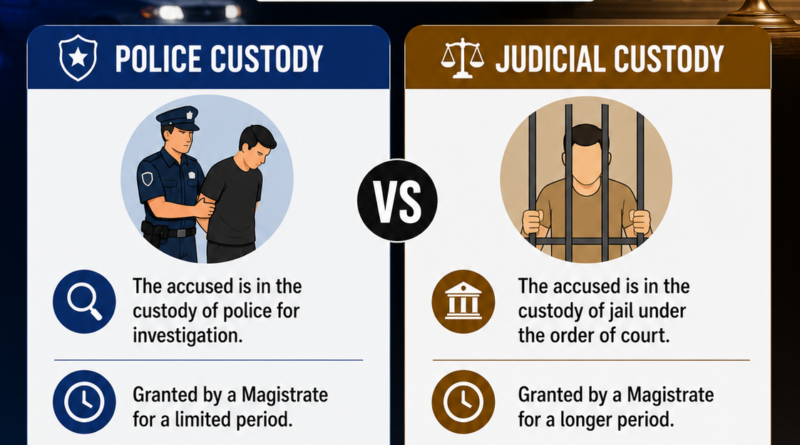
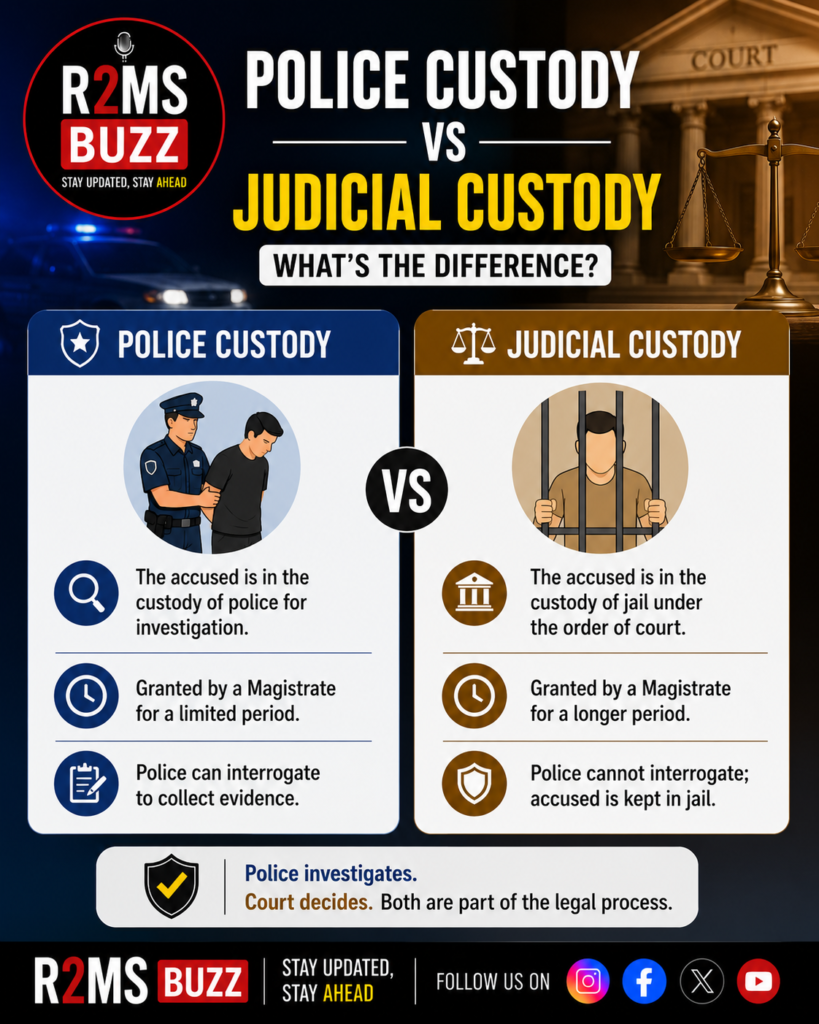
Police Custody vs Judicial Custody: What’s the Difference? Complete Legal Guide (2026)
Introduction
After a person is arrested, one of the first legal questions is whether they will remain in police custody or be sent to judicial custody. These two terms are often used in news reports, but many people mistakenly believe they mean the same thing.
In reality, police custody and judicial custody serve different purposes within the criminal justice system. Understanding the distinction helps citizens better follow criminal proceedings and appreciate the safeguards built into Indian law.
This guide explains both concepts in simple language.
What Is Police Custody?
Police custody refers to the period during which an accused person remains under the physical control of the police for lawful investigation.
The purpose of police custody is to enable investigators to:
- Question the accused.
- Recover evidence where legally permitted.
- Verify facts.
- Identify accomplices, if any.
- Continue the investigation in accordance with the law.
Police custody is subject to judicial authorization and legal safeguards.
What Is Judicial Custody?
Judicial custody means that the accused is placed under the custody of the judicial system and is usually lodged in a jail or correctional facility under the supervision of prison authorities rather than the police.
Even though the accused remains in custody, the police no longer have unrestricted physical control over the person. Any further access for investigation generally requires permission according to the applicable legal procedure.
Quick Comparison
| Feature | Police Custody | Judicial Custody |
|---|---|---|
| Control | Police authorities | Jail/Prison authorities under judicial supervision |
| Purpose | Investigation | Safe and lawful detention during legal proceedings |
| Location | Police lock-up | Jail or correctional facility |
| Supervision | Police | Court and prison authorities |
| Access by Police | Direct, subject to law | Generally requires legal authorization |
Why Does the Law Distinguish Between the Two?
The distinction exists to balance two important objectives:
- Allow the police sufficient opportunity to investigate criminal offences.
- Protect the rights and liberty of individuals through judicial oversight.
This separation reduces the risk of arbitrary detention and ensures that custody remains subject to the rule of law.
When Is Police Custody Granted?
Police custody is not automatic after an arrest.
The investigating agency must satisfy the competent Magistrate that police custody is legally necessary for purposes such as:
- Interrogation.
- Recovery of evidence.
- Verification of facts.
- Identifying co-accused or witnesses.
- Advancing the investigation.
The court considers the facts of each case before granting or refusing such custody.
When Is Judicial Custody Ordered?
A Magistrate may order judicial custody when continued detention is considered necessary under the law but police custody is not required or is no longer justified.
Judicial custody may be ordered:
- During the investigation.
- After police custody ends.
- While bail applications are pending.
- During trial where lawful detention continues.
Each order depends on the circumstances of the case and the applicable legal provisions.
What Happens During Police Custody?
While in police custody, investigators may carry out lawful investigative steps, including:
- Recording statements where permitted.
- Questioning the accused.
- Recovering evidence in accordance with legal procedures.
- Conducting identification procedures where applicable.
- Collecting forensic evidence.
All investigative activities must comply with constitutional protections and statutory safeguards.
What Happens During Judicial Custody?
During judicial custody:
- The accused stays in a jail or correctional facility.
- The prison authorities are responsible for daily custody.
- The accused may consult legal counsel according to prison rules and applicable law.
- Court proceedings continue.
- Bail applications may be heard.
- Investigation may continue through lawful procedures.
Judicial custody does not mean the accused has been convicted.
Common Misconceptions
Myth: Police custody and judicial custody are the same.
Fact: They are two distinct forms of lawful custody with different purposes and different authorities in control.
Myth: Judicial custody means the person has been found guilty.
Fact: Judicial custody is a form of detention during legal proceedings. Conviction can occur only after a court reaches a finding of guilt following due process.
Myth: Police can keep an accused in custody for as long as they want.
Fact: Police custody requires judicial authorization and is governed by the applicable legal framework.
Myth: Judicial custody ends the police investigation.
Fact: Investigation may continue while the accused is in judicial custody, subject to legal procedures and court oversight.
Rights of an Accused Person During Custody
Whether a person is in police custody or judicial custody, Indian law provides important constitutional and legal safeguards. These rights are intended to ensure that investigations and detention are carried out fairly and in accordance with due process.
Some of the key rights include:
- Right to know the grounds of arrest.
- Right to consult and be represented by a lawyer.
- Right to be treated with dignity and humanity.
- Protection against unlawful detention.
- Right to seek bail where legally permissible.
- Right to medical care where required.
- Right to be produced before the appropriate court as required by law.
These safeguards apply regardless of the seriousness of the allegations.
Can Police Question a Person in Judicial Custody?
Yes, but not automatically.
When an accused is in judicial custody, the police do not have unrestricted access to question them. If further interrogation is legally required, the investigating agency must follow the applicable legal procedure and obtain the necessary permission from the competent court.
This judicial oversight helps balance effective investigation with the protection of individual rights.
Can Police Search or Recover Evidence During Custody?
During an investigation, the police may carry out lawful searches or recover evidence in accordance with the applicable legal provisions.
Such actions may include:
- Recovery of relevant documents.
- Collection of digital evidence.
- Seizure of articles connected with the investigation.
- Recovery of property where legally justified.
These actions must follow the procedure prescribed by law and are subject to judicial scrutiny where applicable.
Bail During Police Custody and Judicial Custody
An accused person may apply for bail if the law permits.
The court considers several factors while deciding a bail application, such as:
- Nature and seriousness of the alleged offence.
- Available evidence.
- Risk of the accused absconding.
- Possibility of influencing witnesses.
- Chances of tampering with evidence.
- Progress of the investigation.
The grant of bail does not determine guilt or innocence. It is a judicial decision based on legal principles and the facts of the case.
Medical Examination During Custody
Medical examination serves an important role in protecting both the accused and the integrity of the investigation.
It may help:
- Record any existing injuries.
- Identify injuries sustained during custody.
- Preserve medical evidence where relevant.
- Ensure that necessary medical treatment is provided.
Medical examinations are conducted according to the applicable legal framework.
Important Legal Safeguards
Indian criminal law includes several safeguards to prevent misuse of custodial powers.
These include:
- Judicial oversight of detention.
- Requirement to follow prescribed legal procedures.
- Documentation of arrest and custody.
- Access to legal representation.
- Protection against unlawful detention.
- Court supervision over further remand where applicable.
These safeguards are intended to uphold the rule of law while allowing legitimate criminal investigations to proceed.
Common Mistakes People Make
Many people misunderstand the concept of custody. Some common misconceptions include:
- Assuming police custody automatically means the accused is guilty.
- Believing judicial custody is a punishment.
- Thinking police can question an accused in judicial custody without court approval.
- Assuming custody always prevents a person from obtaining bail.
- Confusing custody with conviction.
Understanding these distinctions helps citizens better interpret criminal proceedings reported in the media.
Common Misconceptions
Myth: Police custody means the accused has confessed.
Fact: Custody does not imply admission of guilt. Investigations continue according to law, and guilt is determined only by a competent court.
Myth: Judicial custody is the same as imprisonment after conviction.
Fact: Judicial custody is a form of lawful detention during investigation or trial. It is different from imprisonment imposed after conviction.
Myth: Bail is impossible during judicial custody.
Fact: Depending on the applicable law and the facts of the case, an accused may apply for bail while in judicial custody.
Myth: Police custody can continue indefinitely.
Fact: Police custody is subject to statutory limits, judicial authorization, and regular court oversight.
Frequently Asked Questions (FAQs)
What is police custody?
Police custody means the accused remains under the control of the police for lawful investigation, subject to judicial authorization.
What is judicial custody?
Judicial custody means the accused is detained under the supervision of the judicial system, usually in a jail or correctional facility, while legal proceedings continue.
Which is more serious: police custody or judicial custody?
Neither is “more serious.” They serve different legal purposes. Police custody primarily facilitates investigation, while judicial custody ensures lawful detention under court supervision.
Can police question an accused in judicial custody?
Yes, but only by following the applicable legal procedure and obtaining the necessary court permission where required.
Can an accused apply for bail while in custody?
Yes. If the law permits, the accused may apply for bail. The court decides the application based on the facts and applicable legal principles.
Does judicial custody mean conviction?
No. A person in judicial custody is presumed innocent unless proven guilty by a competent court after a fair trial.
Can investigation continue during judicial custody?
Yes. Investigation may continue while the accused remains in judicial custody, subject to the applicable legal procedures.
Why is judicial oversight important?
Judicial oversight helps ensure that detention, investigation, and custody comply with the law and protects individuals from arbitrary or unlawful detention.
Can police keep someone in custody without court approval?
Police custody beyond the limits prescribed by law requires judicial authorization. Courts supervise further detention according to the applicable legal framework.
What happens after judicial custody?
Depending on the stage of the case, the accused may be granted bail, remain in custody as permitted by law, face trial, or be released if detention is no longer justified.
Conclusion
Police custody and judicial custody are two distinct stages within India’s criminal justice system, each serving a specific legal purpose. Police custody is primarily intended to facilitate investigation under judicial supervision, while judicial custody places the accused under the authority of the court and prison administration during ongoing legal proceedings. Both forms of custody are governed by constitutional protections, statutory safeguards, and judicial oversight to ensure fairness and protect individual rights. Understanding these differences enables citizens to better interpret legal developments and appreciate the safeguards built into the justice system.
Also see related Article What Is an Arrest? Arrest Procedure, Police Powers & Rights of Arrested Persons in India (2026), What Is Bail in India?, How Police Investigate Criminal Cases in India: Step-by-Step Investigation Process Explained (2026), What Is a Charge Sheet?